The key facts
- The 1,450 kg Swift telescope entered the atmosphere on November 4 at 12:39 GMT over Sumatra
- Over the course of its mission, it recorded more than 2,000 gamma-ray bursts and 1,400 new stars; its last observation was on October 20
- The $30 million LINK rescue operation did not take place due to technical malfunctions
End of the mission
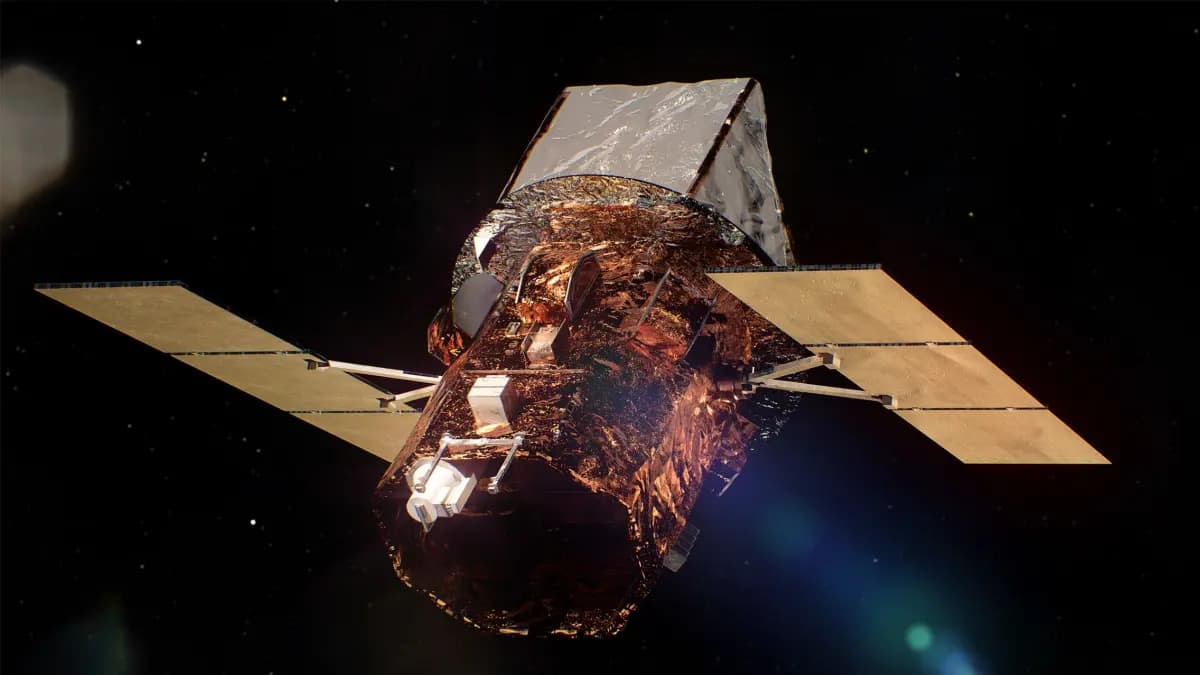
The Swift space telescope, which had operated in orbit for 22 years after launch, fell uncontrolled to Earth on November 4. The 1,450 kg spacecraft entered the atmosphere at 12:39 GMT over the northern part of Sumatra and was destroyed; this was reported by Kun.uz, citing the Romanian outlet Antena 3 CNN.
What Swift managed to accomplish
The telescope was placed into orbit in November 2004 with the task of studying gamma-ray bursts — the most powerful explosions in the Universe. However, its work was not limited to this program: Swift also studied distant supernovae, black holes consuming matter, and Solar System objects — asteroids and comets. The mission proved highly productive: over its years of operation, the spacecraft recorded more than 2,000 gamma-ray bursts and 1,400 new stars. Swift carried out its final scientific observation on October 20 of this year — just two weeks before its fall.
Why the spacecraft could not be saved
Swift had no engines of its own to compensate for atmospheric drag, so it gradually descended, and the process accelerated as it lost altitude. In September 2025, NASA signed a $30 million contract with Katalyst Space for the design, launch, and operation of a robotic spacecraft that was supposed to dock with the telescope and raise it to a higher orbit, extending its service life. On July 3, the LINK mission was launched — a service vehicle the size of a refrigerator with three robotic manipulators, aimed at capturing Swift in August. However, as the outlet notes, the plan was not realized: LINK encountered problems with its propulsion system and attitude control in space. Had the rescue operation succeeded, the telescope could have gathered even more data.