The key facts
- Amir Ohana requires at least 61 members' signatures for an early vote on electing a speaker
- The opposition and Arab parties hold 67 of 120 seats, but no joint request has yet been submitted
- The parties continue consultations with President Herzog on forming a government
Ohana set out the conditions for an early vote
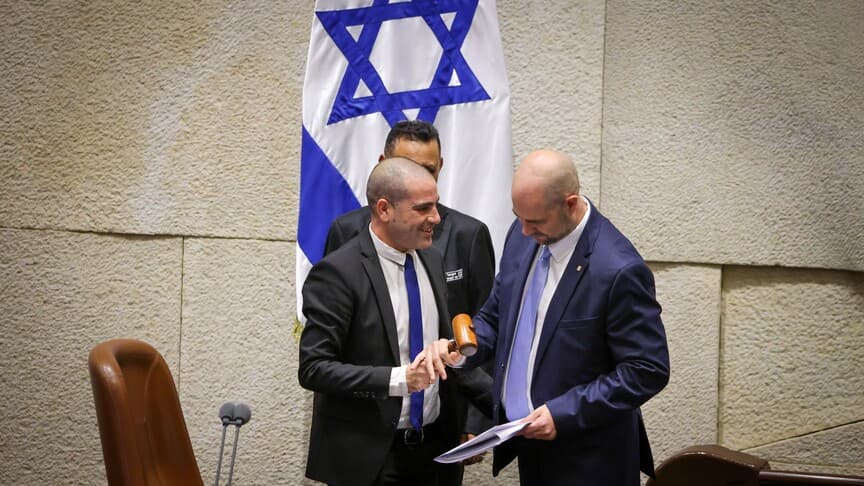
Outgoing Knesset Speaker Amir Ohana on Thursday rejected the opposition's request to hold a vote on replacing him at the opening of the new parliament next Tuesday. According to the Anadolu agency, he said that the usual time for electing a speaker is the moment a government is formed, and that an exception is possible only upon a request bearing the signatures of a majority of members, that is, at least 61 of 120. In that case, Ohana said, he would schedule the discussion at an early date, no later than within a week. He addressed his statement to opposition leaders Gadi Eisenkot, Naftali Bennett, Yusef Jabareen, Yair Golan, Mansour Abbas and Avigdor Lieberman on the social network X.
The arithmetic of votes and the parties' positions
The parliamentary elections on October 27 left Netanyahu's bloc with 53 seats, the Jewish opposition won 48, and the Arab parties 19. Together, the opposition and the Arab parties hold 67 seats — theoretically enough for the threshold of 61 signatures. According to Anadolu, citing the Haaretz newspaper, the parties Yashar, B'Yachad, Yisrael Beytenu and the Democrats requested a vote on replacing Ohana at the first session; the Joint List and Ra'am also supported a replacement, but it is unclear whether they will submit a joint request with the required number of signatures. Eisenkot said as early as Tuesday that the opposition intends to act on two tracks: forming a national security government and parliamentary steps, including electing a new speaker. Israeli media reported that the leaders of the opposition parties are discussing candidates and may reach an agreement by Monday, a day before the Knesset opens.
Consultations at the president's
In parallel, representatives of the 11 parties elected to parliament continued consultations on Thursday with President Isaac Herzog on whom they would recommend to form the next government. Based on the parties' publicly stated positions, if both Arab parties officially back the leader of Yashar, Eisenkot will receive the recommendations of 67 members of parliament against 46 for Netanyahu. Thus, the key uncertainty remains not the arithmetic of signatures, but whether the Arab parties will submit a joint request regarding the speaker and a unified recommendation to the president.