The key facts
- NATO is a military-political alliance created in 1949, uniting 32 states: 30 in Europe, plus Canada and the United States
- The key provision is Article 5 of the treaty: an armed attack against one or more members is treated as an attack against the entire alliance
- The official languages are English and French; the headquarters is located in Brussels
Meaning and origin of the name
NATO is an abbreviation of the English North Atlantic Treaty Organization, that is, the 'North Atlantic Treaty Organization.' It is a military-political alliance created in 1949. The name is tied to geography: the founding treaty was named the 'North Atlantic Treaty' because the northern part of the Atlantic Ocean separates North America and Europe — the two regions where the member states are located. This is reported by Kun.uz in an explainer about how the alliance is structured.
Membership and goals of the alliance
Today NATO comprises 32 independent states: 30 of them are in Europe, and two more — Canada and the United States — are in North America. According to the treaty, the alliance's main goals are the defense of democracy, the personal freedom of peoples, the principle of the rule of law and their common heritage; strengthening stability and well-being in the North Atlantic region; organizing collective defense and preserving peace and security; promoting the development of international relations based on peace and friendship; striving to eliminate contradictions in the international economic policies of member states, as well as building up individual and collective capabilities to resist armed attack.
Article 5: how collective defense works
The key pillar of the treaty is its Article 5. It establishes that an armed attack against one or more member states in Europe or North America is considered an attack against the entire alliance. In such a case, each member assists the state that has been attacked, taking the measures it deems necessary — and these measures may include the use of armed force. For a reader who encounters references to 'Article 5' in the news, this means that what is at stake is not a declaration of solidarity but a norm that explicitly permits a military response by the entire bloc to an attack on one of its members.
Symbolism and headquarters
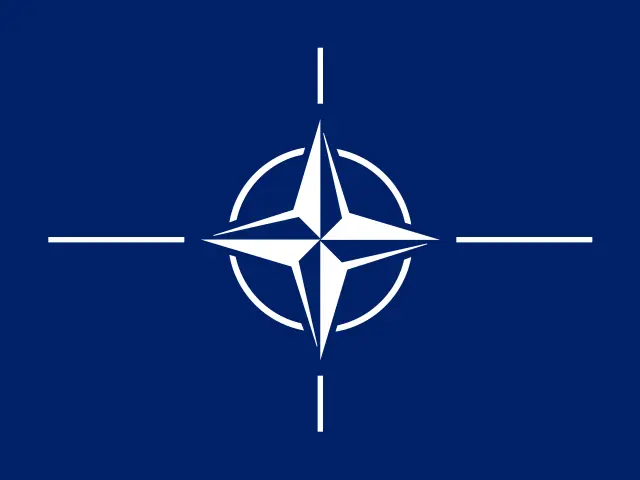
NATO's official languages are English and French. The alliance's flag is blue, with a white image of a compass rose inside a circle at its center: the dark blue background symbolizes the Atlantic Ocean, the circle stands for unity among the member states, and the compass represents the path to peace. The organization's headquarters is located in Brussels, the capital of Belgium.