The key facts
- Turkey officially nominated former Foreign Minister Feridun Sinirlioğlu as a candidate for UN Secretary-General on October 30, following a deadlock in the Security Council.
- On October 30 (the nomination was submitted on Friday), Turkey officially nominated Feridun Sinirlioglu, former foreign minister and permanent representative to the UN
- In the Security Council's straw poll on October 30, Rebecca Grynspan (Costa Rica) led with 11 'encouraging' votes, but no candidate secured the necessary consensus.
- Cyprus condemned Sinirlioğlu's candidacy as a 'deep institutional contradiction' due to the ongoing occupation of its territory.
- Cyprus called Sinirlioglu's candidacy 'a deep institutional contradiction' because of the situation on the island
Turkey has joined the race for the position of UN head
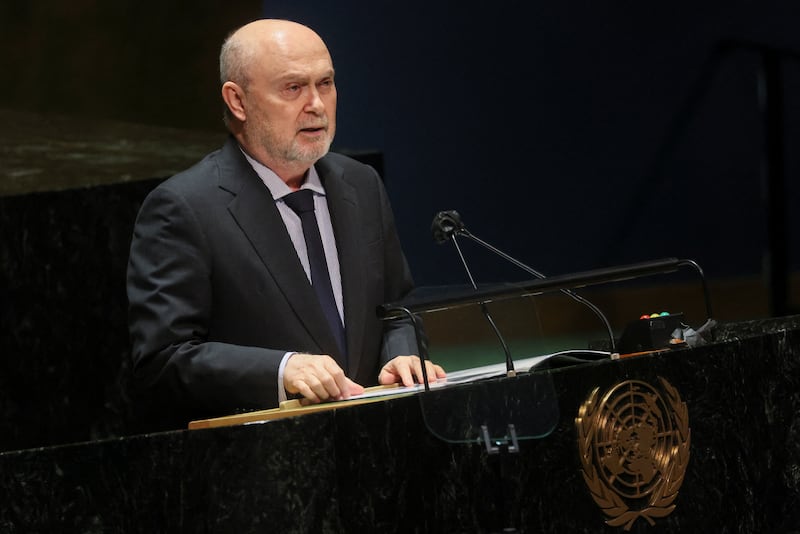
Turkey has officially nominated former Foreign Minister Feridun Sinirlioğlu as a candidate for the position of UN Secretary-General, The National reported. Turkey's Permanent Representative to the UN, Ahmet Yıldız, submitted the documents on Friday, the same day another informal straw poll of the Security Council revealed that none of the current candidates had secured the necessary consensus. Prior to this, Turkey had refrained from participating in the campaign for about a year; according to Foreign Minister Hakan Fidan, Ankara had been waiting for the next UN head to be a representative from Latin America. 'When the deadlock became evident, we officially presented our candidate to the UN with a letter signed by our president,' Fidan stated on Saturday on the sidelines of the G20 Foreign Ministers' meeting in Atlanta, explaining that the goal was to make a 'diplomatic contribution to overcoming the deadlock.'
The situation in the Security Council
The campaign to replace António Guterres was initially expected to be a contest among candidates from Latin America, but the Security Council, divided on this issue, has yet to identify a frontrunner. In the seventh informal straw poll on October 30, Rebecca Grynspan from Costa Rica led with 11 'encouraging' votes, followed by Rafael Grossi from Argentina (9), Carolyn Rodriguez-Birkett from Guyana (8), and Lana Nusayba from the UAE (7). The poll is not a formal vote on recommending a candidate; recommending a candidate to the General Assembly requires at least nine votes and no veto from any of the five permanent members—the USA, the UK, France, Russia, and China.
Who is Sinirlioğlu and why is his candidacy controversial
Feridun Sinirlioğlu, 70 years old, briefly served as Turkey's Foreign Minister in 2015, then represented the country at the UN from 2016 to 2023, and was appointed Secretary-General of the OSCE in December 2024. His candidacy expands the competition and provides President Recep Tayyip Erdoğan a platform for his long-standing argument that countries like Turkey deserve greater weight in an international system dominated by a few powers.
Opponents and potential allies
Cyprus has already opposed the candidacy: Government spokesperson Konstantinos Letimbiotis called it a 'deep institutional contradiction' on Sunday, pointing out that a country 'illegally occupying 37% of the territory of the Republic of Cyprus—a UN member state—for 52 years' cannot lead an organization established to protect international peace. According to analyst Ben Cohen, cited by The National, Sinirlioğlu does not fit the definition of a 'compromise' candidate: Greece, which is currently a member of the Security Council, Cyprus, Israel, a significant portion of the European Union, and several Middle Eastern states could oppose him. Meanwhile, Sinirlioğlu's experience at the OSCE, in Cohen's view, could make him a preferred candidate for Moscow—Sergei Lavrov has praised him several times—and Russian support, in turn, could give Washington grounds to veto. Nevertheless, Cohen notes that Donald Trump's relationship with Erdoğan makes an American veto 'far from certain,' despite sharp disagreements over Israel and Palestinians, the future of Cyprus, and sanction regimes; he assessed China's position as difficult to predict.
What lies behind Ankara's application
Experts interviewed by The National agree that for Turkey, the significance of the campaign extends beyond winning. Richard Gowan from the International Crisis Group notes that conflicts involving Turkey's neighbors—Cyprus, Syria, and Iran—are regularly on the Security Council's agenda, so Ankara naturally seeks maximum influence in New York. Gonul Tol from the Middle East Institute adds that even in case of defeat, the candidacy allows Turkey to raise its diplomatic profile and strengthen Erdoğan's narrative of a country whose voice 'can no longer be ignored.' However, victory would require the consent of exactly those powers whose privileges Erdoğan challenges. A separate issue is the timeline: according to Gowan, Sinirlioğlu, like Nusayba, who entered the race last month and secured the support of the GCC countries, Cyprus, Jordan and Palestine, deliberately waited until the Latin American candidates began to lose ground, since an earlier entry would have looked like jumping ahead of that region.