The key facts
- Democrats took control of Congress in the US midterm elections
- 79% of voters said inflation had caused their families serious or moderate hardship
- 79% of voters said inflation had caused serious or moderate hardship for their families
- 63% consider the military operation against Iran a mistake; Trump acknowledged the war's role in the defeat
Republicans lose Congress
The Democratic Party has won the US midterm elections, taking control of Congress. Although the sitting president's party usually loses such elections, the scale of the Republicans' defeat is seen as an unambiguous rejection of two years of Donald Trump in the White House — this is how the results are assessed by BBC News in its analysis of five reasons for the Republicans' failure.
Prices and the war with Iran
The first reason is the rapid rise in the cost of living. According to government data, prices rose by 3.7% in the year to September, and average retail diesel prices in early October were close to the record $6.52 per gallon recorded in September. According to voter surveys, 79% said inflation had caused their families serious or moderate hardship over the past year, and more than 60% blamed the president's policies for high prices.
The Iran factor
Linked to prices is the second reason — the war with Iran, which the US and Israel began in February. After Tehran, in response, effectively closed the Strait of Hormuz — a key artery for the world's oil and liquefied gas — fuel prices rose sharply, and voters are still paying for it at the pump. The war proved unpopular: 63% of those surveyed considered the decision to take military action against Iran a mistake, and 74% called the conflict an important or decisive factor in their vote. Trump himself, on the morning after the election, acknowledged that the war had played a role in the defeat, but in an interview with Fox News insisted that he had no choice but to intervene to prevent Iran from obtaining nuclear weapons. For MAGA supporters, moreover, the war looked like a breach of a promise from the America First campaign agenda — that there would be no new wars.
Strong Democratic candidates
The third reason is the disciplined Democratic campaign, which focused on the cost of living and access to healthcare. In Texas and Kansas, former teacher James Talarico and pastor Adam Hamilton, who spoke about faith, resonated with voters. In South Carolina, former pediatrician Annie Andrews won a sensational victory with a platform of affordable medicine. In Michigan, former health official Abdul El-Sayed won with the slogan 'get the money out of politics, put the money back in your pocket', and Georgia senator Jon Ossoff, who made the cost of living and corruption the centerpiece of his campaign, was comfortably re-elected in a state Trump had won twice. Even Trump himself praised the Democrats, telling Fox News that they 'did a good job'. The Republicans, meanwhile — for example Ken Paxton in Texas — were criticized for weak campaigns that failed to focus on voters' concerns.
Trump's unpopularity and the shift among voters
The fourth factor was the president's own unpopularity: his approval rating was falling even among Republicans, and a campaign built around his persona, in the BBC's assessment, proved risky and, it seems, backfired. In his final speech in Washington, Trump talked a great deal about the controversial renovation of the Reflecting Pool, while polls showed that Americans wanted attention paid to rising prices.
The shift among minorities
The fifth reason is a reversal of the trend from two years ago, when the shift of some Hispanic and Black voters to the Republicans helped Trump win. Now the Democrats have won all three House of Representatives districts along the Texas–Mexico border with predominantly Hispanic populations. According to an analysis by the New York Times, districts with Hispanic majorities shifted by more than 22 percentage points against Republican Senate candidates compared with the 2024 elections — more than any other major demographic group. The shift is taking place against the backdrop of dissatisfaction with immigration policy: 56% of Americans view ICE unfavorably, according to Pew Research Center. Districts with Black majorities have also shifted toward the Democrats; in Mississippi, where about 37% of voters are Black, the race for the Senate seat is neck and neck, and if Scott Colom wins, he would become the first Democratic senator from that state since 1982.

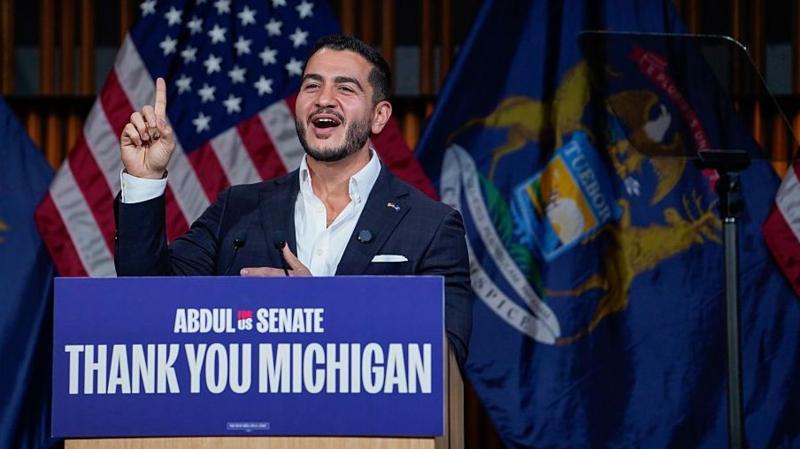 Image source, Bloomberg via Getty Images
Abdul El-Sayed speaking to supporters in triumph