The key facts
- The NSU killed nine men of migrant background and policewoman Michèle Kiesewetter; the group was exposed on 4 November 2011
- The second trial ended with a suspended sentence for Susann Eminger; Ralf Wohlleben was released in May 2026 — Beate Zschäpe remains the only convicted person still in custody
- A National Documentation Centre in Nuremberg is planned by 2030 with a budget of around €9 million; the memorial on Keupstrasse in Cologne will not appear before 2030
How the group was uncovered and whom it killed
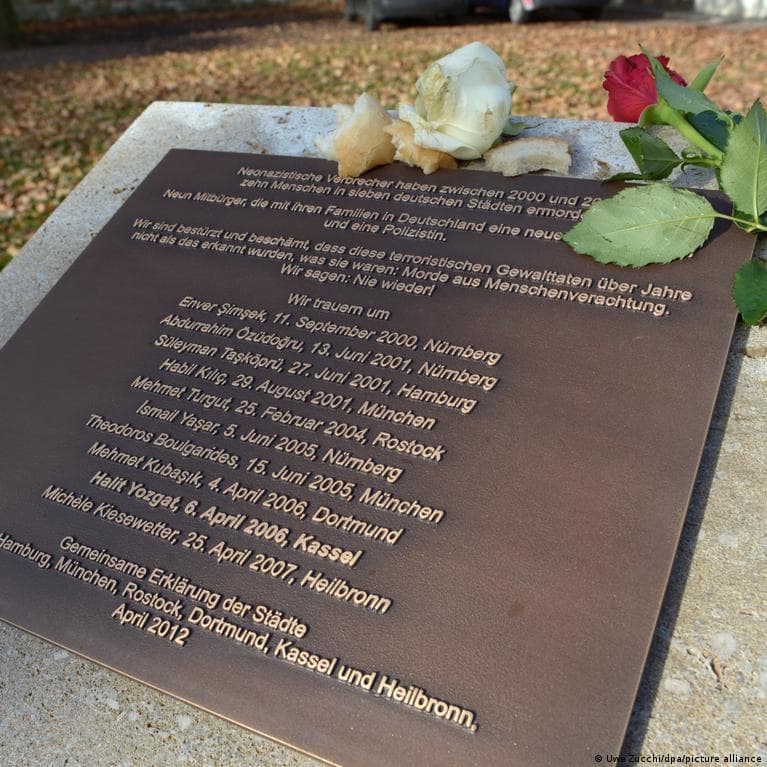
Fifteen years ago, on 4 November 2011, the existence of the National Socialist Underground (NSU) became known. Beate Zschäpe, later sentenced to a long prison term, revealed the group's existence; it also included Uwe Böhnhardt and Uwe Mundlos, who were found dead that same day in a burnt-out motorhome. According to Deutsche Welle, they are believed to have taken their own lives after a failed bank robbery in Eisenach, although the circumstances of their deaths were never fully clarified. The NSU is credited with nine men of migrant background shot at close range from September 2000 onwards, including florist Enver Şimşek, the first victim, and Halit Yozgat, killed on 6 April 2006 in Kassel. The tenth victim was policewoman Michèle Kiesewetter, who died on 25 April 2007 in Heilbronn. In a confession video sent to the media, the terrorists boasted that they had killed nine men out of racist motives.
Judicial outcomes: suspended sentences and dropped cases
The first NSU trial in Munich lasted from 2013 to 2018, but, like the numerous parliamentary committees, it failed to answer the question of why Kiesewetter was killed. Fifteen years after the group's exposure, the judicial track is practically complete. In July 2026, a court in Dresden sentenced Susann Eminger to two years suspended for aiding and abetting: she had given Zschäpe her health insurance card and identity card so that she could conceal her identity, but the court was unable to prove that Eminger knew about the series of murders. The verdict provoked outrage among the victims' relatives. 'Ten people were cold-bloodedly executed and countless others were harmed by the bombings,' said Michalina Bulgarides, whose father Theodoros was shot dead in Munich on 15 June 2005, asking: 'When will the victims get justice?' Her husband André received two and a half years in prison in 2018, of which he served only two-thirds. The sentence of Ralf Wohlleben, who was given ten years for aiding and abetting murder, ended in May 2026. As a result, Zschäpe remains the only person convicted in the NSU case who is still in custody; she is expected to remain behind bars until 2035. All other investigations by the federal prosecutor's office against suspected accomplices have been dropped.
Memorial projects: Nuremberg, Cologne, Chemnitz
Alongside the judicial track, a public debate about the series of murders and attacks continues. Two key projects are progressing slowly. A National Documentation Centre on the victims of racism and right-wing extremism is planned for Nuremberg — the city where the NSU killed its first victim and where, according to DW, the group carried out its first bombing; in the Nazi era, party rallies were held there. The Bundestag has been considering the idea since 2024, but rapid implementation was derailed by the early collapse of Chancellor Olaf Scholz's coalition; the project is now to be completed by 2030. According to the federal government's response to a query from the Greens, just under €9 million has been allocated for creating the centre under the leadership of the Federal Agency for Civic Education. Chemnitz moved faster: since 2025, a documentation centre has been operating there with the exhibition 'Open Process' — it was there that the terrorists hid for years. 'They also planned my father's murder here,' said Gamze Kubasik at the opening; her father Mehmet was shot dead in Dortmund on 4 April 2006. The centre's directors, Nora Krzywinska and Ester Gerstenberg, consider the national centre necessary but stress that it 'cannot replace work at the sites of terror themselves.' Meanwhile, residents of Keupstrasse in Cologne, where 22 people were injured in the NSU bombing on 9 June 2004, are still waiting for the promised memorial: according to media reports, construction cannot begin before 2030, as old buildings must first be demolished. In the meantime, the Bundestag has scheduled debates under the title 'Remembering the victims, fulfilling one's duties and taking today's threats seriously.'