The key facts
- The 'Student List' received 53% of the vote against 39% for Vučić's coalition — according to an Anadolu opinion column.
- Serbian arms exports to Israel grew from ~€1.4 million in 2023 to €42.3 million in 2024, with subsequent reports citing $132 million in 2025.
- According to an NSPT poll (April 2026), about 57% of Serbs support Palestine and only 5% support Israel.
The End of a 14-Year Era
The early parliamentary elections in Serbia on October 25 ended Aleksandar Vučić's long-standing dominance: the student-led movement 'Student List' received 53% of the vote against 39% for Vučić's coalition. This is written by Idlir Lika, an associate professor at Istanbul Ibn Haldun University, whose opinion column is published by Anadolu. The author sees the result primarily as a verdict on domestic problems — corruption, poor governance, and the capture of state institutions by the ruling Serbian Progressive Party — but also examines a foreign policy factor separately: Vučić's close rapprochement with Israel against the backdrop of the war in Gaza.
Arms, Drones, and Opacity
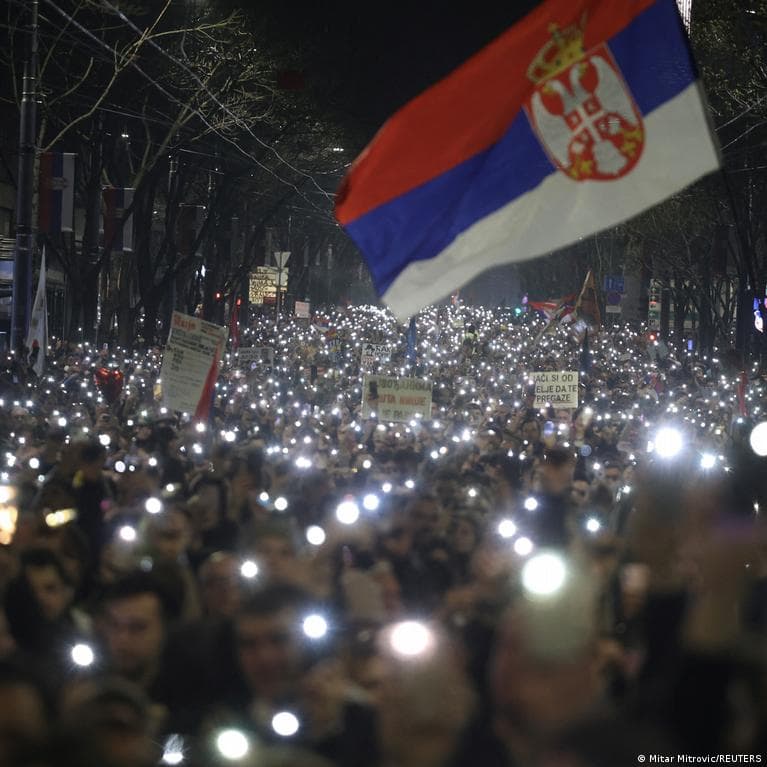
The movement that unseated Vučić began after the collapse of a canopy at the Novi Sad railway station in November 2024, which killed 16 people, and grew into a nationwide protest against corruption and the capture of institutions. Foreign policy was not a central demand of the protest, yet, as the author notes, Belgrade's policy toward Israel was politically sensitive: traditionally, Serbia supported Palestinian diplomatic initiatives, but under Vučić, after October 2023, it turned to close military cooperation with Israel. According to an investigation by BIRN and Haaretz cited in the column, Serbian arms exports to Israel grew from roughly €1.4 million in 2023 to €42.3 million in 2024, with subsequent reports citing $132 million in 2025. Moreover, on September 17 — eight days after parliament was dissolved — Vučić opened a combat drone assembly plant in Belgrade, a joint venture between Israel's Elbit Systems and the state-owned Jugoimport.
What the Polls and the Winners' Program Say
The author offers two arguments for the possible influence of this issue on voters. According to a New Serbian Political Thought poll (April 2026), about 57% of Serbs supported Palestine and only 5% supported Israel; among opposition supporters, roughly 74% expressed support for Palestine. The 'Student List' program states in its foreign policy section that the country 'will not be a complicit in the systematic attempt to destroy the Palestinian people that Israel is waging in the Gaza Strip.' At the same time, in the author's assessment, Vučić himself did not expect electoral consequences: he presented the drone plant as a contribution to jobs and technological development.
The Author's Cautious Conclusion
The column's final conclusion is restrained: the rapprochement with Israel may have contributed to Vučić's electoral difficulties, but its independent effect is difficult to establish, since the protest was driven primarily by domestic problems, and foreign policy mattered only to the extent that it intersected with demands for transparency and accountability. The test of the winners' promises, in the author's view, will be how the new government builds relations with Israel and whether it can break with the ideology of Greater Serbia. It should be noted that this is one outlet's opinion piece, not a confirmed analysis of the election results; an independent assessment of the role of the Israel factor is not yet available.