The key facts
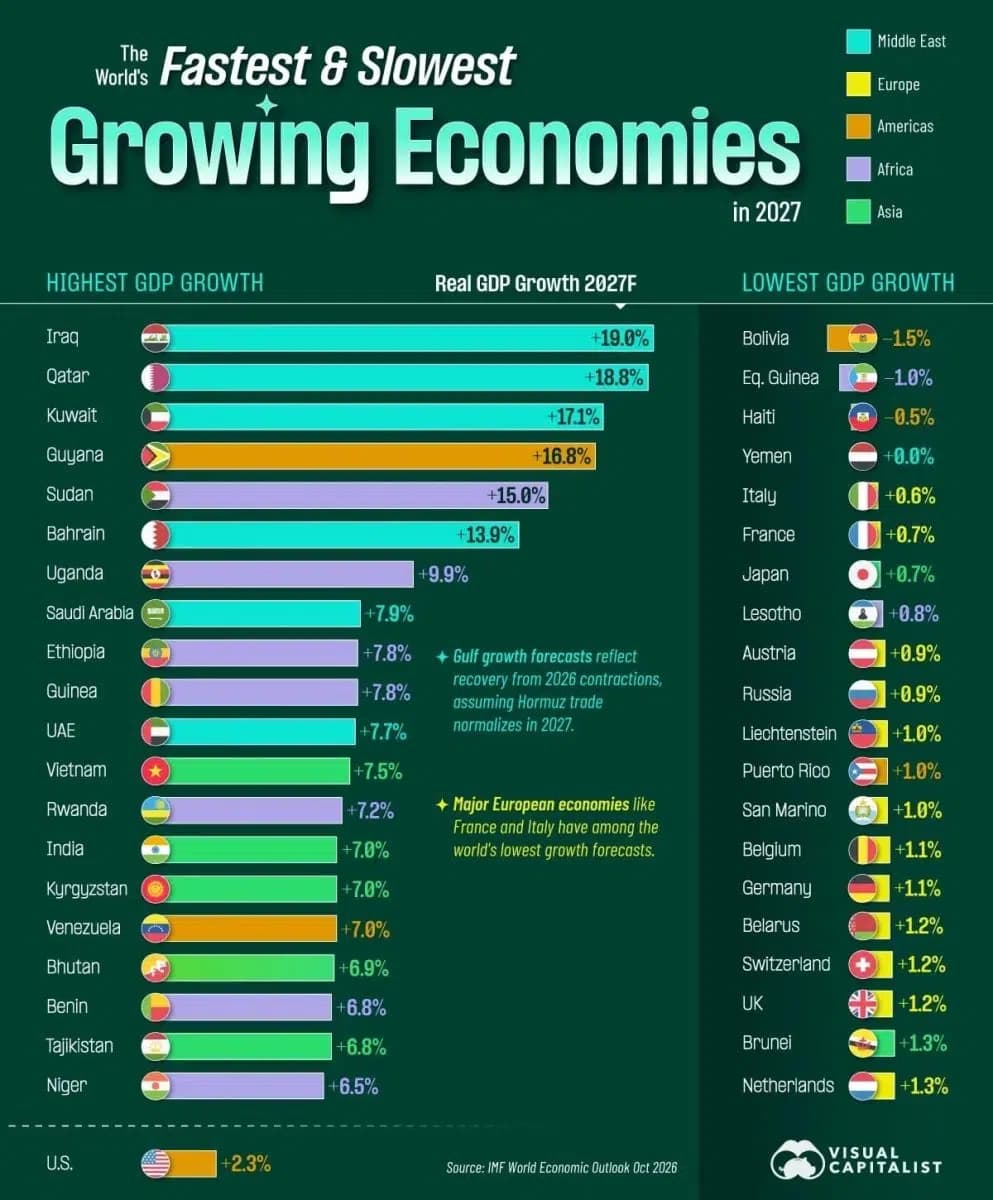
- Iraq, Qatar, and Kuwait top the 2027 GDP growth forecast — 19%, 18.8%, and 17.1% respectively
- The high figures are explained by recovery from the 2026 downturn: the IMF projected a 16% decline for Iraq, 15.6% for Qatar, and 16.7% for Kuwait
- GDP contraction in 2027 is expected in Bolivia (−1.5%), Equatorial Guinea (−1%), and Haiti (−0.5%)
Who will lead growth in 2027
A ranking of countries by expected real GDP growth rates in 2027 has been prepared by the publication Visual Capitalist based on the International Monetary Fund's World Economic Outlook report published in October 2026. First place went to Iraq with a projected growth of 19%, followed by Qatar (18.8%) and Kuwait (17.1%). Outside the Middle East, one of the highest figures belongs to Guyana — 16.8%, whose economy is growing thanks to expanding offshore oil production. The list of the fastest-growing economies also includes Vietnam (7.5%), where growth is supported by exports of manufactured goods, and India (7%), which relies on domestic consumption.
Record figures are in fact a recovery
A key detail of the ranking: the impressive figures of the three Middle Eastern countries reflect not an acceleration, but a rebound after a sharp contraction. According to the IMF forecast, in 2026 Iraq's economy will shrink by 16%, Qatar's by 15.6%, and Kuwait's by 16.7%. Thus, the large growth of the following year mainly means a recovery of lost output. The expected post-war recovery in the Middle East after the war with Iran could increase the production and export of oil and other energy resources, but this scenario depends on how quickly shipping through the Strait of Hormuz resumes. The calculations assume that traffic in the strait will begin to gradually recover from March 2027, and by October transport conditions will largely return to pre-war levels.
Who is in the red and why growth in Europe is weak
An economic contraction in 2027 is forecast for three states in the ranking: GDP will fall by 1.5% in Bolivia, by 1% in Equatorial Guinea, and by 0.5% in Haiti. Weak growth is also expected in a number of large developed countries: in Italy, France, and Japan it may not reach 1%, in Germany 1.1% is forecast, and in the United Kingdom 1.2%. In Europe, expensive energy resources are holding back consumer and industrial activity, and intensifying competition from Chinese exporters, according to IMF expectations, will remain a factor slowing the economic growth of the European Union until 2028: European manufacturers face stiff competition both in domestic and foreign markets.