The key facts
- BGE: 5% of Germany's territory in 11 of 16 states remains under consideration
- The goal is to select a final disposal site by 2050; Minister Carsten Schneider is examining whether the process can be accelerated
- The search and interim storage cost about €1.4 billion per year, with the repository itself estimated at €14 billion
Narrowing the search after ten years of work
The federal company for the disposal of radioactive waste (BGE) announced this week that only 5% of Germany's territory, spread across 11 of the 16 federal states, remains as potential sites for the final disposal of nuclear waste. The search for a suitable site has been underway for almost ten years, reports Deutsche Welle. The agency consults with geologists, nuclear energy specialists and physicists, as well as with citizens and politicians.
What has already been determined and what remains unclear
No specific site has been chosen yet: the government expects to identify a location by 2050, and Environment Minister Carsten Schneider (SPD) is examining whether the search process can be accelerated. Most of the waste is currently kept in temporary storage at or near the places where it was produced — including 19 nuclear power plants being decommissioned and several research facilities. After the Fukushima accident in 2011, Germany decided to abandon the commercial use of nuclear energy, and the last nuclear power plant was shut down in 2023, but the waste remains in the country pending permanent disposal.
Requirements for the repository and the cost of the issue
Candidate sites are assessed for geological suitability: the repository must be located at a depth of about 400 meters, where the rock will remain stable and groundwater will not be contaminated. The goal is to find a site surrounded by a layer of clay, granite or rock salt about 100 meters thick, which would serve as a natural barrier. According to BGE representative Dagmar Demmer, the safety of the repository must be proven over a very long period: in Finland this horizon is 100,000 years, while in Germany, Switzerland and France it is one million years.
Finland as a model and the cost of the project
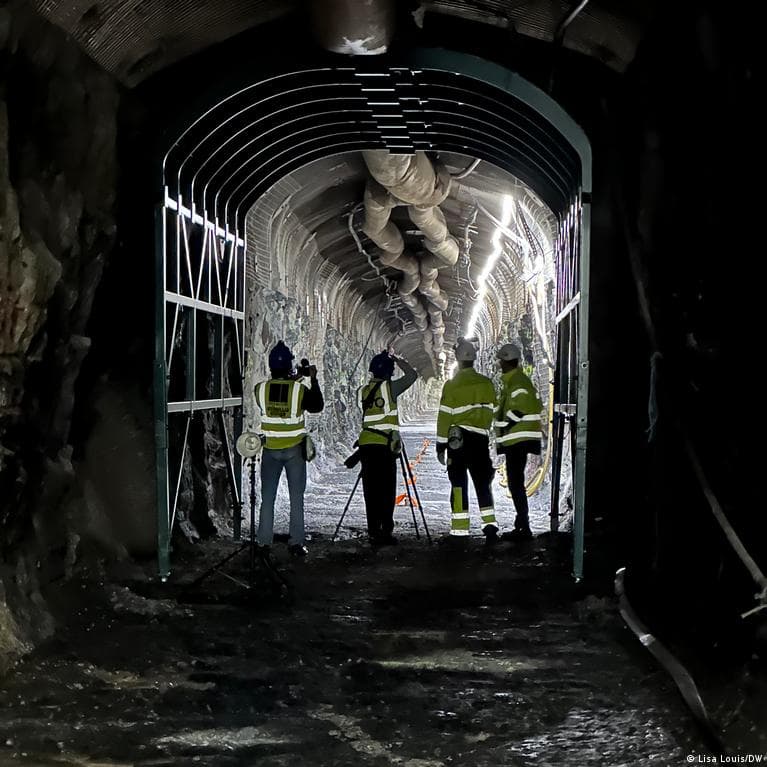
Finland recently became the first country in the world to approve a radioactive waste repository: it is located 400 meters underground on an island in the west of the country, at the site of one of its two nuclear power plants, and the project took about 40 years. Demmer attributes Finland's success to high trust in state institutions, noting that the regulator STUK is one of the country's most respected organizations, and that Germany should learn consistency and patience from Finland. The costs are already considerable: the search for a repository and the storage of waste near the former reactors cost roughly €1.4 billion per year, while the final repository itself is estimated to cost around €14 billion; it is expected to hold 28,000 cubic meters of radioactive waste.