The key facts
- The Student List won the elections on October 25 with 53% of the vote, while Vučić's SNS received 39%
- The student list won the elections on October 25 with 53% of the vote, while Vucic's SNS received 39%
- Vučić accuses the winners of 'revolutionary terror' and threatens to 'organize'
- Vucic accuses the winners of 'revolutionary terror' and threatens to 'get organized'
- The list opposes sanctions against Russia and recognition of Kosovo, but promises reforms for EU accession
Vučić's Defeat and Rapid Changes
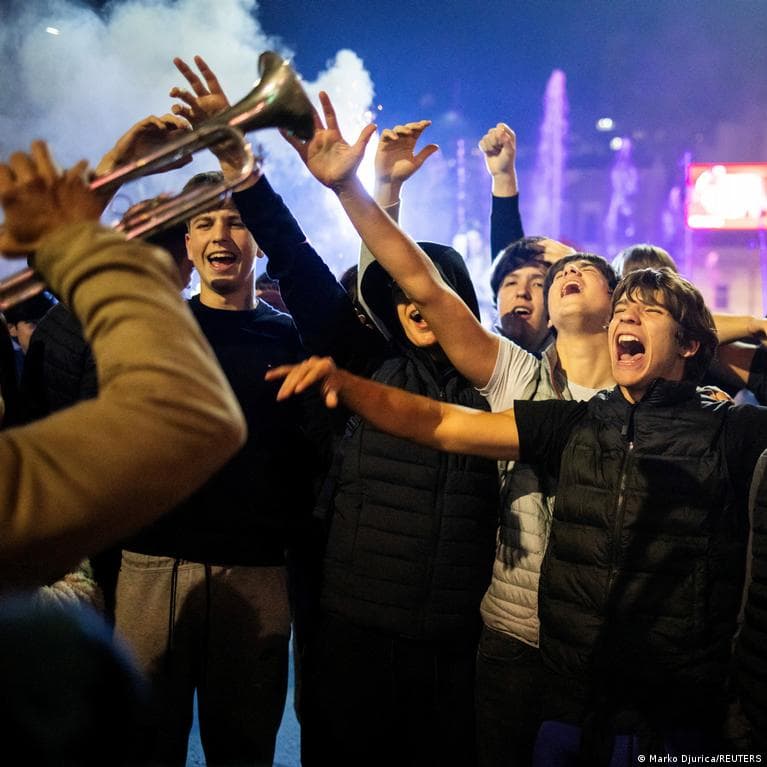
On October 25, the Student List won Serbia's parliamentary elections — a movement that grew out of student protests and consists of professors, activists, and artists. It received 53% of the vote, while Aleksandar Vučić's Serbian Progressive Party (SNS) gained only 39%, and Vučić conceded defeat. This is reported by Deutsche Welle.
Accusations of 'Revolutionary Terror'
After the elections, events unfolded quickly. At a press conference, held before fewer microphones than usual, Vučić stated that the winners practice 'revolutionary terror' and threatened: if they 'continue to terrorize those who think differently' and the authorities do nothing, his supporters 'will be forced to organize.' As an example of 'terror,' he cited the immediate resignation of the director general of the state broadcaster RTS, where senior editors were also dismissed. On Monday, a small group of protesters stormed the media outlet Informer, which has received thousands of complaints over the years for smearing Vučić's critics; journalists' associations are demanding that its license be revoked. Meanwhile, tabloids loyal to Vučić have already changed their tone and stopped calling the Student List 'terrorists' and 'mercenaries.'
Investigations and Old Accusations
In many cities, citizens are peacefully removing portraits of Vučić from municipal buildings. The organized crime prosecutor's office has launched investigations, including into election fraud; a special commission is examining the work of the Higher Prosecutor's Office in Belgrade, which critics accused of acting on Vučić's orders and persecuting his opponents. The accusations themselves are not new: tight control over the media, awarding state contracts to loyal companies, and the regime's ties to organized crime. The catalyst for the protests was the collapse two years ago of a concrete canopy over the renovated railway station in Novi Sad, which killed 16 people; the accident has been linked to poor quality of work and corruption in the awarding and execution of the renovation contract.
The Winners' Impatience and the Risk from the Old Regime
The new parliament has not yet been formed, the SNS retains control over many levers of power, and those celebrating in the streets are already showing impatience. 'A society so long oppressed by a party that acted like a feudal lord now, naturally, expects justice. In this power vacuum, people are losing patience,' Dejan Bursać of the Institute of Philosophy and Social Theory at the University of Belgrade explained to DW. Zlatko Minić of Transparency Serbia warns that officials still have time to conclude contracts and create financial obligations of their subordinate bodies without formally committing a crime. According to sources familiar with the situation cited by DW, the Student List has for some time maintained contacts with police and administration officials dissatisfied with Vučić's style of rule and may be able to block certain decisions. On Wednesday, the list again demanded the resignations of the police and judiciary leadership and called on whistleblowers to come forward if the outgoing government attempts to 'destroy documents.' A symbolic detail: the list's representatives held their first press conference in Pioneer Park in front of the parliament, which Vučić's supporters fenced off in 2025 and turned into a pro-government camp — according to investigative journalists, a base for attackers on demonstrators; the morning after the victory, the list's supporters cleaned up the park with garbage bags.
Foreign Policy Without Drastic Changes
The Student List unites left and right, pro-European and pro-Russian forces, and focuses on domestic policy. It intends to advance EU accession negotiations through genuine reforms, but opposes sanctions against Russia and recognition of Kosovo — positions with which almost the entire population of Serbia agrees. 'Our plan is to stabilize and develop the country, not to destabilize it with a sharp change of foreign policy course,' Oliver Toskovic, a professor of psychology and future member of parliament, told DW. He added that Serbia is heavily dependent on Russia in the energy sector — 'this is indeed a mistake of the previous government' — but sanctions now would destabilize the country. Serbia's EU accession process has recently stalled, while Vucic accused 'the West' of fomenting a 'color revolution.' Unlike Vucic, who frequently attacked Kosovo, Croatia, and Bosnia and Herzegovina, the list's leaders promise to reduce tensions with their neighbors: the leading candidate Ilija Srdanovic declared readiness for dialogue with Pristina and has already spoken by phone with the Croatian prime minister.
What comes next
The electoral process is not over: on November 1, voting will be repeated at about 50 polling stations due to irregularities during the first vote. After these votes are counted, parliament can be convened; the formation of the government is expected to be quick, but the names of the future ministers have not yet been revealed. Vucic and his top officials promise to become a strong opposition and count on a quick return, but most critics demand an investigation and criminal charges against Vucic himself. 'The people from SNS behave as if they lost a local election somewhere in democratic Scandinavia, rather than being part of a deeply corrupt and criminal regime,' Bursac said.