The key facts
- Textbooks have documented the addition of hijabs to drawn characters, the removal of paintings (including the 'Mona Lisa'), statues, and historical figures
- Historical texts: the 'martyrs' executed on May 6 are described as 'agents of Britain and France'; portraits of Sultan Pasha al-Atrash and Gamal Abdel Nasser have been removed
- The Ministry of Education calls the reports 'inaccurate' and states that the changes are limited to the January (2025) amendment removing symbols of the former regime
What was found in the new textbooks
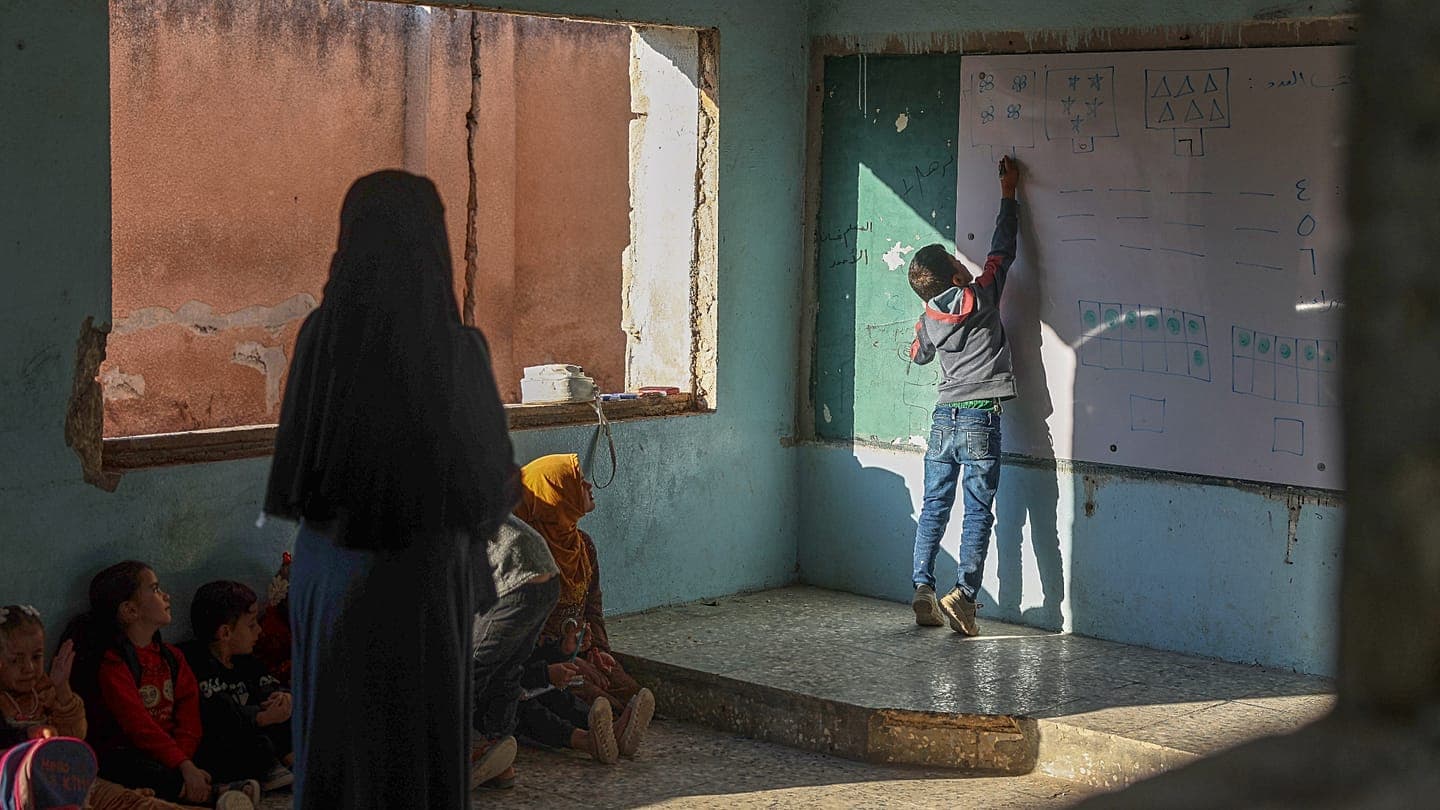
A dispute has flared up in Syria after comparisons of different editions of school textbooks appeared on social media. According to Euronews, the revisions affected textbooks for primary grades, the seventh grade, and the 'Social Studies' textbook for the sixth grade, reissued for the current academic year based on the 2012–2013 version. In addition to removing materials associated with the former regime, lessons on local self-government, political life, citizenship, the media, and democratic participation disappeared from it.
Images and historical figures
The revisions affected not only texts: with the help of Photoshop, hijabs were added to drawn female characters, and in some cases long robes; entire images of women were removed, statues were covered, and paintings and sculptures were removed or replaced. Among the most widely discussed examples are the removal of the 'Mona Lisa' and a drawing of a girl jumping rope. Historical figures were also altered: the portrait of the Phoenician princess Elissa, the founder of Carthage, was replaced with an edited version with the chin and neck covered, and a pharaoh's statue was 'dressed' in a striped shirt that users compared to a prison uniform.
Revisions to the historical narrative
A separate wave of outrage was caused by revisions in history textbooks. According to activists quoted by Euronews, the 'martyrs' executed on May 6, who were executed by the Ottoman governor Jamal Pasha, are now described as 'agents of Britain and France' rather than symbols of the national movement. The portrait of Sultan Pasha al-Atrash has been replaced with an image of Sheikh Salih al-Ali, which critics link to possible exclusion on sectarian grounds; a photo of Gamal Abdel Nasser has also been removed. On one of the maps, the Iskenderun district and the occupied Golan Heights disappeared, as did a paragraph on the role of Syrian women in the resistance to the French mandate.
Parents' reaction and accusations of ideology
Parents fear that a single model for depicting women will affect children's perception of social diversity. Aliya, the mother of a middle school student, told Euronews that the priority should be 'fundamental development of educational programs' rather than cosmetic revisions, and warned that such practices could deepen ideological divisions. Jabar, the father of a schoolgirl, called on international child rights organizations to ensure children receive a 'balanced and neutral' education, noting: 'While the world has made leaps in the development of artificial intelligence, we in Syria are still drowning in fruitless disputes about whether to cover images of women.' Some critics accuse the ministry of attempting to impose ideology through education, but others note that the published revisions by themselves do not prove the existence of a consistent policy — an objective assessment requires official standards and the full scope of the changes.
The ministry denies new changes
In an official statement, the Syrian Ministry of Education called the circulating information 'inaccurate' and stated that no new changes to the current textbooks had been approved. According to the ministry, changes after the fall of the former regime were limited to one amendment announced in January 2025 concerning the removal of symbols and ideological content of the ousted regime. The ministry also announced the completion of work on a 'national framework of curricula' and called for relying on official sources. The statement, however, did not remove the criticism: activists point out that the denial contradicts visual comparisons of actual textbooks. At the same time, on August 17, 2026, the ministry announced the introduction of unified textbooks across all provinces for the 2026–2027 academic year based on the 'Damascus program,' and on September 14, 2026, Education Minister Mohammad Abdulrahman Turkaw himself confirmed at parliamentary hearings the removal of images and symbols of the former regime from the last two editions of the textbooks.