The key facts
- Residents of the island of Pamaravan (3,000 people) spent years raising their homes with concrete, but the floods continued
- The project, costing 70 million pesos (~1.1 million dollars), is cheaper than a concrete dam (~90 million pesos); the first phase was completed at the end of 2025
- A scientific evaluation of the project is expected next year; the decision on mangrove planting has not yet been made
The island where concrete no longer saved the day
Residents of the tiny island of Pamaravan north of Manila, home to about 3,000 people, spent years raising their homes with layers of concrete, but floods kept threatening them again and again. The island suffers from storm surges, land subsidence and sea level rise exacerbated by climate change. Fisherman Edgar Javier told the AFP agencythat strong waves once brought down the concrete wall of his house: 'When the waves strike, the wall shakes.'
A project with Dutch consultants and no blueprints
The project began when the city administration of Malolos, which includes the island, launched a study together with a Dutch engineering consulting firm. Mayor Christian Natividad told AFP that concrete infrastructure 'will not solve the problem,' and admitted that the initiative, the first of its kind in the country, initially met resistance from officials and residents who worked without a ready-made plan. 'Either you accept daily flooding, or you take a risk and do something different. I chose the risk,' he said.
How the natural barriers work
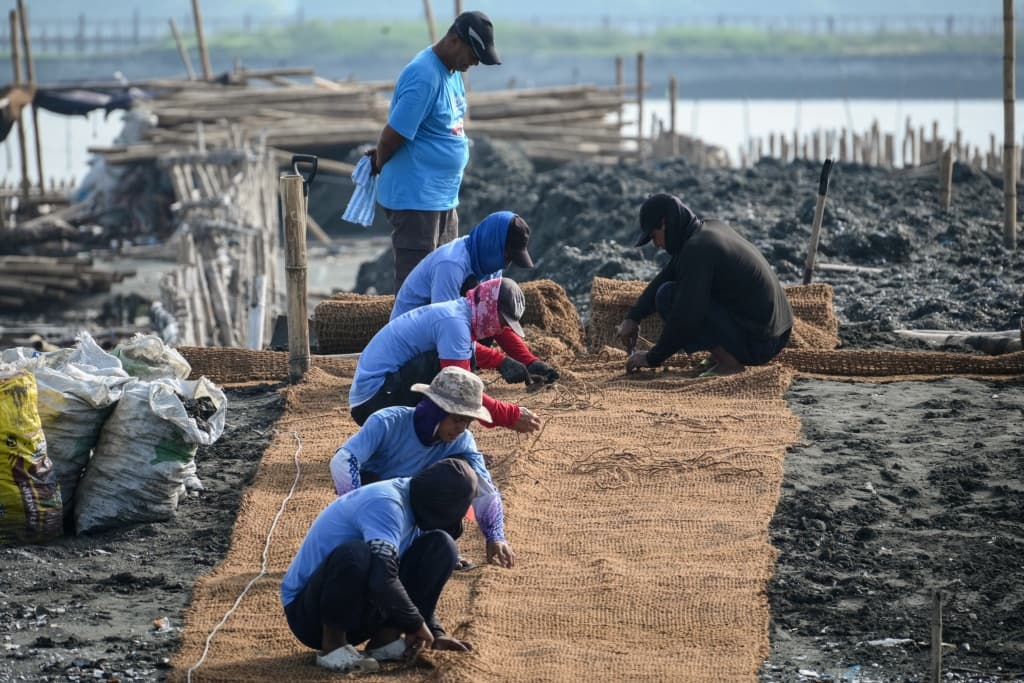
Since May of last year, workers — mostly the residents themselves — have been installing bamboo stakes packed with brushwood along the coast: they slow the flow of water and trap sediment, gradually raising the seabed and supporting mangrove growth. During a visit by AFP journalists, a breakwater made of oyster shells was being built about 100 meters from the shore: wooden stakes secure bags of coconut fiber filled with shells on an artificial shore made of marine sand. Project manager Liana Galang explained that the main task of the breakwater is to weaken the wave before it reaches the settlement, while the shell barriers work in tandem with the bamboo sediment traps.
The cost and the context of the scandal
The structures occupy about 14 hectares along Manila Bay and cost 70 million pesos (about 1.1 million dollars) including maintenance, whereas a concrete dam would have cost about 90 million pesos, according to the mayor's estimate. The bamboo will have to be replaced roughly every five years. The project's context is a multibillion-dollar scandal surrounding substandard — and sometimes entirely nonexistent — concrete flood protection projects, which caused public outrage in the Philippines. Filipino scientist Antonio Contreras noted that the country has long relied on concrete dams and breakwaters, often without proper research, and that design errors linked to corruption have cost lives. He warned that nature-based solutions are not a universal answer, especially during catastrophic floods, and should complement conventional infrastructure; moreover, bamboo and shells must be sourced sustainably, since decomposing bamboo releases carbon.
First results and open questions
The first phase was completed at the end of 2025, and residents are already reporting relief: Javier said the breakwaters weakened the waves during this year's typhoons and monsoon rains, while 58-year-old Arsenia Cabigao, whose fish-drying business suffered from flooding, said: 'Our feet are finally dry. That never used to be the case.' Public Works Secretary Vince Dizon (before his recent reassignment) expressed hope that the Pamaravan experience could be replicated in other flood-prone areas. At the same time, the long-term effectiveness remains uncertain: a scientific evaluation is scheduled for next year, and it will determine whether mangrove planting can begin; according to the mayor's estimate, success will become tangible over the next decade, as accumulated sediment stabilizes the seabed. 'It is hard to fight the water. Now we are trying to live with the water,' Natividad concluded.