The key facts
- The CCP Central Committee held a four-day closed session in Beijing, adopting a resolution praising Xi Jinping for the fight against corruption
- Xi called for identifying and removing 'two-faced officials' and 'political opportunists'
- Experts see a dilemma: tighter control suppresses initiative, while encouraging it may weaken control and increase corruption
CCP Central Committee Plenum: discipline and loyalty
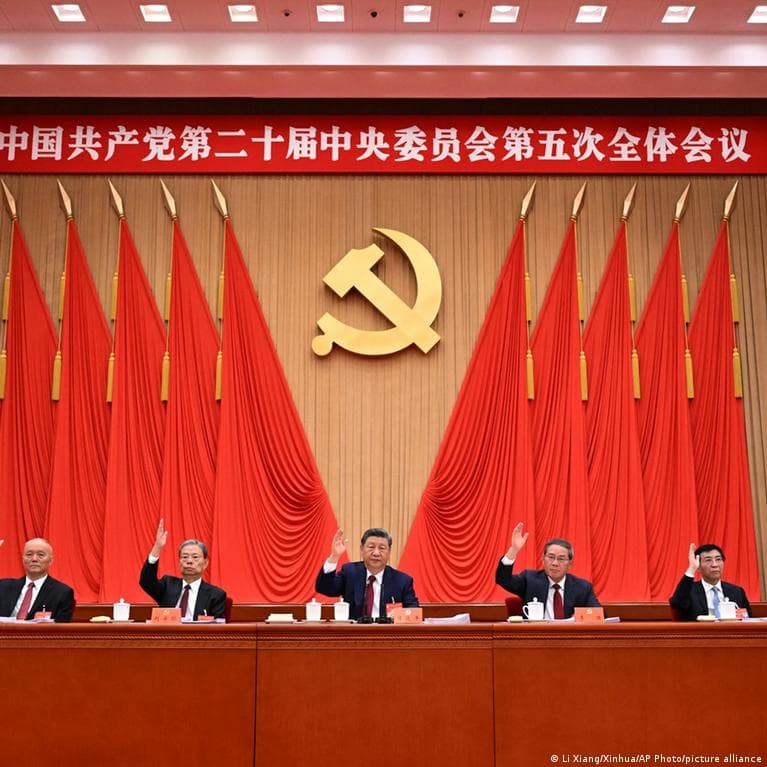
The top leadership of the Communist Party of China held a closed four-day plenary session in Beijing this week, devoted to strict leadership and discipline within the ruling party. As Deutsche Wellereports, Xi Jinping, who holds the posts of General Secretary of the CCP and head of state, made it clear that he will not only continue the anti-corruption campaign but also demand greater loyalty and initiative from party officials at all levels.
The resolution and 'two-faced officials'
The resolution published on Thursday by the Central Committee contains praise for Xi Jinping for his 'enormous political courage and strong sense of responsibility' in fighting corruption and the weakening of the party's governability. The statement emphasized the need to 'consistently advance comprehensive and strict party governance.' Earlier, in mid-October, the party journal Qiushi carried a speech by Xi in which he called for identifying and removing from the political system 'two-faced officials' — those who display loyalty to the central leadership but act against its instructions while pursuing 'individualistic' goals. He called them 'political opportunists' and criticized officials who pose as 'nice guys,' that is, who hide behind harmony to avoid solving problems.
The dilemma of control and initiative
Kerry Brown, head of the Lau China Institute at King's College London, believes that Xi seeks to minimize potential sources of instability against the backdrop of international tensions and domestic economic difficulties: in his words, the campaign will intensify because the party fears sharing the fate of 'divided and unstable' countries. Brown pointed to a key dilemma: if officials are expected to show boldness and innovation, party control may weaken, which could fuel corruption; if, however, pressure is placed on rank-and-file members, there is a risk of suppressing initiative — down to the army. In his assessment, the party is 'very, very risk-averse.' Political scientist Chong Ja Ian of the National University of Singapore added that the 'proactivity' Xi demands is limited to execution rather than decision-making: officials must act decisively within specific tasks, but not so independently as to call into question the agenda set by Xi.
The question of succession
Observers are also discussing the future of the 73-year-old Xi and possible successors. For now, according to analysts, he firmly holds power: it is quite likely that next autumn he will be confirmed as General Secretary and will be able to remain in office until 2032 — a consequence of the 2018 changesthat removed term limits for the leaders of the state and the party. Both analysts link the course toward internal stability to the question of succession. Brown noted that 'he cannot rule forever,' while Chong pointed to a dilemma: appointing a successor early could undermine Xi's authority, but a failure to prepare one in time could create a power vacuum and major instability. To solve this problem, in Chong's view, the leader needs self-confidence and a willingness to step aside, 'as his predecessors did' — 'but not everyone has such confidence.'