The key facts
- A Renfe AVE train ran into the rear of an Iryo train on the Madrid–Seville line; four carriages derailed
- Casualty figures differ: from 10 to 68 dead in various publications
- Traffic between Madrid, Ciudad Real and Andalusia has been suspended; a signalling failure and human error are being considered
What happened
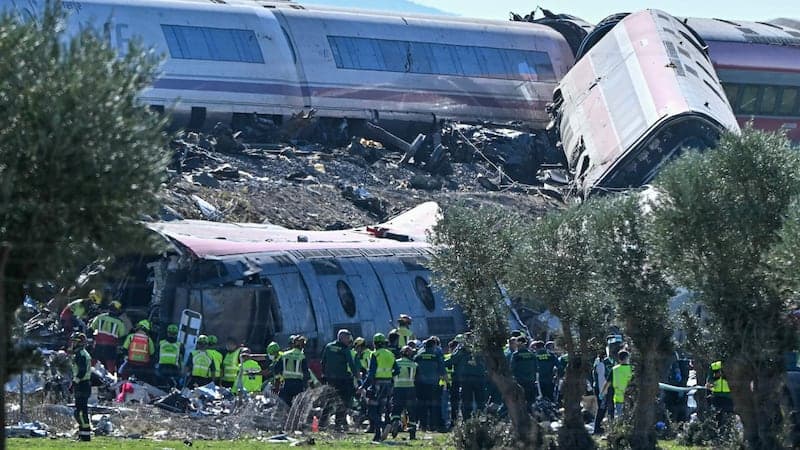
On the morning of October 28, two trains collided on the Madrid–Seville high-speed line in the province of Toledo. According to the ABC newspaper, which is cited by Zamon.uz, at around 08:54 local time an AVE train of the state-owned company Renfe, travelling from Madrid to Seville, ran into the rear of a stationary train belonging to the private operator Iryo. The impact derailed four carriages of the Iryo train, and at least two fell down an embankment. More than 500 passengers were on board the two trains: the Iryo train carried 146 passengers and an infant, and the Renfe train 397 people, according to Esther Padilla, a spokesperson for the government of the region of Castilla-La Mancha, quoted by the BBC.
Conflicting casualty figures
The death toll reported in publications differs substantially, reflecting different points in time and sources of information. Daryo.uz, citing Reuters , initially reported at least 10 dead, and later said the number had risen to 30 according to the government of Castilla-La Mancha. Zamon.uz, citing ABC , wrote of 46 dead and more than 100 injured. UzNews.uz gives the highest figures: at least 68 dead and more than 170 injured, some in serious condition. There is no officially confirmed final death toll in the sources; the president of Castilla-La Mancha, Emiliano García-Page, according to the BBC, spoke of
Possible causes and consequences for rail traffic
The exact cause of the disaster has not been officially confirmed. According to ABC sources cited by Daryo.uz, a signalling failure stopped about eight trains, after which an employee at the traffic control centre at Atocha station allowed one of the trains to proceed even though another train was on the track. Zamon.uz notes that preliminary versions under consideration include a malfunction of the traffic control system and human error. High-speed rail traffic between Madrid, Ciudad Real and Andalusia has been suspended, and the operator Adif has halted all traffic on the line. The British BBC points out that this is already the second disaster on Spain's high-speed lines this year: in January, 46 people died when a train derailed in the south of the country, and government sources, in a conversation with El País, do not rule out that the new crash may turn out worse than the Almudén accident.
Reaction of the authorities and of Uzbekistan
Spanish Prime Minister Pedro Sánchez called the incident a serious tragedy and expressed condolences to the victims and their families; according to the BBC, he and other politicians cancelled all public events, including campaigning ahead of next month's parliamentary elections. Hospitals in Toledo, Ciudad Real and Alcázar de San Juan cancelled scheduled operations, and the blood transfusion centre in Madrid appealed to residents for urgent blood donations. President of Uzbekistan Shavkat Mirziyoyev sent condolences to King Felipe VI of Spain over the victims of the disaster in the province of Toledo, UzNews.uz reports.