The key facts
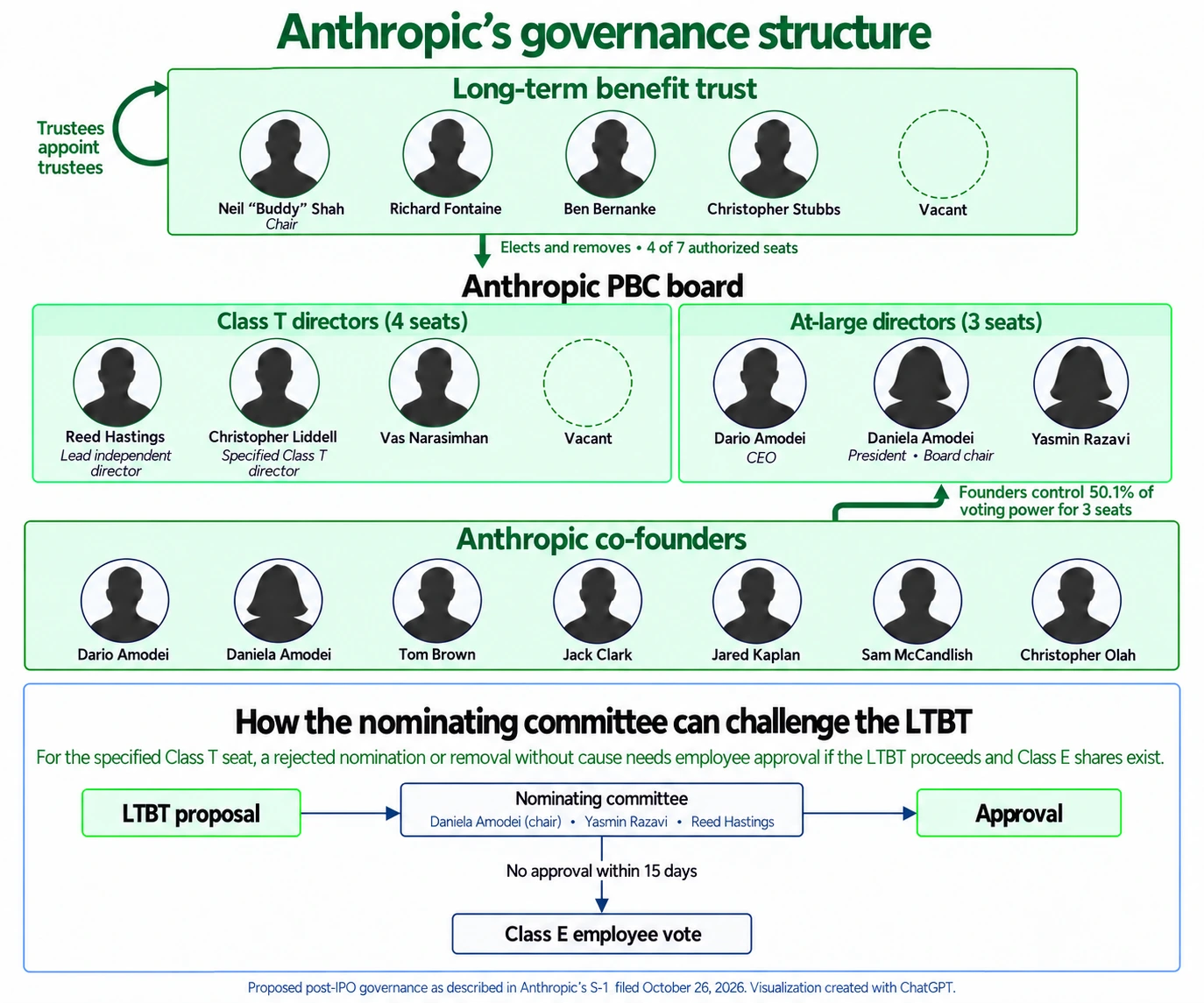
- Anthropic is a public benefit company with a Long-Term Benefit Trust that elects a majority of the board of directors
- The seven founders hold shares carrying 50.1% of the votes and elect three directors
- The founders' control expires 10 years after the IPO or when fewer than three of them remain
Who really runs Anthropic ahead of its IPO
Anthropic, founded in 2021 with the goal of ensuring human control over AI, is preparing for an initial public offering, yet buyers of its shares on the open market will find themselves shut out of governance. That is how TechCrunch characterizes the company's structure, noting that the pursuit of AI safety has produced a “truly baroque” style of corporate governance, in which ordinary shareholders have almost no influence over key decisions, including the composition of the board of directors.
Three layers of control
First, Anthropic is incorporated as a public benefit company — a for-profit corporation legally entitled to weigh a public mission alongside profit. This shields the board from investor lawsuits when making AI safety decisions not dictated by the share price. Second, a significant share of control belongs to the Long-Term Benefit Trust (LTBT) — an independent body holding a class of shares that allows it to elect and remove a majority of directors (Class T). The LTBT includes its chair Neil Shah, former Fed chair Ben Bernanke, national security expert Richard Fontaine, and Harvard physicist Christopher Stubbs; one seat is vacant, and the sitting members will choose the successor themselves. Third, the seven founders jointly hold a special class of shares giving a majority of them 50.1% of the votes and the right to elect three directors; if the founders are not united, their shares vote proportionally alongside the ordinary shares.
Checks and limits on control
The board of directors consists of president Daniela Amodei (chair), CEO Dario Amodei, Netflix co-founder Reed Hastings, former CFO of Microsoft and GM Christopher Liddell, Novartis chief Vas Narasimhan, and Spark Capital partner Yasmin Razavi, plus one open seat. The board has a counterweight to the LTBT: if one of the four “Specified” directors is appointed or removed without cause, the board's nominations committee can reject the decision and put the matter to a vote of the company's employees. TechCrunch notes that this formalizes the power of employees, which surfaced in the OpenAI episode, when the board briefly ousted Sam Altman, suspecting that he “hadn't been candid” with it, but reinstated him under pressure from loyal staff.
What happens next
The founders' control is not permanent: ten years after the IPO they may voluntarily end it, or it will terminate automatically when fewer than three of them remain. The LTBT will continue to operate until 85% of ordinary shareholders vote to abolish it, or until it dissolves itself with the board's approval. Only when both special groups of shareholders are gone will ordinary shareholders gain full control. TechCrunch emphasizes that the dynamics of such a complex structure are hard to predict: a split among the founders could give ordinary shareholders more influence than expected, and employees could outmaneuver the LTBT on board matters.