The key facts
- The Zeekr 001 caught fire in April 2025 in the parking lot of the Friendship of Peoples Palace of Arts while charging
- The ruling of the Yashnabad (Yakkasaroy) district court was announced on May 8, 2026
- Expert findings: the fire is linked to the battery repair, not the factory manufacturer
Timeline of the incident
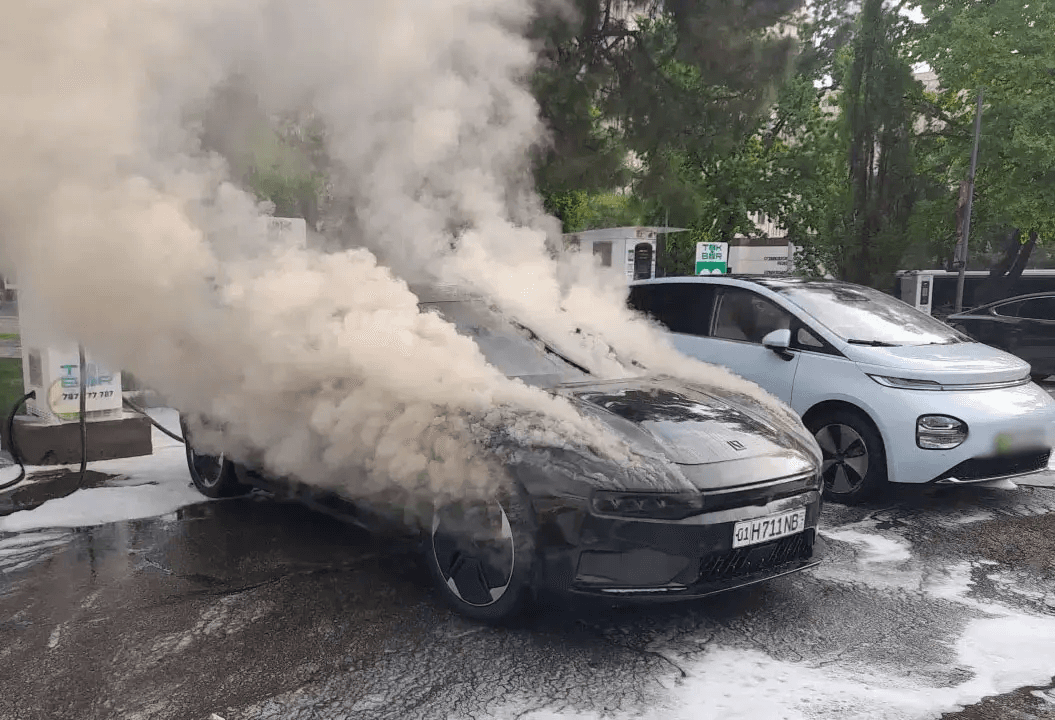
In April 2025, a Zeekr 001 electric vehicle caught fire while charging in Tashkent. Kun.uz examined the details of the incident based on court documents. The case was heard in the Yashnabad (Yakkasaroy) district court, and the ruling was announced on May 8, 2026.
What happened at the charging station
According to the court ruling, on the night of April 10, the owner, Khotambek Mirzayev, drove his Zeekr 001 to the parking lot near the Friendship of Peoples Palace of Arts, where a Tok Bor brand charging station is located. At 1:46 a.m., the charging start button was pressed — the battery charge was 7%. The owner left the car and went home. At 3:51 a.m., the station stopped supplying power and the session ended; at that moment there was no smoke or signs of malfunction. About three hours later, around 7:30 a.m., smoke appeared from the front of the vehicle, and the car began to burn. Witnesses reported the incident to the fire service.
Repairs and expert findings
An important aspect of the case concerns the car's repair: on January 25, 2025, the owner had contacted the E-GO MOTORS auto service because the charge was suddenly dropping from 50% to 0%. To determine the cause of the fire, multiple inspections and expert examinations were conducted. The initial inspections established that the fire resulted from a 'thermal runaway' of the lithium-ion battery. The court then ordered a final expert examination to resolve ambiguities. The specialists concluded that the vehicle manufacturer had no connection to the fire: the fire occurred due to an imbalance in the battery cells' internal resistance and capacity that persisted after the repair, which led to overheating, an internal short circuit, and the development of thermal propagation. Simply put, the cells inside the battery were operating unevenly, certain areas overheated, and the battery caught fire from within.
Significance of the case
This case shows how liability in electric vehicle fires is legally delineated in Uzbekistan: according to the expert findings on which the court relied, liability is tied to the quality of the battery repair rather than the factory manufacturer. For electric vehicle owners, the practical implication is that the battery's condition after service intervention may become a key factor in investigating similar incidents. The final amount and the distribution of liability under the court ruling are not disclosed in the cited materials, so the ultimate consequences for the parties remain unknown.