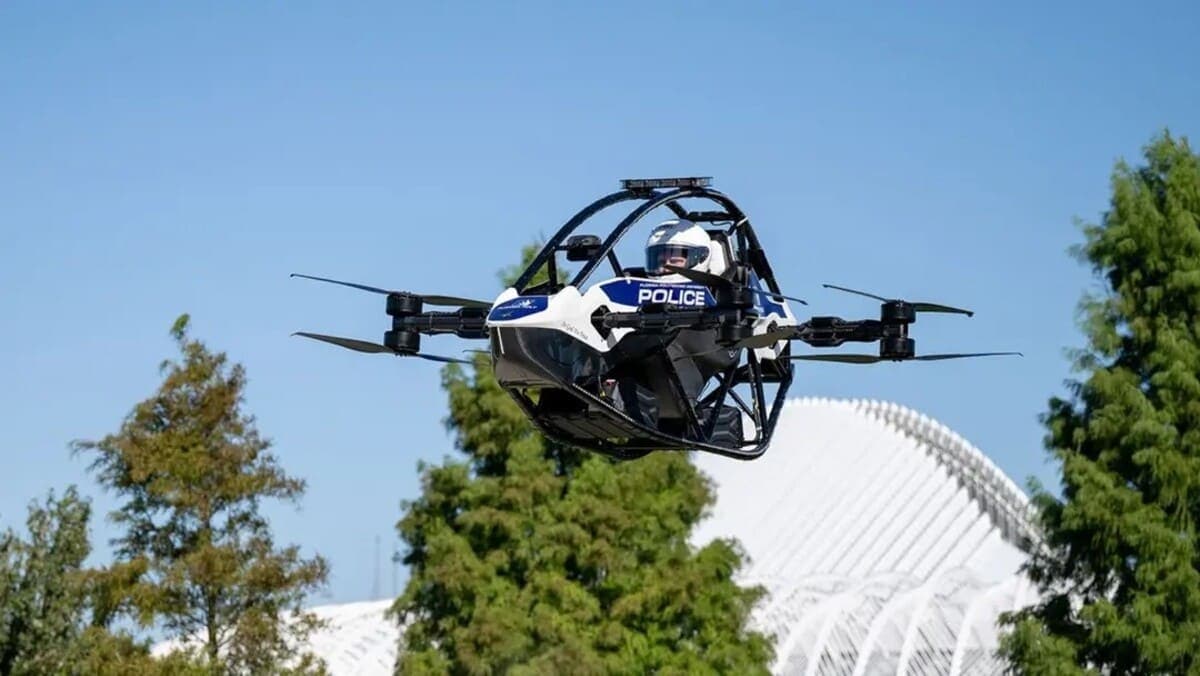
The key facts
- A US university police department has ordered the Jetson ONE flying electric car for patrolling hard-to-reach areas
- The vehicle, with eight electric motors, reaches up to 100 km/h, flies for about 20 minutes, and weighs around 115 kg
- Jetson expedited the order despite a three-year purchase waiting list
University police order a flying electric car
A university police department in the US plans to use the Jetson ONE, a piloted electric aircraft dubbed a 'flying electric car.' According to the university, the vehicle is meant to allow officers to reach places that are difficult to access in a regular patrol car. Kun.uz reports this, citing the university's announcement.
Specifications and an expedited order
The Jetson ONE is equipped with eight electric motors. According to the manufacturer, it can fly at speeds of up to 100 km/h and stay airborne for about 20 minutes. The vehicle weighs nearly 115 kilograms including its batteries; it comes with a ballistic parachute and an automatic landing function. The California-based company Jetson expedited the university's order despite a three-year waiting list for purchases. According to the company's CEO, Stefan D'haenens, the reason was that the university specializes in engineering and has public safety tasks, which made it possible to classify the project as a priority.
From recreation to practical tasks
Until now, Jetson has focused mainly on buyers using the vehicle for recreational flights. Now the company intends to explore applications for practical tasks. It is expected that the project with the university police will help assess the vehicle's capabilities in service conditions: it aims to test the use of personal electric aircraft not only for leisure flights but also for tasks such as patrolling and emergency response.
Why it matters
The project reflects a shift in how piloted electric aircraft are perceived: technology originally created for private recreational flights is, according to published reports, being tested for the first time as a public safety tool. For the university police, this means potentially faster access to hard-to-reach areas of the campus and its surroundings; for the manufacturer, it is the first test of the vehicle in real service conditions, on which expanding the market beyond the hobby segment depends. The practical limitations are already evident from the specifications: about 20 minutes of flight time and a mass of around 115 kg set narrow boundaries for use, and the vehicle's real effectiveness in patrol work will only become clear after the trials.