The key facts
- The president announced the cotton plan fulfilled at 101% at a meeting in Kashkadarya region on October 21
- By October 22, 4.63 million tons of raw cotton had been harvested — 103% of the contractual target of 4.5 million tons (Ministry of Agriculture)
- The state order was abolished in 2020, but HRW and the Uzbek Forum for Human Rights reported continued restrictions for farmers
The president's statement
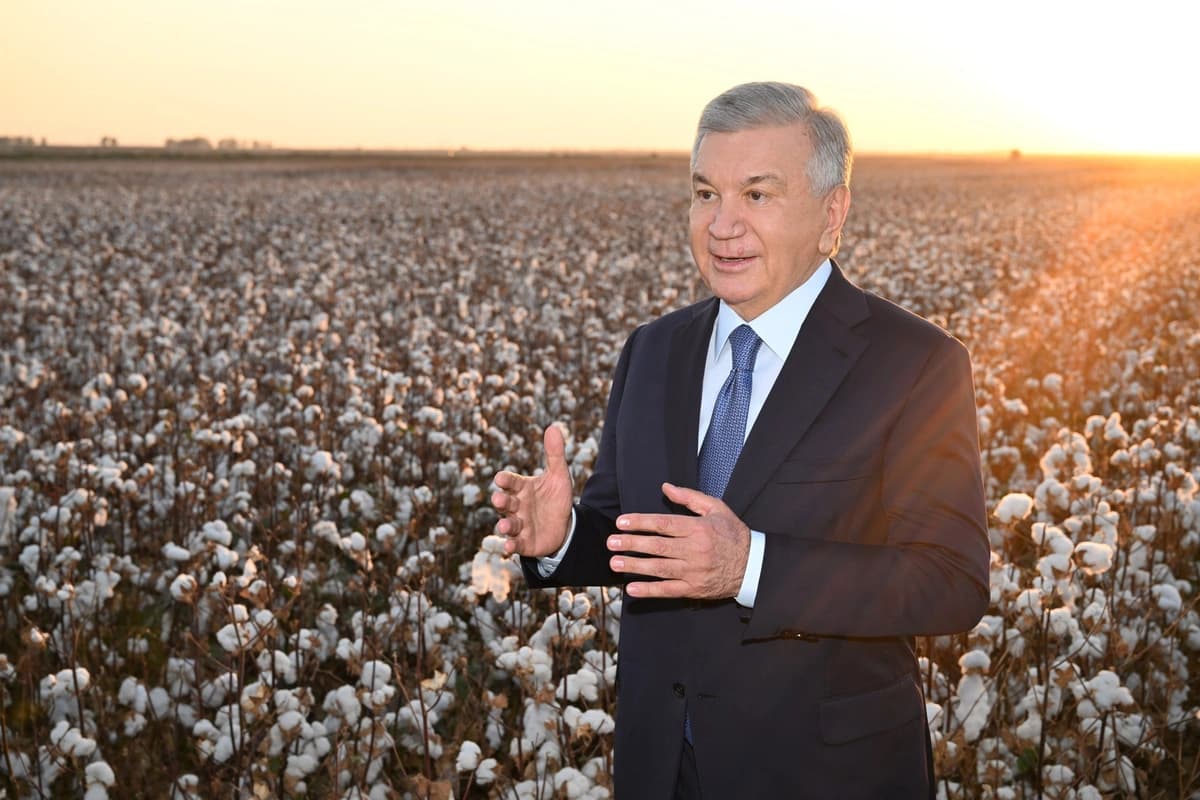
President of Uzbekistan Shavkat Mirziyoyev said the country had fulfilled its cotton harvest plan at 101%. According to him, he never sets figures as an end in themselves — 'behind the figures there must be' benefit. The statement was made on October 21 at a meeting with entrepreneurs and investors during a trip to Kashkadarya region; the speech was broadcast on the Uzbekistan 24 TV channel. The president recalled that the harvest campaign used to begin on October 1 and did not end even by December 20, with evening headquarters and plans for the next day. According to him, the sector is now developing under new conditions: enterprises for deep processing of raw materials are being created in the regions, and products are exported.
Harvest campaign statistics
According to the Ministry of Agriculture, as of October 12, 3.4 million tons of raw cotton had been harvested — 76% of the contractual target of 4.5 million tons set for the season for cotton-textile clusters and farms. By October 22, the volume reached 4.63 million tons, or 103% of the plan. About 3.52 million tons (76%) were harvested with the help of nearly 3,000 cotton-picking machines. The campaign is not over: the first harvest continues on an area of more than 49 thousand hectares.
Abolition of the state order and retention of planned targets
In March 2020, the president signed a resolution abolishing the state order for raw cotton starting from that year's harvest, providing for a transition to market relations between farmers and processing enterprises. Instead of state procurement, contractual relations with clusters were introduced, and producers gained the ability to sell cotton through exchange mechanisms. At the same time, forecast and contractual targets remain in the sector: in 2026 the target is 4.5 million tons.
Human rights activists' criticism and the Foreign Ministry's response
In February 2026, Human Rights Watch and the Uzbek Forum for Human Rights published a study stating that, despite the abolition of the state order, farmers still face restrictions in choosing crops and production volumes. According to the organizations, local authorities continue to set cotton and wheat targets based on projected yields, and also reported pressure on farmers who failed to meet targets, including threats of land seizure. The Foreign Ministry of Uzbekistan, in its response, pointed to legislative guarantees of farmers' rights and provisions on the liability of officials for unlawful actions.
The president's past statements
In August, the president said that due to the lack of political will in the past, 'everyone was a slave to cotton': according to him, virtually the entire year was spent on plowing, topping, defoliation and cotton harvesting. Schoolchildren, as the khokim of Syrdarya region noted, 'did not leave the fields'.