The key facts
- The yield on 10-year French bonds exceeded 5% for the first time since 2002; the spread over German bonds is 170+ bps, and 184 bps for 30-year bonds.
- France's CDS rose above 100 bps for the first time since October 2012; Moody's, as expected, may cut the rating from Aa3 to A1.
- The ECB, as expected, will keep rates unchanged; Lagarde and Bank of France head Muller are skeptical about intervention but have not ruled it out entirely.
Record yields and rising cost of default insurance
The yield on 10-year French government bonds traded above 5% on Friday — a level first reached on Wednesday for the first time since 2002. The spread over 10-year German bonds, considered the safest debt in the eurozone, exceeded 170 basis points. The yield on 30-year bonds reached 5.5%, with the gap over German equivalents at 184 basis points. On Thursday, the cost of five-year French credit default swaps — contracts insuring investors against a state default — rose above 100 basis points for the first time since October 2012, when the eurozone was experiencing the sovereign debt crisis.
Budget deadlock and expected rating downgrade
Lawmakers are divided over next year's budget, which provides for spending cuts and additional revenue measures worth €43 billion; the government has no majority to pass it. Moody's rates France at Aa3 (the fourth-highest tier) with a negative outlook and will announce its decision on Friday evening — markets largely expect a downgrade. A one-notch cut to A1 would align France's ratings with those of S&P and Fitch. The government expects debt servicing costs in 2027 to rise by more than €10 billion compared with the current year; the debt-to-GDP ratio stands at 119.1%.
Social tensions heighten investor concerns
New protests are expected in France this weekend: Paris police prefect Patrice Faure recommended in a letter that business owners hire private security. After a meeting with Prime Minister Sébastien Lecornu on Wednesday, the unions expressed unanimous disappointment and called for mass mobilization on November 5. CGT leader Sophie Binet urged workers to 'make the strike general.'
ECB: rates likely to remain unchanged
At next Thursday's meeting, the ECB, as expected, will keep rates unchanged — partly because rising government bond yields are already making borrowing more expensive across the eurozone. The ECB raised rates twice this year, bringing the deposit rate to 2.5%, and eurozone inflation jumped to 3.8% in September on the back of energy prices. Carsten Brzeski, ING's global head of macro research, estimated in a note to investors that the rise in German bond yields since September, in terms of its effect on growth and inflation, is roughly equivalent to a 25 bps rate hike, and for France roughly 50 bps: 'the bond market has done the ECB's job.' In his view, the ECB will wait for new staff projections in December. Christine Lagarde told the European Parliament on September 28 that long-term rates 'have risen markedly, which will restrain growth.'
Possibility of ECB intervention: skepticism, but not ruled out
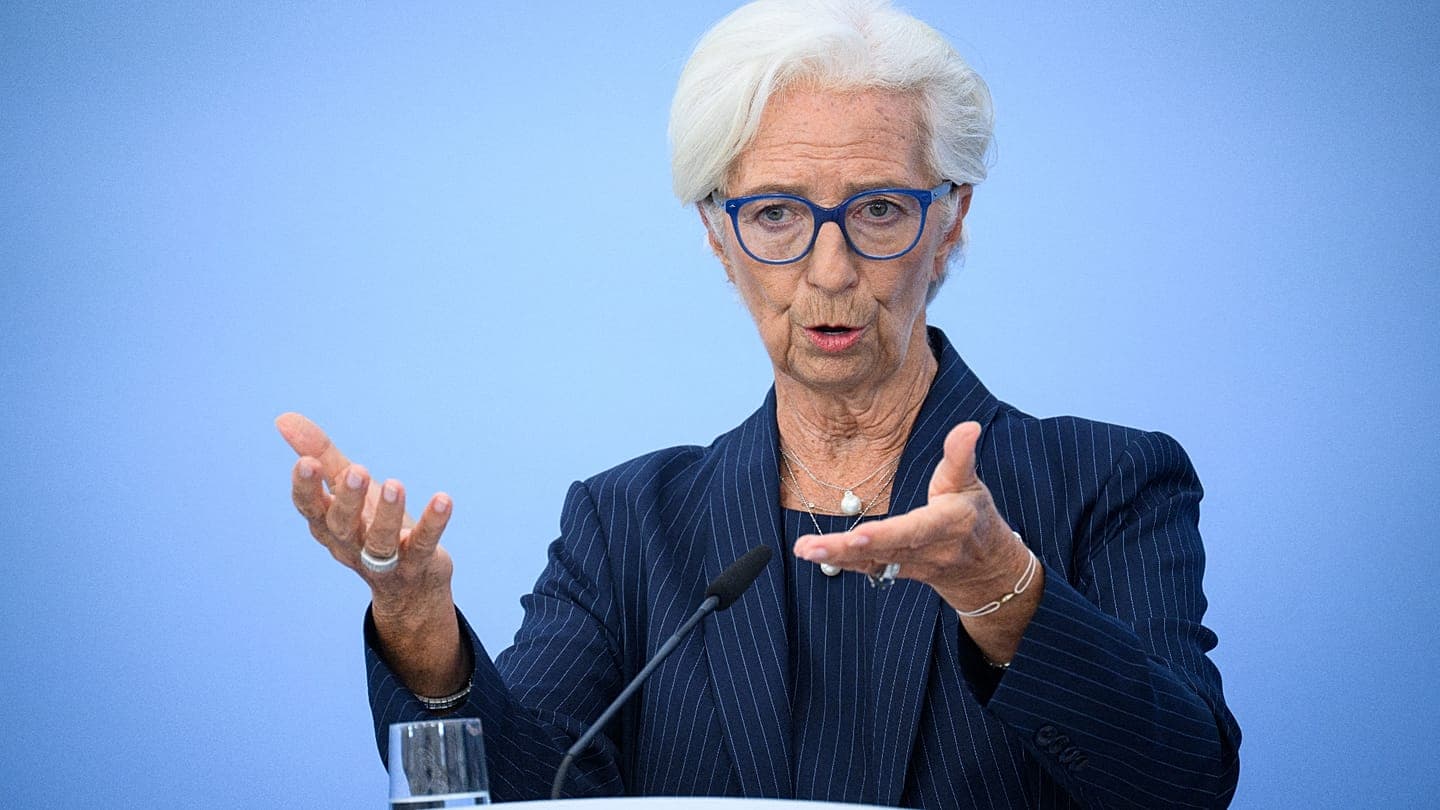
ECB officials have downplayed the likelihood of intervention to reduce France's borrowing costs, but have not ruled it out entirely. On the sidelines of the IMF and World Bank meetings in Bangkok, Lagarde noted that 'there are specific circumstances under which individual countries suffer more; France is an example,' but added: 'the main and first solution must be found within France itself. And it relates to fiscal policy.' Bank of France head Emmanuel Muller said last Friday that the conditions for intervention are not currently met, since there is no financial fragmentation in the eurozone. Both spoke before the yield on 10-year French bonds exceeded 5%.
ECB tools and analysts' scenarios
One option for intervention could be the Transmission Protection Instrument (TPI), created in 2022 and never used: it allows the purchase of debt of countries whose borrowing costs, in the regulator's view, are rising unjustifiably relative to fundamentals. To receive support, a country must comply with EU fiscal rules and keep its debt on a sustainable path. Another tool, the OMT (2012), is available only to governments that have first entered an assistance program through the European Stability Mechanism. Brzeski believes that 'the threshold for launching an ECB bond purchase program remains high': for France, this would mean at minimum the adoption of a full budget, and intervening too early could be 'seen as monetary financing of a country that is unwilling to follow the rules.' He expects the ECB instead to quietly pause the reduction of its bond portfolio, flexibly reinvesting maturing securities, as during the COVID-19 pandemic. If turbulence spreads to other eurozone markets, the TPI could become a tool of last resort; if France continues to violate fiscal rules, 'the ECB might even consider buying the bonds of almost all eurozone countries except France itself.' Brzeski calls the upcoming meeting 'of little significance in terms of decisions, but not at all in terms of rhetoric.'