The key facts
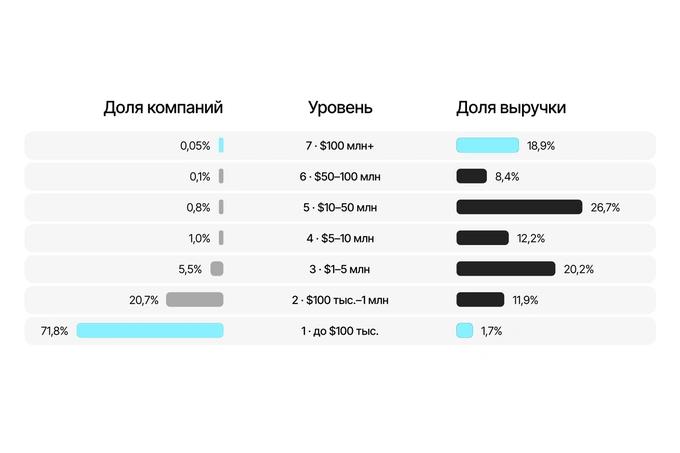
- 72% of companies in Uzbekistan are microbusinesses with revenue up to $100,000, but they receive only 1.7% of market revenue; 71 companies with revenue above $100 million (0.05%) hold 18.9% of revenue
- In 65% of companies, marketing is handled by the owner himself; 90% of companies lack a full-fledged annual plan
- The 7 Qadam model divides businesses into seven steps by revenue — from 'up to $100,000' to 'from $100 million' — with marketing budgets from $5,000 to $10 million per year
Lokals Marketing Study
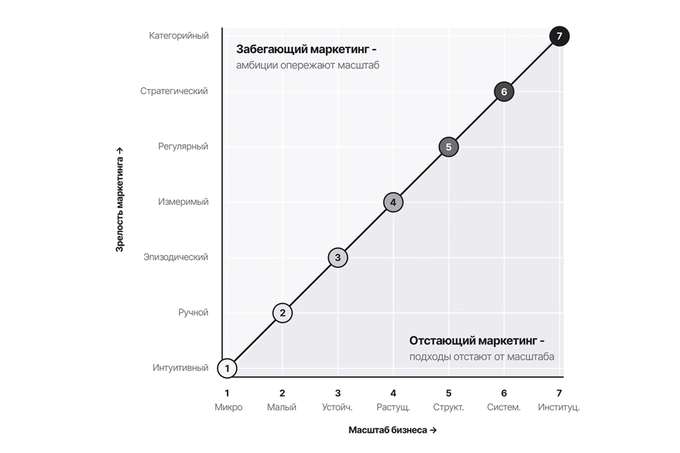
The Lokals Marketing agency published a study on how marketing is structured among companies in Uzbekistan. The team came to the project after 7 years of work in the market and 500 projects. 'For many years we saw the same situations among hundreds of clients. But our experience is not proof. We decided to test the patterns beyond our own clients,' noted the company's co-founder and CEO Farhod Norbaev. The authors conducted 54 in-depth interviews with owners, CEOs, marketing directors, operations and commercial directors, and then cross-checked the conclusions against the tax reports of 157,000 companies. The main conclusion: marketing is determined by company size, not industry. Based on this, the 7 Qadam model was developed — a marketing ladder of seven steps, where each corresponds to its own revenue, its own marketing, typical mistakes and expenses not worth spending on yet.
A Young Mobile-First Market
According to the authors, the Uzbek market is young and changing rapidly: local brands are growing while international players arrive at the same time. The median age of the population is 27, internet penetration is 87–89%, and 82% of users go online only from a phone. Telegram, by the researchers' estimate, is 'the internet of the country, not just a messenger': it has 25 million users — almost 80% of the internet audience — and channels and bots often replace websites. The main social network is Instagram with more than 14 million users; two-thirds of transitions to external sites go through it. Personal connections matter more than in mature markets: direct sales through acquaintances remain a working channel up to mid-sized business. Communication is bilingual, roughly 90% in Uzbek.
Two Pyramids: Companies and Money
The authors divided companies into seven levels by annual revenue and compared the share of companies and the share of revenue at each level. The largest group is microbusinesses with revenue up to $100,000 per year — 72% of all companies; another 21% are small businesses with revenue of $100,000–$1 million. Together that is 93% of the market by number of companies (and this only counts those that filed reports — the real share of microbusiness is even higher). Companies with revenue above $100 million number only 71 — 0.05%. The money picture is the reverse: microbusiness receives only 1.7% of revenue, small business another 11.9%, meaning all companies with revenue up to $1 million account for 13.6%. And the 71 largest companies alone receive 18.9% — more than the 146,000 companies of the two lowest levels combined. The three top levels (from $10 million) make up less than 1% of companies but hold 54% of revenue. 'Most companies in the country are small, and most of the money is with large ones. Hence the mistakes: small business copies the solutions of large brands that operate on a completely different scale,' said Norbaev.
The Owner as Marketer and Life in Reaction Mode
The interviews revealed two patterns. In 65% of companies, marketing is handled by the owner himself, in 25% by a marketer or director, and in 10% decisions are made collectively. According to the authors, for a small project this is the only possible option, but for a company with revenue of $10–50 million the same scheme becomes a ceiling: the company's speed equals the owner's speed. The second pattern: 90% of companies have no full-fledged annual plan — 70% operate tactically, and 20% have only a partial strategy. Most companies, according to the authors, 'live in reaction mode, not planning mode': marketing switches on when sales fall or competitors become active.
Problems Repeat by Revenue, Not Industry
The authors heard the same problems from a manufacturer, a clinic and a café chain — what matched was not the industry but the revenue. Each level has its own typical complaint: up to $100,000 — 'What marketing? We need sales'; $100,000–$1 million — 'We seem to be doing something, but I don't know what works'; $1–5 million — 'We're looking for a proper marketer and just can't find one'; $5–10 million — 'We have leads, we have activity, but no system'; $10–50 million — 'We wrote a strategy but live in a different reality'; $50–100 million — 'We want to look like market leaders'; above $100 million — 'We work to global standards while the market lives by its own rules.' As the authors summarize, a small company lacks clients, a mid-sized one lacks order, and a large one lacks speed.
The 7 Qadam Model and Recommendations by Step
The 7 Qadam model ('7 steps') describes seven steps. Step 1 (micro, up to $100,000, budget up to $5,000): squeeze the maximum out of one channel, don't spend on a logo, brand book or reach advertising. Step 2 (small, $100,000–$1 million, $5,000–30,000): regularity, one or two profitable channels, a Telegram channel for repeat sales, promotions without overusing discounts. Step 3 (established, $1–5 million, $30,000–100,000): work on positioning and meaning, survey 15–20 regular customers, segment the database; no expensive videos or rebranding. Step 4 (growing, $5–10 million, $100,000–300,000): marketing as a separate function with metrics; the main risk is 'lots of advertising, no brand,' growth limited by the advertising budget. Step 5 (structural, $10–50 million, $300,000–$1 million): linking business and brand strategy, 1–2 brand campaigns per year, separating channels. Step 6 (systemic, $50–100 million, $1–3 million): operating nationwide, measuring market share and brand strength once or twice a year. Step 7 (institutional, from $100 million, $3–10 million and more): setting the standards of the category; international brands are advised to run local projects instead of copying global ones. One of the main conclusions: effective tools do not exist, only suitable ones — a brand campaign at one step builds market share, while two steps lower it 'burns the budget.' The authors clarify that the ladder shows how marketing is most often structured, not necessarily so, and does not suit everyone. The full study and a seven-question test are available on the Lokals Marketing website.