The key facts
- On October 1, the US sanctioned three Iranian railway companies, seven automakers, and five foreign auto parts suppliers under the Economic Outcast operation.
- Iran's railways carried about 44 million tons of freight in the year ending in March 2026, versus ~40 million tons the year before; the target for the current year is 54 million tons.
- According to Bloomberg, the frequency of freight trains from Xi'an to Tehran rose from roughly one a week to one every three to four days, but actual delivery times, per a Chinese freight company's estimate, reach 50–60 days.
New Sanctions Against the Railway Industry
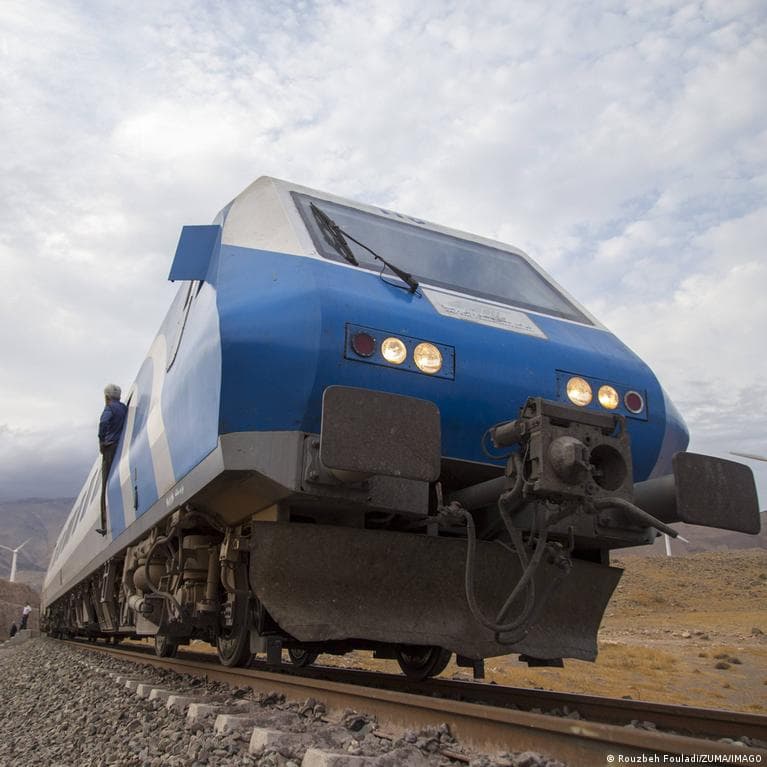
The United States has expanded economic pressure on Iran, for the first time deliberately targeting the railway sector. On October 1, the US Treasury added three Iranian railway companies, as well as seven automakers and five foreign suppliers of automotive components, to its sanctions lists — as part of the Economic Outcast operation. According to Washington, the railway and automotive industries provide the state with revenue and logistics capabilities and are linked to networks involving the Islamic Revolutionary Guard Corps (IRGC).
Why the Timing Is No Accident
The significance of the move is tied to changes in Iran's trade logistics. After the US maritime blockade sharply restricted southern trade routes, Tehran has been trying to move more cargo across land borders and via rail links with China, Central Asia, Russia, and Turkey. Thus, rail transport became more important precisely at the moment Washington decided to make it a sanctions target. The outlet notes that the new restrictions raise the question of how foreign railway operators, freight forwarders, banks, and insurers will continue working with Iranian railway companies.
The Scale of Iran's Railway Network
Shahriar Naghizadeh, director of foreign trade at Iran's railway authority, told the semi-official Mehr news agency that the country has about 15,000 km of main and secondary railway lines, more than 35,000 wagons, and nearly 500 diesel locomotives. According to him, the network carried about 44 million tons of freight in the Iranian year that ended in March 2026, compared with roughly 40 million tons the year before; the target for the current year is 54 million tons. Iran is connected to neighboring markets through 13 railway crossings, providing land access to Turkey, Azerbaijan, Afghanistan, Pakistan, and onward to Central Asia and China via Turkmenistan.
Growth of China–Iran Rail Links
Bloomberg reported in May that the frequency of freight trains from China's Xi'an to Tehran had risen from roughly one a week before the US maritime blockade to about one every three to four days. In September, a train carrying auto parts, consumer goods, and other cargo departed from China: it passed through Kazakhstan, Uzbekistan, and Turkmenistan and entered Iran at the Sarakhs crossing with a stated transit time of 14–16 days. For Iran, such routes provide access to Chinese suppliers bypassing the Strait of Hormuz area, where shipping has faced serious disruptions since the start of the US–Iran war this year.
Stated Versus Actual Delivery Times
Stated timelines do not always reflect reality. A Chinese freight company told DW that actual delivery times can significantly exceed advertised schedules due to border inspections, customs procedures, and the availability of trains. By its estimate, rail transit on the main route from western China to Tehran currently takes 50–60 days, whereas trucking a similar route takes 22–25 days. The gap between the stated 14 days and the commercial estimate of up to 60 days illustrates one of Iran's key problems. Potential bottlenecks cited include customs checks, gauge changes, payment difficulties, and sanctions; increasing the number of trains also requires more locomotives, wagons, and cooperation among several transit countries.
Expert Assessments: Rail Is No Substitute for the Sea
Alireza Salavati, managing director of the London-based Middle East Analytica, believes that railways are increasingly useful for Iran but should not be seen as a replacement for maritime trade. 'A working land route between China and Iran now exists, but I would not call it a replacement for sea freight,' he told DW. Under normal conditions, ships carry far larger volumes at lower unit cost; rail is more attractive for goods where speed and continuity of supply matter more — auto components, equipment, electronics, and industrial parts, the absence of which can halt a production line. Salavati also emphasized the impact on working capital: for a manufacturer importing $1 million worth of inputs every 30 days, extending the delivery time from 30 to 45 days means more money gets 'stuck' in transit, and a factory may be forced to cut production even with orders in hand. 'Reliability matters no less than speed,' he noted. 'A 15-day train is of little use if a container waits a week for departure, or if a bank or insurer refuses to touch it.'