The key facts
- Since 2009, the OTS has grown to 65 cooperation mechanisms; 32 of them created since 2023
- Combined GDP of OTS members and observers exceeded $2.4 trillion, trade turnover — about $1.27 trillion
- The 13th OTS Summit will be held in Ankara under the motto 'Turkic Century: Unity in Language, Thought and Deed'
Results at the end of the term
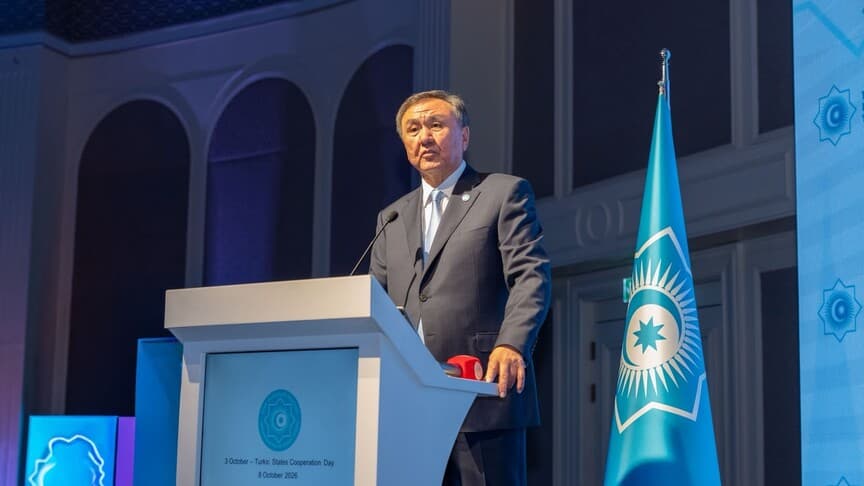
Secretary General of the Organization of Turkic States (OTS) Kubanychbek Omuraliev, in an op-ed published by the Anadolu agency, summed up the organization's development on the eve of the end of his term. In his view, the Turkic world is experiencing a moment when shared history ceases to be mere memory and becomes a force shaping the future. He noted that the Turkic world unites about 180 million people across a vast space between East and West, bound by historical, cultural and linguistic ties, as well as growing cooperation in trade, transport, investment, education and technology.
From dialogue to institutions
Omuraliev recalled that since its creation in 2009, the OTS has transformed from a platform of predominantly political dialogue into a comprehensive structure of practical cooperation. Today, 65 cooperation mechanisms operate under the organization's auspices — from economy, trade, transport and customs to energy, digitalization, healthcare, education, space and other fields. Since 2023 alone, 32 new mechanisms have been created — as many as in the entire period up to the end of 2022. The Secretary General emphasized that more important than the figures is the change in working style: political consultations have become more frequent and substantive, and ministries and specialized institutions interact more closely. He characterized the stage in three words: implementation, transformation and institutional deepening.
Institutional architecture and financial instruments
The OTS, as chair of the Coordination Committee of Turkic Cooperation Organizations, interacts with the Parliamentary Assembly of Turkic States (TURKPA), the International Organization of Turkic Culture (TURKSOY), the Turkic Academy, the Foundation of Turkic Culture and Heritage, the Turkic Investment Fund (TIF) and the Union of Chambers of Commerce and Industry (TCCI). Omuraliev called the creation of the Turkic Investment Fund an important milestone: for the first time, Turkic states established a joint financial institution to mobilize economic potential and support investment, entrepreneurship and small and medium-sized businesses. It is complemented by the Council of Central Banks, the Council of Green Finance and the investment network TurkIPAnet. According to the author of the op-ed, particularly encouraging is the emergence of cooperation networks outside state structures — among notaries, auditors, engineers, trade unions, as well as within the OTS Union of International Road Transport Associations, the Union of Turkic Ski Resorts and the Turkic Red Network.
Economic and energy potential
According to data cited for late 2025, the combined GDP of OTS member and observer states exceeded $2.4 trillion, and combined trade turnover amounted to about $1.27 trillion. If the Turkic states were considered as a single entity, they would represent the world's 11th-largest economy and the third-largest energy supplier. The countries possess significant reserves of oil, gas, coal and critical minerals, including more than 40% of global uranium production, and are increasing investments in renewable energy. Key infrastructure projects named include the Southern Gas Corridor, the Green Energy Corridor Central Asia — Azerbaijan, the Kambarata-1 hydroelectric power plant and the Black Sea submarine cable. The strategic benchmark is the 'Vision of the Turkic World — 2040'.
Transport corridors and digitalization
The Trans-Caspian International Transport Route 'East — West' (Middle Corridor) is becoming an increasingly significant link between Asia and Europe: freight volumes could potentially reach 11 million tons by 2030. The China — Kyrgyzstan — Uzbekistan railway, with a design capacity of up to 15 million tons per year, will further strengthen regional connectivity. The OTS complements physical infrastructure with customs and digital solutions — a simplified customs corridor, e-Permit, e-CMR and digital TIR — and is also working on an agreement on partnership in the digital economy and an agreement on free trade in services and investment. Recently, according to the author, cooperation has been established between antitrust authorities, financial intelligence units, investment promotion agencies, supreme audit institutions and tax administrations.
Outward openness and the upcoming summit
In the humanitarian sphere, Omuraliev mentioned the Union of Turkic Universities (TURKUNIB), the 'Orkhon' academic exchange program, youth initiatives, as well as the discussed projects of a 'Turkic Identity Card' and a unified museum card. At the international level, the OTS is expanding interaction with the UN system and developing the OTS+ format for partnership with countries outside the organization. The author emphasized: the goal is not to build walls around the Turkic world, but to build bridges with the surrounding world. The op-ed concludes with an announcement of the 13th OTS Summit in Ankara under the motto 'Turkic Century: Unity in Language, Thought and Deed', which will mark the beginning of Türkiye's chairmanship. In Omuraliev's view, the success of cooperation should be measured not by signed agreements but by real benefits for the peoples. The Anadolu editorial board notes that the opinions expressed belong to the author and do not necessarily reflect the agency's editorial policy.