The key facts
- Eka Robotics raised $150 million Series A at a $1.45 billion valuation (a16z, F-Prime)
- Vision-force-action model with a force-sensitive gripper: up to 1,500 objects per hour versus ~600 for a human, accuracy >95%
- The company is running closed pilots with industrial customers; experts also note limitations
Major round at a $1.45 billion valuation
Startup Eka Robotics closed a Series A round of $150 million at a post-money valuation of $1.45 billion. The round was led by venture funds a16z and F-Prime. The company was founded by MIT professor Pulkit Agrawal and former Google DeepMind researcher Tuomas Haarnoja, who met back in graduate school at the University of California, Berkeley. Both are considered leading specialists in reinforcement learning for robot control.
Results that impressed experts
Eka's demonstrations impressed experienced roboticists. Professor Kris Hauser of the University of Illinois Urbana-Champaign noted the 'wow effect' and the robot's ability to adapt to many different objects without retraining, as well as an 'eerie humanness' in the form of retrying after failures. A roboticist from a frontier lab, who asked to remain anonymous, compared what he saw, in emotional impact, to the moment when robots first learned to walk reliably five to ten years ago. In his words, the speed of the arm's movement speaks to the developers' great confidence in the algorithm.
Manipulation performance
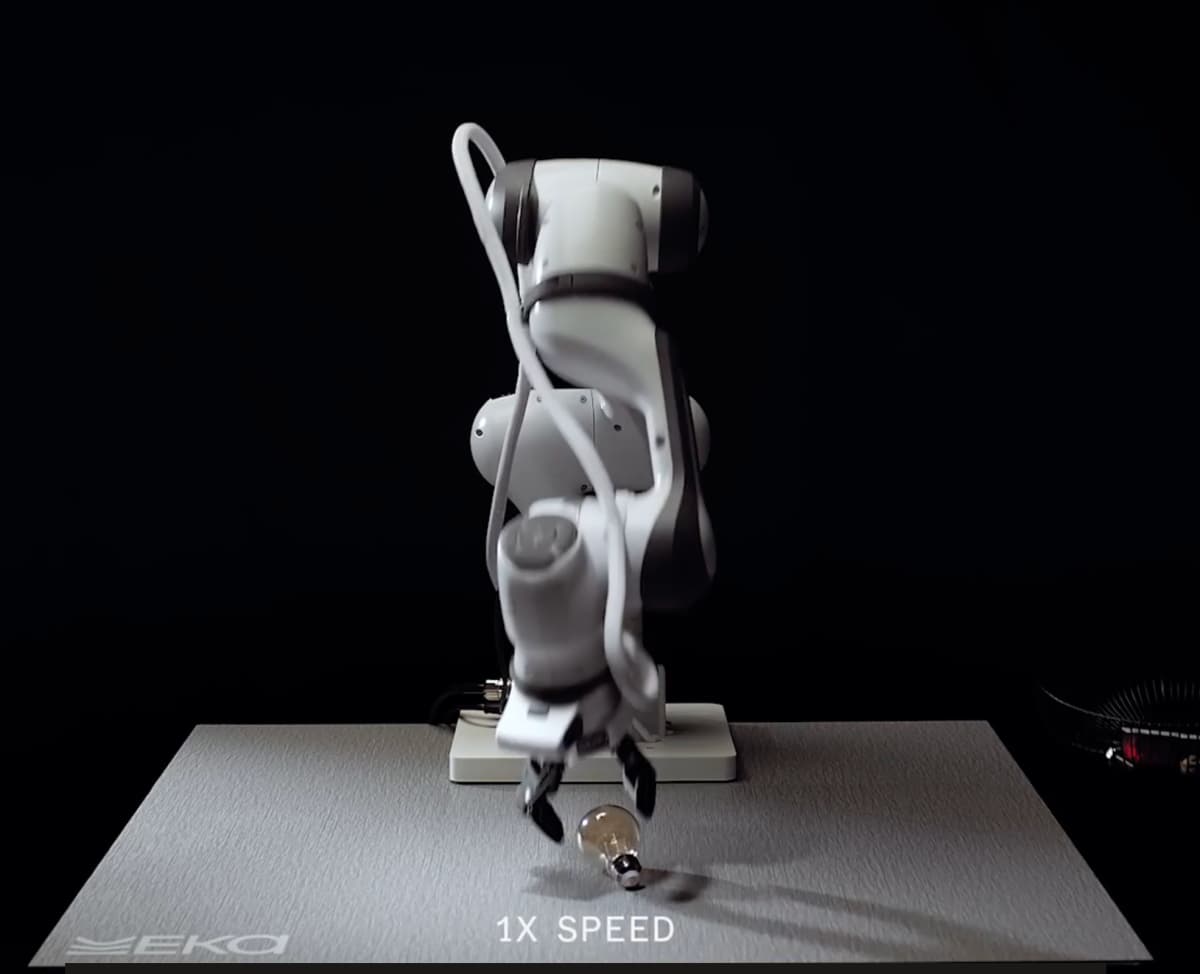
According to Eka, the robot picks up about 1,500 objects weighing up to 1 kg per hour — versus roughly 600 for a human — and does so reliably in more than 95% of cases. In one demonstration, the robot gently picked up a raspberry without crushing it: the arm decelerates sharply just before contact.
The vision-force-action approach
Instead of the widespread vision-language-action architecture, Eka uses a vision-force-action model that links language, force data, and actions. Agrawal explains that vision only approximately determines an object's position, while the actual grasping happens through forces. To this end, the company developed its own flexible gripper with a large number of force sensors costing less than $1,000. The key bet is scaling reinforcement learning through a physics simulator: according to the founders, they can generate thousands of hours of 'robot experience' in minutes, without relying on operator demonstrations. Hauser notes that this allows the robot to surpass any demonstrations used in training.
Market position and open questions
Eka positions its approach as a solution to 'the gap between generality and performance': general-purpose models handle tasks slowly and expensively, while narrowly specialized ones do not pay off. The idea is that Eka's model handles physical interaction, while a more general model handles planning. Haarnoja says most of the industry is going 'top-down,' from high-level intelligence, whereas Eka is going 'bottom-up.' The company is running closed pilots with industrial customers in pick-and-place and wire handling. Hauser points to the main risks: a year of failure-free operation on real assembly lines and generalization to tasks more complex than pick-and-place. Agrawal says the gripper is rated for 5 million cycles, with the goal of reaching the industry standard of 20 million cycles.