The key facts
- The Development Road project is estimated at $55 billion contribution to Turkey's economy over 10 years and 70,000 jobs annually
- The route will link the Grand Fao port in Iraq with Europe through Turkey, cutting the journey to 25 days versus 45 around the Cape of Good Hope
- Turkey and Iraq agreements were signed on July 28; parliamentary ratification is planned before construction begins
Minister's Estimates and the Corridor's Route
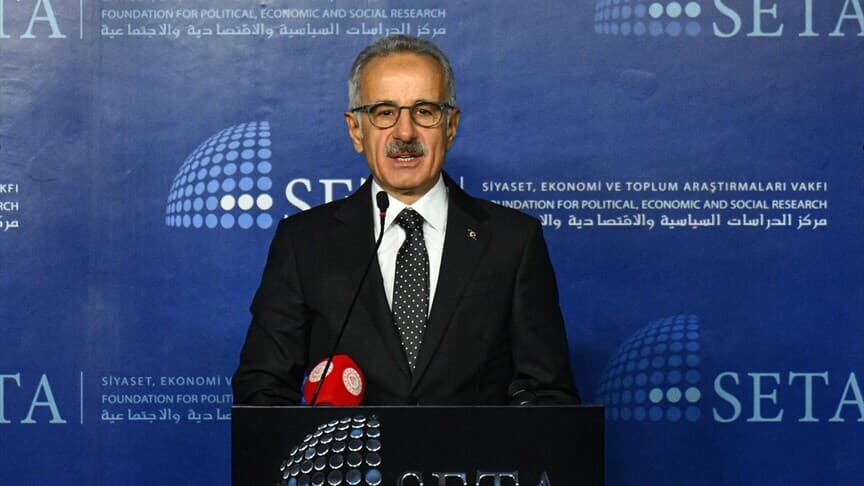
The Development Road project is expected to bring about $55 billion to Turkey's economy over 10 years and provide an average of 70,000 jobs per year, Minister of Transport and Infrastructure Abdulkadir Uraloglu said on Monday at a conference in Ankara. According to him, the corridor will strengthen Turkey's position in global trade and support Iraq's economic reconstruction. The planned route will connect the Iraqi port of Grand Fao in the Persian Gulf with Europe through Turkey, combining railways and highways with power transmission lines, fiber-optic infrastructure and oil and gas pipelines.
An Alternative to Vulnerable Routes
Uraloglu noted that tensions around the Strait of Hormuz and Russia's war with Ukraine have exposed vulnerabilities in global transport networks, prompting countries to seek safer, shorter and more predictable routes. In his view, the project will reduce dependence on the Strait of Hormuz, especially for cargo from Gulf countries to Europe. Travel time will be reduced to approximately 25 days versus 45 days via the route around the Cape of Good Hope and 35 days via the Southern Corridor.
A Complement to the Middle Corridor
The minister emphasized that Turkey views the Development Road as a complement to existing trade networks, including the Middle Corridor, which links China and Central Asia with Europe through the Caspian Sea and Turkey. 'There is no corridor without Turkey,' he stated. Turkey's railway lines connected to the Middle Corridor — existing, under construction and planned — total 2,156 km, while completed and planned investments are estimated at $47.1 billion.
Agreements with Iraq and Saudi Arabia
According to Uraloglu, the project will help Iraq diversify an economy dependent on oil revenues, earn income from transit trade and strengthen its role as a regional trade hub. He recalled the agreements signed by Turkey and Iraq on July 28 of this year: a memorandum on railway and road transport through the Fishkhabur—Ovakoy border crossing and a framework agreement on developing Iraq's transport infrastructure in exchange for natural resources. Before construction begins, the countries plan to obtain parliamentary approval. The minister also mentioned a recent memorandum on railway cooperation with Saudi Arabia: the revival of the historic Hejaz Railway should create additional routes from the Gulf through Turkey to Europe. According to him, the project can 'reintegrate the fragmented geoeconomic structure of the Middle East' and turn Iraq into one of the crossroads of regional trade.