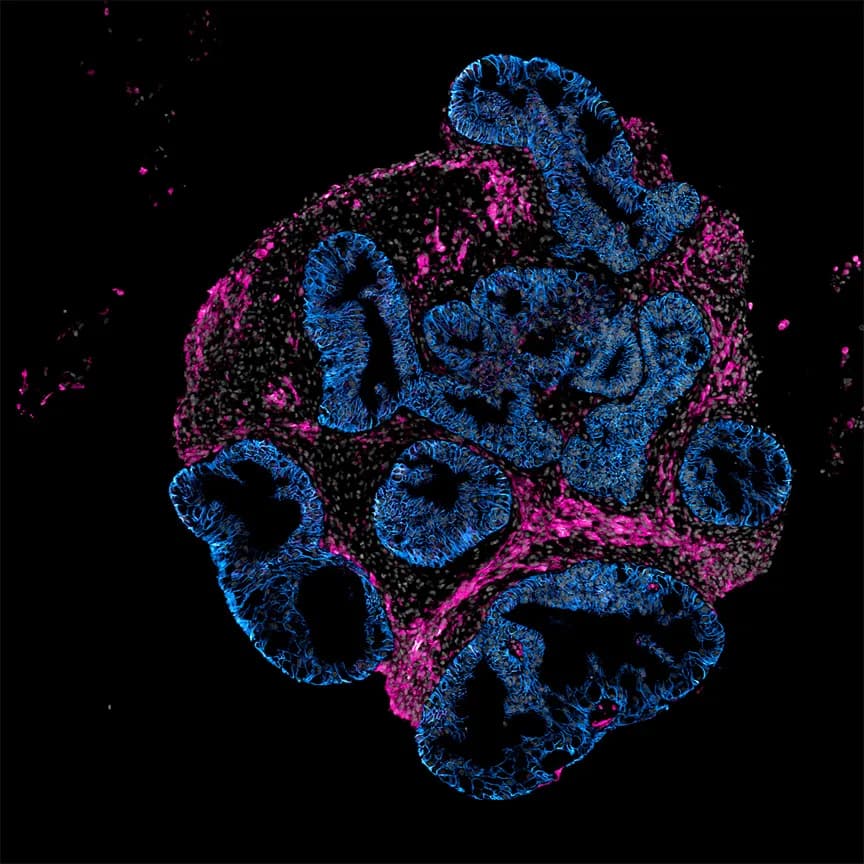
The key facts
- GastroScreen — gut organoids made from induced pluripotent stem cells, containing multiple cell types and tissues of the intestine
- Founded in 2024, 7 employees, nearly 10 customers, $2.3 million pre-seed, revenue of more than $400 thousand from Q4 of last year through Q3 of this year
- In April of last year the FDA announced reducing reliance on animal testing, and in March of this year it issued draft guidance on validating NAMs
Denver startup grows mini-guts for drug testing
Drug development has long relied on animal models, but interspecies differences mean that what works in animals does not always translate to humans, and most drugs still fail. Intero Biosystems, a Denver startup spun out of the University of Michigan, is developing human gut organoids — lab-grown tissue that mimics the intestine — as another way to study the effects of drugs and other compounds on the body before human trials. According to co-founder and CTO Madeline Aiken, the company's organoids differ from simpler models in that they contain multiple cell types and tissues of the human intestine. "Most drugs fail in clinical trials, and it's pretty easy to understand that we are not mice and not flat layers of cells," Aiken said.
The GastroScreen product and business model
Intero's flagship product, GastroScreen, is a human gut organoid model that the company sells to pharmaceutical, biotech, food and chemical companies. Each organoid is about 1 mm in size, and the company ships roughly 100 per tube, said co-founder and CEO Charlie Childs: "We literally mail mini living organs." Customers can use the organoids as healthy gut models or induce disease states. In addition to the organoids themselves, Intero sells consumables — nutrient mixes and chemicals — and also conducts research for clients: designing experiments, performing lab tests and delivering data. The core work involves drug safety and disease study.
Metrics and regulatory context
Founded in 2024, the startup has seven employees and nearly 10 customers after raising a $2.3 million pre-seed round last year. Revenue from the fourth quarter of last year through the third quarter of this year exceeded $400 thousand. Interest in alternatives to animal testing is also being fueled by regulatory changes: in April of last year, the FDA outlined plans to reduce reliance on animal testing, naming organoids, organs-on-chips and AI-based computational models as possible alternatives. In March of this year, the FDA issued draft guidance on how drug developers should validate new approach methodologies (NAMs) when using them for regulatory submissions; the guidance sets a validation framework but does not approve specific methods. Aiken noted that changes in U.S. legislation allowing non-animal methods in some cases have made pharmaceutical companies more receptive to organoids: previously cautious companies now want to adopt the technology in-house.
Competitors and differences
Intero is not alone: Altis Biosystems is developing gut models from stem cells, InSphero offers patient-derived organoids for testing gastrointestinal toxicity, and MIMETAS uses organs-on-chips technology. Intero claims it stands out through the sophistication and scalability of its model: unlike models grown from tissues obtained after procedures such as colonoscopies, GastroScreen is derived from induced pluripotent stem cells — adult cells reprogrammed into nearly any cell type, which can be obtained from a blood sample. This, according to Aiken, offers the potential to personalize models to patients and to scale production more easily.
Validation and plans
When asked about evidence that GastroScreen predicts human responses more accurately than existing models, Childs replied that the company is still collecting this data and is at the second stage of a three-stage validation process. First, the presence of key gut tissues was demonstrated; now known drugs with documented effects are being tested: GastroScreen showed the expected responses to drugs that reduce gut inflammation and to compounds that damage the gut. In the final stage, results will be directly compared with pharmaceutical companies' animal and clinical data; such studies are already underway with several companies. Intero does not use AI to create organoids, but sees an opportunity to generate biological data for AI models and plans to license such datasets. In the near term, the company is scaling production: it can currently make several thousand organoids at a time and is automating production with the goal of producing hundreds of thousands per batch. In the long term — personalized medicine, and the most ambitious goal is an artificial intestine. Intero presented at TechCrunch Disrupt in San Francisco among 20 startups competing for the Startup Battlefield title.


