The key facts
- Karipbek Kuyukov was born without arms in the village of Egindybulak, about 100 km from the Semipalatinsk test site, where the USSR conducted 456 nuclear tests in 1949–1989
- In 2026, the 35th anniversary of the closure of the test site was marked; Kuyukov spoke at a high-level meeting of the UN General Assembly
- The artist published his first autobiographical book, which he began working on 35 years ago
The artist who paints with his mouth at the foot of Balkantau
Behind a door marked 'Art Studio' in his apartment, the Kazakhstani artist Karipbek Kuyukov is working on an autumn landscape: holding a brush in his mouth, he leans toward the canvas, rolls back in his chair to view the work from a distance, and moves closer again. The painting shows a road strewn with fallen leaves, leading toward the Balkantau mountains near the village of Egindybulak, about 100 kilometers from the former Semipalatinsk nuclear test site. 'I love nature very much. Where a person appears, everything is already… he spoils it all,' the artist says. It was in Egindybulak that he was born without arms.
Childhood near the nuclear test site
From 1949 to 1989, the Soviet Union conducted 456 nuclear tests at the Semipalatinsk test site. Kuyukov remembers how the ground trembled after the explosions and shock waves spread like ripples on water; according to him, in the surrounding villages many children were also born with congenital developmental disorders. 'When I was born, I was shown to my mother, and she saw that I had no arms. It was very hard for her,' he recalls. From childhood he learned to manage without arms, using his legs, and one day, having found a large box of colored pencils, he began to draw, holding the pencils with his toes.
Art as a form of activism
In 1989, the poet and public figure Olzhas Suleimenov founded the anti-nuclear movement 'Nevada — Semipalatinsk,' which Kuyukov later joined. Painting became his main way of expressing his position. His first anti-nuclear painting, 'The First Explosion,' depicted a family in a yurt caught in a nuclear blast: 'The blast wave sweeps the yurt away, everything turns over. I wanted to show what the people who lived there went through,' the artist explains. Later came works such as 'Nuclear Mushroom,' 'Atomic Childhood,' 'Radiation,' 'Fear,' and others.
35 years after the closure of the test site and a speech at the UN
On August 29, 2026, the 35th anniversary of the closure of the Semipalatinsk test site was marked. For this date, Kuyukov was invited to speak at a high-level meeting of the UN General Assembly devoted to the consequences of nuclear tests for people. 'I didn't want to speak, I wanted to shout, because the time has come to shout about it to the whole world,' he said. 'I addressed the heads of state from whom nuclear threats emanate.' It was not his first speech at the UN: for many years he has drawn attention to the problem of nuclear weapons through paintings and public speeches. According to the artist, against the backdrop of nuclear threats once again sounding in international rhetoric, his decades-long campaign remains relevant.
An autobiography, a sister, and the portrait of his mother never created
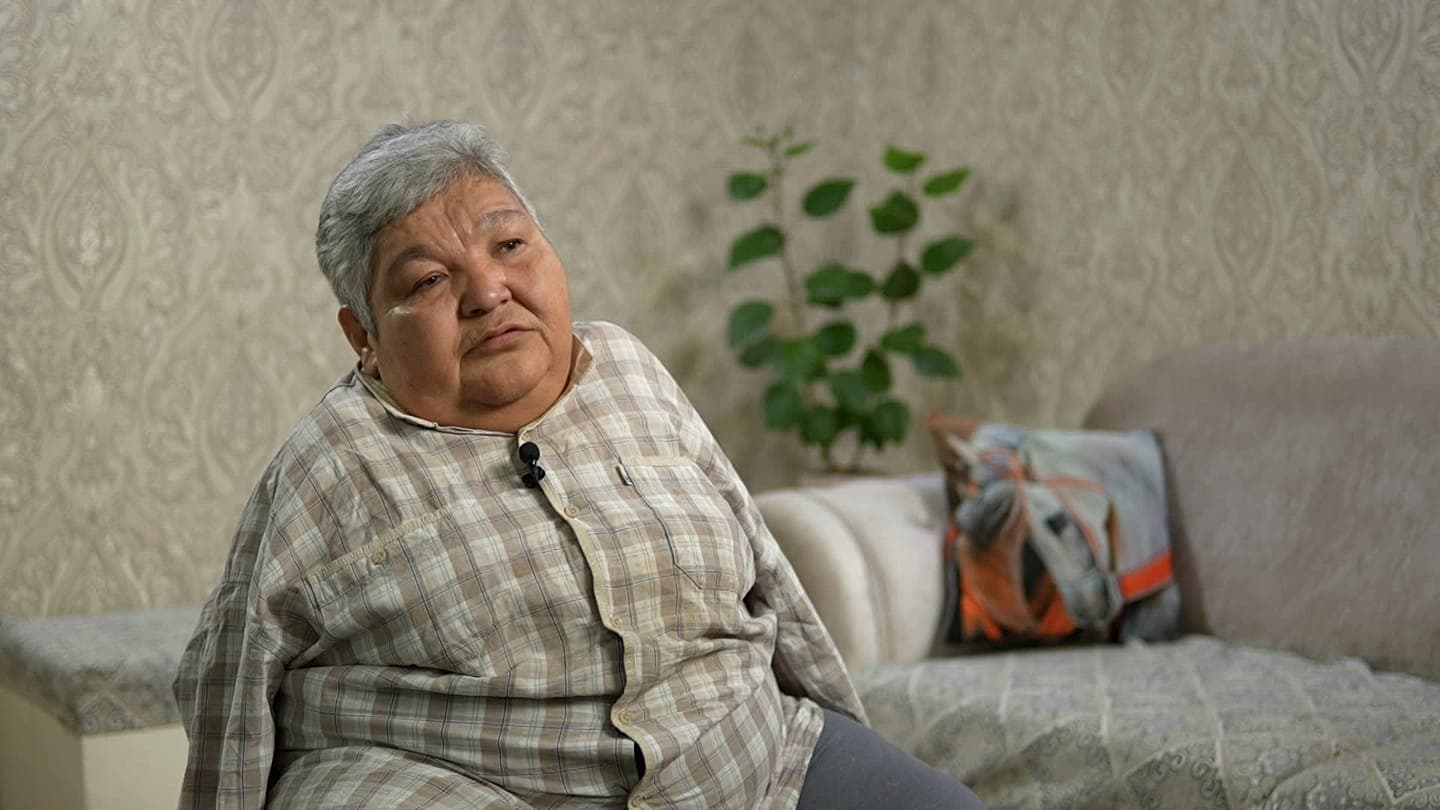
Recently, Kuyukov published his first autobiographical book — he began working on it 35 years ago and only now completed it. With the financial support of people who believed in the project, he recorded his memories in voice messages, on the basis of which editors prepared the manuscript. Speaking about his life, the artist cannot hold back tears; his sister Saule gently wipes them away — he calls her his 'guardian angel' and dedicates an acknowledgment to her in the book. She is often nearby, although she prefers not to give interviews. With age, Kuyukov lost the ability to draw and write with his feet — he now holds the brush and pen in his mouth, as he did at the book presentation, where he patiently signs copies for those who ask. In recent years, he increasingly paints landscapes — mountains and corners of nature untouched by human activity — but, according to him, his commitment to a world without nuclear weapons remains unchanged. There is only one portrait he has never dared to paint — the portrait of his mother: he admits he is afraid to take on this work, but hopes that one day he will find the courage.