The key facts
- The FY2027 defense bill provides nearly $1.1 trillion, including tens of billions from the Pentagon's $350 billion request
- The State Department and foreign operations are proposed $50.11 billion in base funding: Israel — $3.3 billion, Taiwan — $300 million, Ukraine — $129 million
- The bill bans funding for UNRWA, the International Court of Justice and the International Criminal Court
Nearly $1.1 Trillion for Defense
US Senate Republicans on Monday introduced a fiscal year 2027 defense appropriations bill totaling nearly $1.1 trillion. The document provides for major investments in US military capability, weapons production, shipbuilding and advanced defense technologies. It includes tens of billions of dollars for programs originally contained in the Pentagon's $350 billion reconciliation funding request.
The Bill Authors' Position
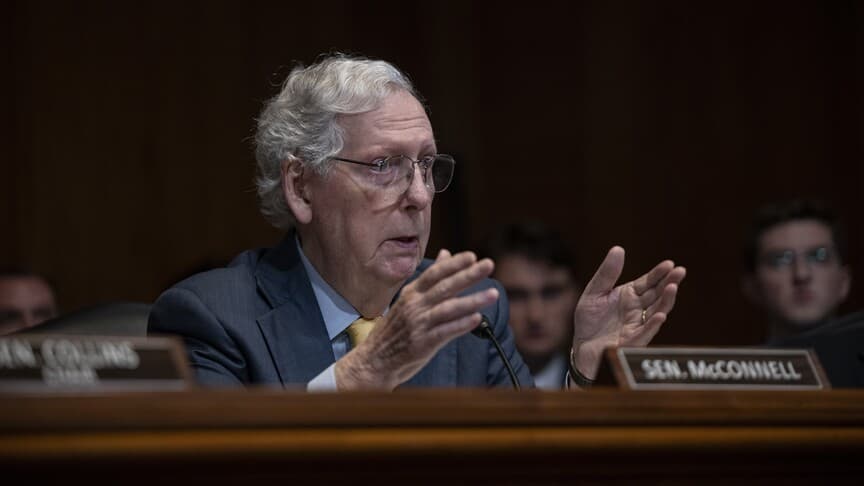
Senator Mitch McConnell, who chairs the Senate Appropriations Defense Subcommittee, described the document as a long-term investment strategy aimed at preserving US military superiority. “This bill is a roadmap for the sustained and responsible delivery of generational investments in national defense,” he said. The Senate Appropriations Committee simultaneously released the texts of five more fiscal year 2027 spending bills — covering defense, foreign operations, financial services, labor and education, as well as transportation and housing.
Foreign Policy Appropriations
Alongside the defense document, Republicans introduced a State Department and foreign operations bill with base discretionary funding of $50.11 billion. It includes significant security assistance to US allies and partners, primarily in the Middle East and the Indo-Pacific region: Israel is to receive $3.3 billion under the Foreign Military Financing program, Taiwan — $300 million, and the Philippines — $100 million. $1.8 billion is allocated for implementing the US Strategy in the Indo-Pacific region, and $400 million for the Countering PRC Influence Fund.
Ukraine, Iran, Russia and Humanitarian Programs
For Ukraine, the bill provides $129 million in security assistance and another $30 million for efforts to return abducted Ukrainian children. Also allocated are $45 million for a new Countering Iranian Influence Fund, $55 million for promoting democracy and reform in Iran, and $300 million for the Countering Russian Influence Fund. $5 billion goes to international humanitarian assistance, disaster response and refugee support; the bill also provides $667 million for educational and cultural exchange programs, $431 million for the Peace Corps and $1 billion for the US International Development Finance Corporation. $10.7 billion is proposed for State Department operations, and $6.5 billion in total for strengthening embassy security and protecting American diplomats; funds will also go toward counter-drone capabilities at diplomatic facilities, embassy construction and maintenance, and security measures related to the Epic Fury operation.
Funding Bans
The bill prohibits allocating funds to the UN agency for Palestinian refugees (UNRWA), the International Court of Justice and the International Criminal Court. The documents were introduced as bills, meaning their adoption will require further passage through Congress; no subsequent steps are mentioned in the released materials.