The key facts
- A signal at frequencies of 42–50 MHz was detected by the LOFAR telescope from the star GJ 725A, 11.5 light-years from Earth
- This is the lowest-frequency reliably confirmed coherent radio signal from a star system
- Scientists are considering three versions: auroras from a large planet, the star's own activity, or interaction with the known planet GJ 725Ab
An unusual signal from a nearby star
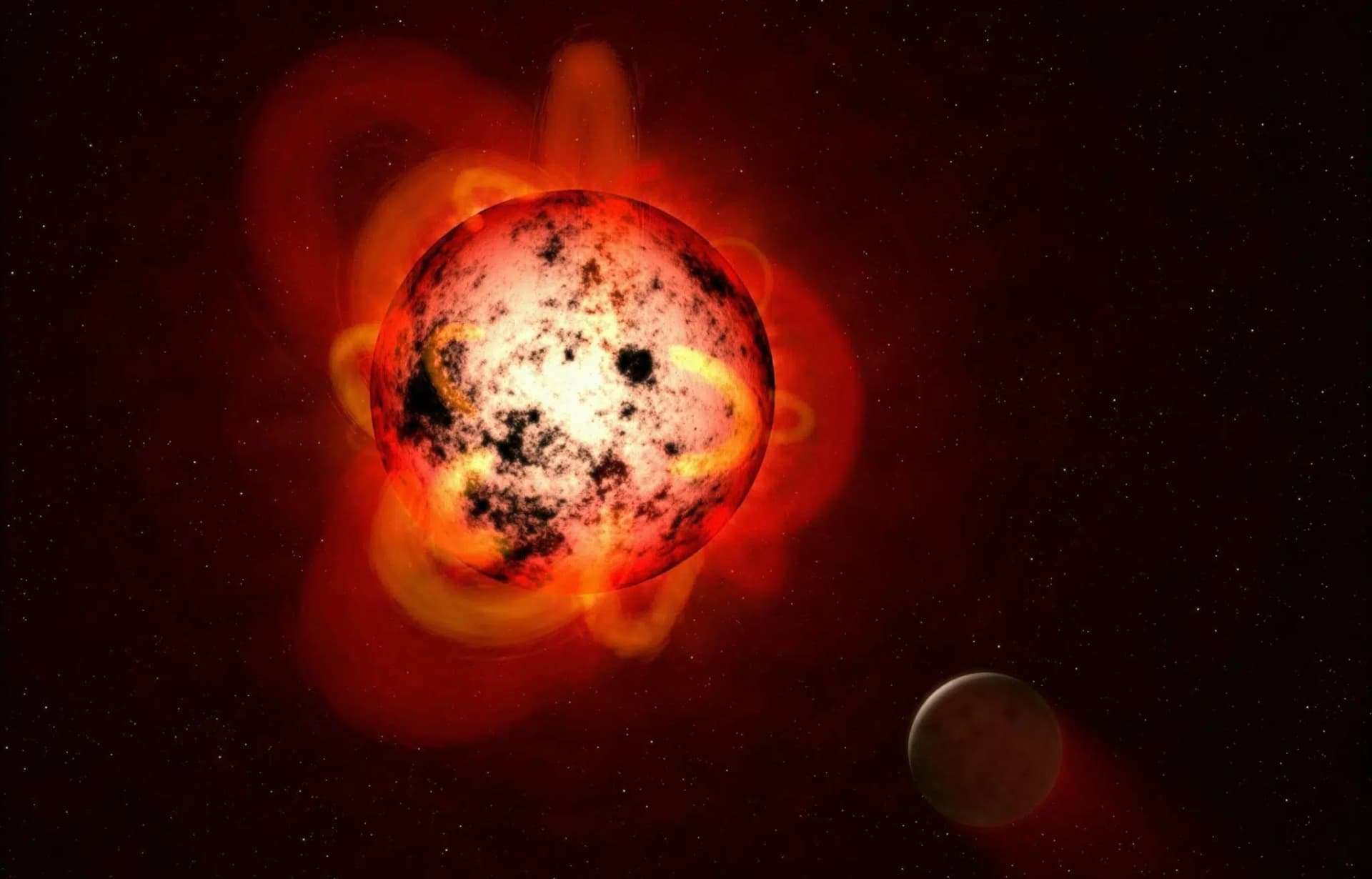
An international team of astronomers, including specialists from the Netherlands Institute for Radio Astronomy and the University of Amsterdam, has detected a mysterious radio signal at a frequency of about 45 MHz from the red dwarf system GJ 725A, located roughly 11.5 light-years from Earth. The discovery is reported by Kun.uz citing a preprint by the researchers posted on arXiv.org. The signal was detected by the LOFAR radio telescope during a wide sky survey.
What exactly was detected
The radio waves lay in the 42–50 MHz range and showed strong circular polarization — about 74%. The signal persisted throughout an hour-long observation, but was not detected in other observation periods. According to the study, precise astrometric analysis confirmed that the source of the emission is associated specifically with the star GJ 725A, not with its companion star. Because of the signal's extremely high brightness, the scientists immediately ruled out ordinary emission mechanisms and concluded that a special physical process is at work here — the kind that produces auroras on the giant planets of the Solar System. This is the lowest-frequency reliably detected and confirmed coherent radio emission signal ever received from a star system.
Three hypotheses of origin
Astronomers currently have three main versions of the signal's source. The first: it is an aurora from a large undiscovered planet orbiting the star on a wide orbit. However, according to the authors' calculations, the strong magnetic field of such a planet alone is not enough — if it is far from the star, the stellar wind will not provide the necessary radio emission power. Therefore, the researchers suggested that the hypothetical planet may have a volcanically active moon, similar to Io, Jupiter's moon.
Alternatives: stellar activity and a known planet
The second version is that the flare was caused by the internal activity of the star itself, although its activity is assessed as very low: GJ 725A rotates on its axis roughly once every 103 days. The third hypothesis links the signal to constant magnetic interaction between the star and the already known small rocky planet GJ 725Ab, which completes an orbit in just 11 days. This version, however, is difficult to explain: the planet's mass is 2.8 ± 0.4 Earth masses, and according to widely accepted models this is not enough for a magnetic field capable of producing such a powerful radio signal. The publication does not yet say which of the hypotheses is correct.