The key facts
- Jensen Huang stepped down from the posts of president, CEO and board member of Nvidia with immediate effect
- Finance chief Colette Kress will lead the company on an interim basis, and Harvey Jones became the first chairman of the board
- Nvidia shares are falling: from 10% to 13% at the opening according to various outlets, with the loss of market capitalization estimated at more than $300 billion over the week
The resignation and the interim leader
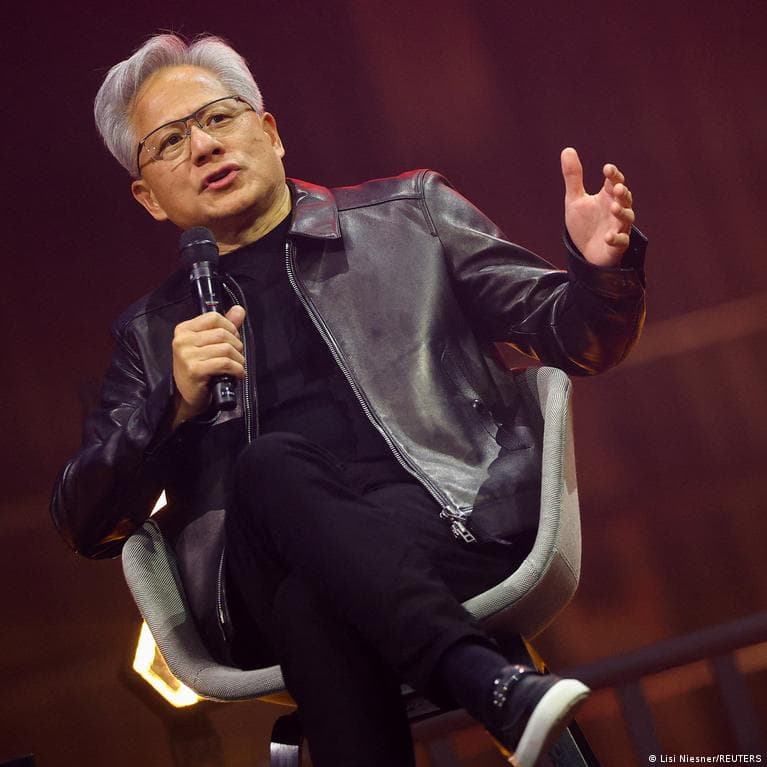
Nvidia's board of directors announced on Thursday that Jensen Huang had stepped down from the posts of president, chief executive officer and board member with immediate effect. The company did not state the reason for the resignation. As Euronews reported, Huang founded Nvidia in 1993 and led it for 33 years. The company's finance chief, Colette Kress, has been appointed interim head and will retain her existing duties; the board will search for a permanent successor among both internal and external candidates. Harvey Jones — the former head of Synopsys, who has sat on Nvidia's board since 1993 — became the first chairman of the board in the company's history. According to TechCrunch, in its filing with the US Securities and Exchange Commission (SEC) the company stated that the board accepted the resignation on Wednesday.
What is known about the reasons
The resignation followed a series of publications about Huang's personal life. On Sunday he admitted to employees in a letter that he had been unfaithful to his wife and promised to fully cooperate with the board's investigation. The matter concerned a relationship with Alice Huang (Huang Le), a top executive at the Singapore-based company Megaspeed, which operates data centers in Southeast Asia and has become Nvidia's largest customer in the region. According to media reports, the US intelligence community circulated a memorandum in the spring in which Alice Huang was described as a possible officer of China's Ministry of State Security, allegedly involved in smuggling AI chips into China. Beijing rejected these claims: in October, a spokesperson for China's Foreign Ministry called the publication 'baseless speculation' and an attempt to smear China. On Wednesday, The New York Times reported a second affair — with Nvidia's vice president for healthcare, Kimberly Powell — citing video recordings from a conference in San Jose. Nvidia's code of conduct requires employees to avoid conflicts of interest, citing 'personal relationships' as an example. Shareholders have filed a class-action lawsuit against Huang and the company, arguing that investors were not informed of these relationships.
The investigation and the market reaction
According to Anadolu, the board of directors announced an independent investigation on November 8, and on Tuesday the independent directors hired former acting US attorney Jun H. Kim and the law firm Wachtell, Lipton, Rosen & Katz. As recently as November 8, the directors had expressed confidence in Huang and said they had 'no reason to believe' that US national security or the company's secrets had been compromised. At the same time, the company thanked Huang for his contribution, calling Nvidia 'one of the most significant technology companies in the world.' The market reacted sharply: at the opening of trading the shares fell 13% (Euronews), more than 11% in pre-market trading (TechCrunch), and according to Nasdaq trading data, by 16:55 Moscow time the shares were down 10.21% — to $156 from the previous session's close of $173.73. TechCrunch estimates the loss of market capitalization since Friday at more than $300 billion; Kun.uz puts it at roughly $600 billion over the week. The discrepancy between the outlets' estimates persists. Nvidia confirmed that it will publish its quarterly report on schedule — on November 17.