The key facts
- Mirshohid Aslanov, director of the Center for Progressive Reforms, stated that the shaping of the information agenda is shifting from people to algorithms
- Deputy Minister of Digital Technologies Oleg Pekos noted that it is becoming increasingly difficult to recognize AI-generated images
- Deputy Ilkhom Abdullaev proposed enshrining requirements for the digital transparency of government information systems in law
What Was Discussed at the Forum
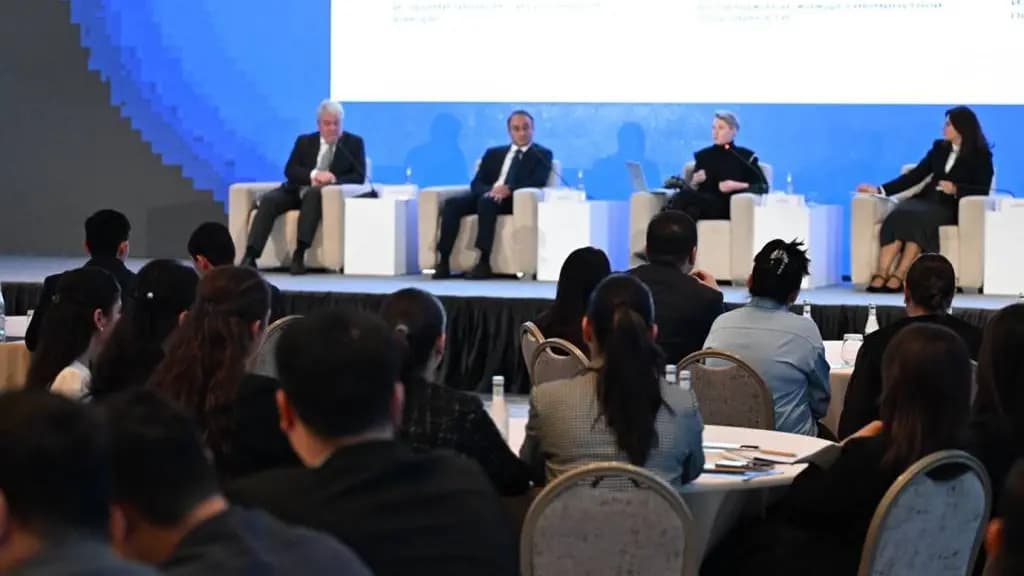
The III Uzbek-Russian Media Forum was held in Tashkent, organized by the UzA and TASS news agencies. As part of the session “The Future of Media in the Digital Age,” participants discussed new technologies for producing and distributing content, the role of artificial intelligence, and formats of cooperation between media organizations of the two countries. The discussion touched on several levels of the problem at once: from how audiences perceive information to legislative regulation of the digital environment.
Algorithms, Not People, Are Shaping the Agenda
Mirshohid Aslanov, director of the Center for Progressive Reforms of Uzbekistan, believes that one of the main shifts of the digital age is the transfer of information agenda-setting from people to algorithms. Users increasingly trust platform recommendations and receive content that matches their views, which can create the impression that those around them think the same way. “Media in the digital age is a direct dialogue between the state and citizens, a driver of reforms, an instrument of public oversight. But digitalization must not mean the loss of informational subjectivity,” he noted. Among three key tasks, he named protecting the information space from manipulation, preserving national identity, and developing AI in national languages; according to him, in Uzbekistan, on the president’s instruction, a national language model and a corpus of the Uzbek language are being created.
Fakes Are Becoming Harder to Detect
Oleg Pekos, First Deputy Minister of Digital Technologies, compared the work of a media professional to the work of a test pilot: there is less and less time for fact-checking, while creating and spreading false information is becoming easier with the development of AI. “If yesterday we could identify photographs created by artificial intelligence by six fingers on a person’s hand, now it is becoming harder and harder to recognize such images,” he said. Pekos proposed two areas of cooperation between the two countries: creating trusted media with shared approaches to verifying information and jointly developing AI tools for newsrooms; he also noted the importance of educational projects and anti-phishing platforms.
An Editor Is Still Necessary
Aleksandra Kosharnitskaya, editor-in-chief of NTV, emphasized that the introduction of AI does not allow newsrooms to shift their tasks onto it: programs help identify possible fakes faster and determine whether material was created with AI, but verifying the accuracy of specific information must remain the editor’s job. She also drew attention to the growing workload on staff: AI speeds up task completion, but it is difficult for humans to maintain the same pace, which can lead to emotional burnout. Alexander Krainov, Director for AI Development at Yandex, added that artificial intelligence has no opinion of its own — it is a “mathematical formula” that produces results based on context and the texts it finds, and in content creation AI remains a tool in the hands of the author. In his view, technology is changing so fast that legislative regulation may not keep up with it.
Legislation and Media Revenue
Ilkhom Abdullaev, chairman of the Legislative Chamber’s Committee on Innovative Development and IT, noted that the information environment has changed noticeably in recent years, whereas the core provisions of media legislation have not been updated as substantially. He proposed enshrining in law requirements for the digital transparency of government information systems: recording the actions of officials and documenting the state of systems so that responsibility can be established for violations of citizens’ rights when working with digital services. He also raised the topic of the financial sustainability of the media: he named digital content and advertising as the most promising revenue streams, where the rules are largely set by major platforms, and stated the need for legislative mechanisms that would allow the local market to earn revenue on fair terms.