The key facts
- VEON bought Perfectum for $207 million, of which $93 million is the operator's debt
- Beeline receives 115 MHz of frequencies and a 5G Standalone network; its frequency portfolio will grow by roughly 50%
- Approval conditions: at least 3 years of independent operation for Perfectum, tariffs preserved for 12 months, and speed of no less than 300 Mbit/s
The deal and its terms
VEON Group, which owns the Beeline operator, has acquired the Uzbek operator Perfectum for $207 million. The amount includes $93 million of Perfectum's debt; VEON plans to pay the cash portion of the deal from its own funds. This was reported by Spot.uz. Along with the asset, Beeline receives 115 MHz of frequencies and a ready-made 5G Standalone network — according to VEON's estimate, this will increase its frequency portfolio by roughly 50%.
The road to the sale
The privatization of Perfectum was first discussed back in 2020. In August 2024, the operator's co-owner Farkhod Mamatjanov stated that he had privatized the company and planned, together with Uzcard, to create a telecom company with the British Vodafone, with investments of 250 million euros and a launch in 2025. The plans then changed: in August 2026, Mamatjanov said he was in talks with VEON and had agreed on attracting $200 million, and asked President Shavkat Mirziyoyev to help with approval of the deal — the president promised to take the matter under his personal control.
The Competition Committee's conditions
In October, the Competition Committee approved VEON's purchase of 100% of Perfectum's shares , but with conditions: Perfectum must operate as an independent operator for at least three years, subscribers will keep their current tariffs for 12 months, and the average speed must not fall below 300 Mbit/s. In addition, VEON is obliged to expand the 5G Standalone network in other regions, protect subscribers' rights and their data, and not force users to switch to Beeline's and VEON's digital platforms.
What the experts say
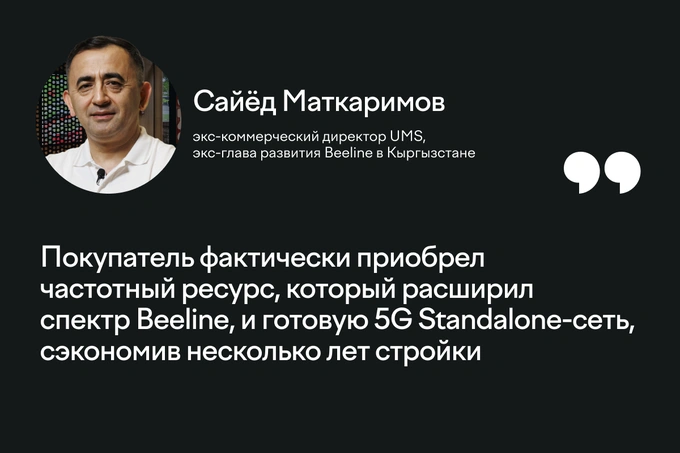
Spot.uz discussed the deal with telecom experts Shavkat Berdiyev, who headed Beeline's marketing in Uzbekistan from 2005 to 2010, and Sayyod Matkarimov, former commercial director of UMS. Both consider the purchase beneficial. Berdiyev calls Perfectum's radio frequency spectrum its main value — a 'limited resource of all countries' that determines how much data a network can transmit. Matkarimov views the deal as an infrastructure purchase: Beeline will not have to build a 5G network from scratch, and part of the load will shift from 4G to 5G. 'The investment will pay off through optimization of capital expenditures and relief of the 4G networks,' he noted.
Competition and subscribers
In the experts' opinion, the consolidation of operators will not harm competition. 'Any merger in a market with more than three players is, in fact, extremely beneficial, including for competition and the development of service quality,' Berdiyev believes, adding that fragmentation of spectrum and the subscriber base only worsens the market's position. Matkarimov expects fiercer competition within the 'big four' (Beeline, Ucell, Uztelecom and Mobiuz) and calls the deal a signal for international investors. Berdiyev, however, cautions that assessing the risks is difficult for now — it depends on how transparent the buyer selection process was. As for subscribers, the experts do not expect price increases: the first changes in coverage quality and speed, according to Matkarimov, residents of large cities will notice a few months after the technical integration.