
The key facts
- The 'Northern Route of the Anabasis' connects the provinces of Erzurum, Bayburt, Gümüşhane and Trabzon
- The route is named after Xenophon's 'Anabasis' about the retreat of 10,000 Greek mercenaries after the Battle of Cunaxa in 401 BC
- It is the third stage of the 'Route of Ancient Cities' project by Turkey's Tourism Promotion and Development Agency
A route in the footsteps of the 'Ten Thousand'
Turkey's Tourism Promotion and Development Agency has launched a new tourist route inspired by the march of the 'Ten Thousand' described by the ancient Greek commander and historian Xenophon. According to Anadolu, the 'Northern Route of the Anabasis' has become the third stage of the 'Route of Ancient Cities' project, linking four provinces: Erzurum, Bayburt, Gümüşhane and Trabzon.
Historical background
The name refers to Xenophon's 'Anabasis', a work about the retreat of some 10,000 Greek mercenaries after the death of Cyrus the Younger at the Battle of Cunaxa in 401 BC. Left without a leader and commanders, the soldiers made an arduous journey through Mesopotamia and Anatolia until they reached the Black Sea. According to the agency, Xenophon's account is valuable not only for its description of the military expedition but also for its information about the geography, peoples and living conditions of that era.
What the route includes
The modern route brings together archaeological sites, historic settlements, religious buildings and the natural landscapes of eastern Anatolia, the Çoruh river basin and mountain passes leading to the Black Sea. In Erzurum, tourists are invited to see the 'fairy chimneys' of Narman, Oltu, the Rainbow Hills, the Engüzek fortress, the Pirinkalar observation terrace and the Osk Vank monastery. In Bayburt — the Bayburt fortress, the Ulu Mosque and the underground city of Aydıntepe. The fortress rising above the Çoruh once guarded the routes between eastern Anatolia and the Black Sea: it was repaired in the Byzantine period and later reinforced by Turkic dynasties and the Ottoman Empire. The Ulu Mosque is regarded as a significant example of Seljuk religious architecture; despite extensive restorations, parts of the original structure have survived, including fragments of the minaret and decorative elements.
Gümüşhane and Trabzon
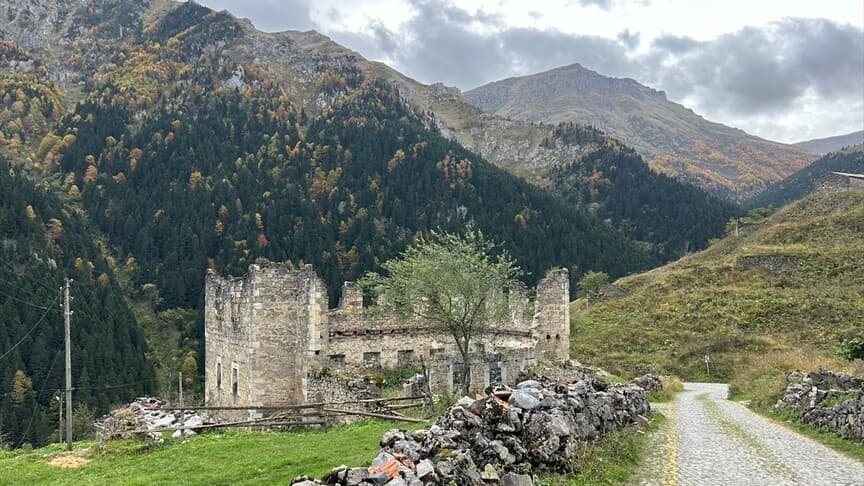
In Gümüşhane, the route passes through the ancient city of Satala, the ruins of Santa and the historic Süleymaniye district, known as Old Gümüşhane. Thanks to its silver deposits and its position on the Silk Road, the district became a major mining and trading centre; mosques, churches, baths, bridges and madrasas reflect its multinational past, when Turkish, Greek and Armenian communities lived side by side. The ruins of Santa on the mountain slopes near the village of Dumanlı include more than 300 houses, churches and other stone structures; after the 1923 population exchange the settlement was largely abandoned and is now protected as an archaeological and natural site. The route ends in Trabzon: there, tourists can visit the Çal cave, the Çanakdere waterfall, the Devuşek monastery (Kız Manastırı) and traditional Black Sea architecture, as well as a cable car running from the Beşikdüzü coast to Beşikdağı mountain with panoramic views of the Black Sea, and the Atatürk Mansion, where Mustafa Kemal Atatürk stayed during his visits to the city.