The key facts
- Kashim Chowdhury has been found guilty on nine counts; he faces a 'very substantial prison sentence'
- Kashim Chowdhury was found guilty on nine counts; he faces a 'very substantial prison sentence'
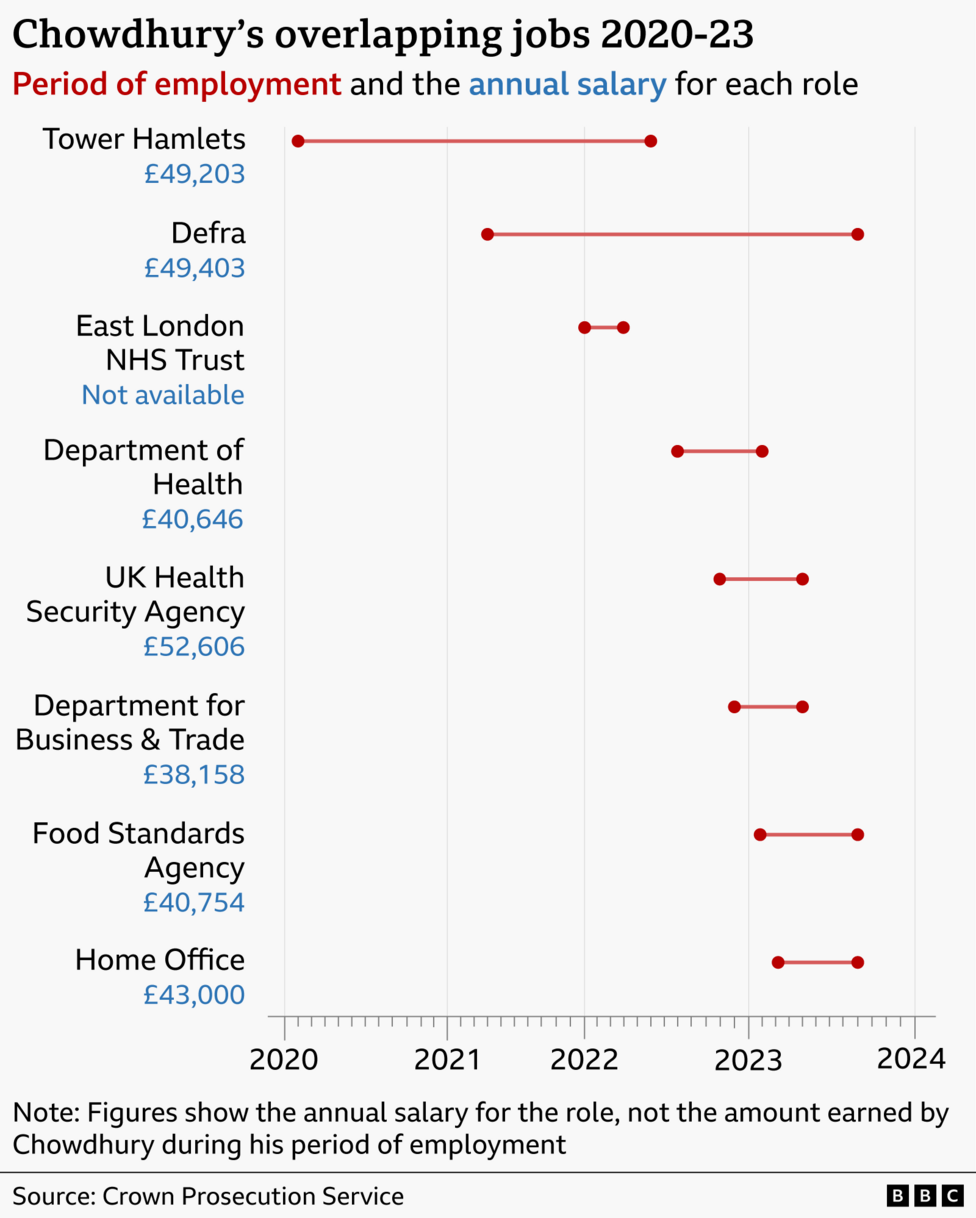
- In the spring of 2023 he held five full-time jobs, totalling 183 working hours per week
- In 2024 he was detected by the National Fraud Initiative, which reviews civil service databases every two years
- In 2024 he was identified by the National Fraud Initiative, which checks civil service databases every two years
The jury's verdict
British civil servant Kashim Chowdhury, 56, from east London has been found guilty of nine counts of fraud: eight counts of fraud by false representation and one of fraud by failing to disclose information. The jury returned a unanimous verdict after seven hours of deliberation; the judge told him he faces a 'very substantial prison sentence'. This was reported in two BBC News articles prepared by employment correspondent Zoe Conway.
The scheme: eight jobs over three years
According to the prosecution, from 2020 to 2023 Chowdhury held eight overlapping full-time positions in the public sector and earned a total of £350,000, of which more than £284,000 was obtained fraudulently. In the spring of 2023, when his mother — who suffered from dementia and had been diagnosed with terminal cancer — was months away from death, he was simultaneously working at the Department for Environment, Food and Rural Affairs (Defra), the Department of Health and Social Care, the UK Health Security Agency (UKHSA), the Department for Business and Trade, the Food Standards Agency and the Home Office. In total, his contracts entitled him to 183 working hours per week — more hours than there are in seven days.
How he hid the workload
On job applications he did not tell the departments that he was already a civil servant, and he did not tell his employers about work elsewhere. He was allowed to work fully from home on the pretext of caring for his mother, with whom he lived in east London. He covered the impossible schedule with sick leave: in March 2023 he was on sick leave at four organisations at once, while continuing to work at the Home Office without telling them he was ill. The prosecution described his conduct as 'deliberate, intentional dishonesty' and 'an exploitation of the system'; prosecution barrister Lucy Organ told the jury that he 'lied under oath'. Chowdhury himself explained what happened by fear of losing his livelihood after unstable employment and a PTSD diagnosis, claiming that he 'was not thinking clearly because of stress, distress and panic'.
Failure at every workplace
A number of his managers gave evidence about his poor performance. Particularly telling was the testimony of Dan McCartney, who supervised him at Defra: he said he had to 'constantly literally tell him what to do', and that on video calls Chowdhury kept his camera off, citing technical problems — for four to five months. Nevertheless, since formal performance metrics were not applied to him at Defra, he received a permanent position and worked there for two years. His manager at UKHSA, Aleesha Adams, described a characteristic episode: on a video call in May 2023, after three months of his sick leave, he was coughing and showing tissues, and his pallor, she said, turned out to be white make-up that was running down his forehead with sweat. Chowdhury denied this in court, calling the accusation slanderous. Adams was also suspicious of the fact that he joined the call from a Defra work address, which he attributed to a technical error; she passed her concerns up the chain, but the fraud remained undetected until he left the civil service in September 2023.
Why the system failed to notice for years
He was only caught in 2024 through the National Fraud Initiative — a government programme that checks civil service databases, including payroll records, for anomalies every two years. A second BBC publication explains why the scheme worked for so long: the civil service's HR system is decentralised, and since Chowdhury did not declare his existing employment, no one flagged the duplicate. Hannah Keenan of the Institute for Government said the system 'clearly failed': departments hire independently of one another without interconnected systems. A survey of 1,700 civil servants conducted by the think tank Re:State found that 76% of respondents believe the service handles poor performers badly; an anonymous former senior official told the BBC that a significant part of the civil service 'culturally' avoids performance management, fearing protracted complaints and accusations of wasting taxpayers' money. Defra said its counter-fraud team had conducted the investigation and that the department is using 'every available avenue' to recover taxpayers' money.
The broader context and a parallel dispute
The case illustrates the phenomenon of so-called 'polygamist working' — secretly holding several jobs at once, whose growth is linked to the spread of remote work; there are even websites offering advice on how to hide it from employers. In the latest National Fraud Initiative report, 23 such cases were identified in London, with overpaid salaries amounting to £500,000 over several months. Separately, it is reported that alongside the criminal case, Chowdhury is involved in a dispute with three siblings who accuse him of having 'intimidated' their mother, forcing her in the final days of her life to transfer to him half of a house worth £2.1 million; he denies this. In September 2023, more than £40,000 was found in his accounts, along with investments including £45,000 in premium bonds.
 Image source, PA Media
Civil servant Kashim Chowdhury juggled multiple public sector jobs