The key facts
- According to Boulevard Voltaire, the traditional political camp accounts for only 25–30% of votes, split among five candidates
- Le Pen promised a 'nation of peace' and Bardella as prime minister; Mélenchon's program envisions a security conference with Russia's participation
- If Le Pen cannot run in the election, the outlet names Jordan Bardella as her replacement
Favorites and 'zombies': the line-up one year before the election
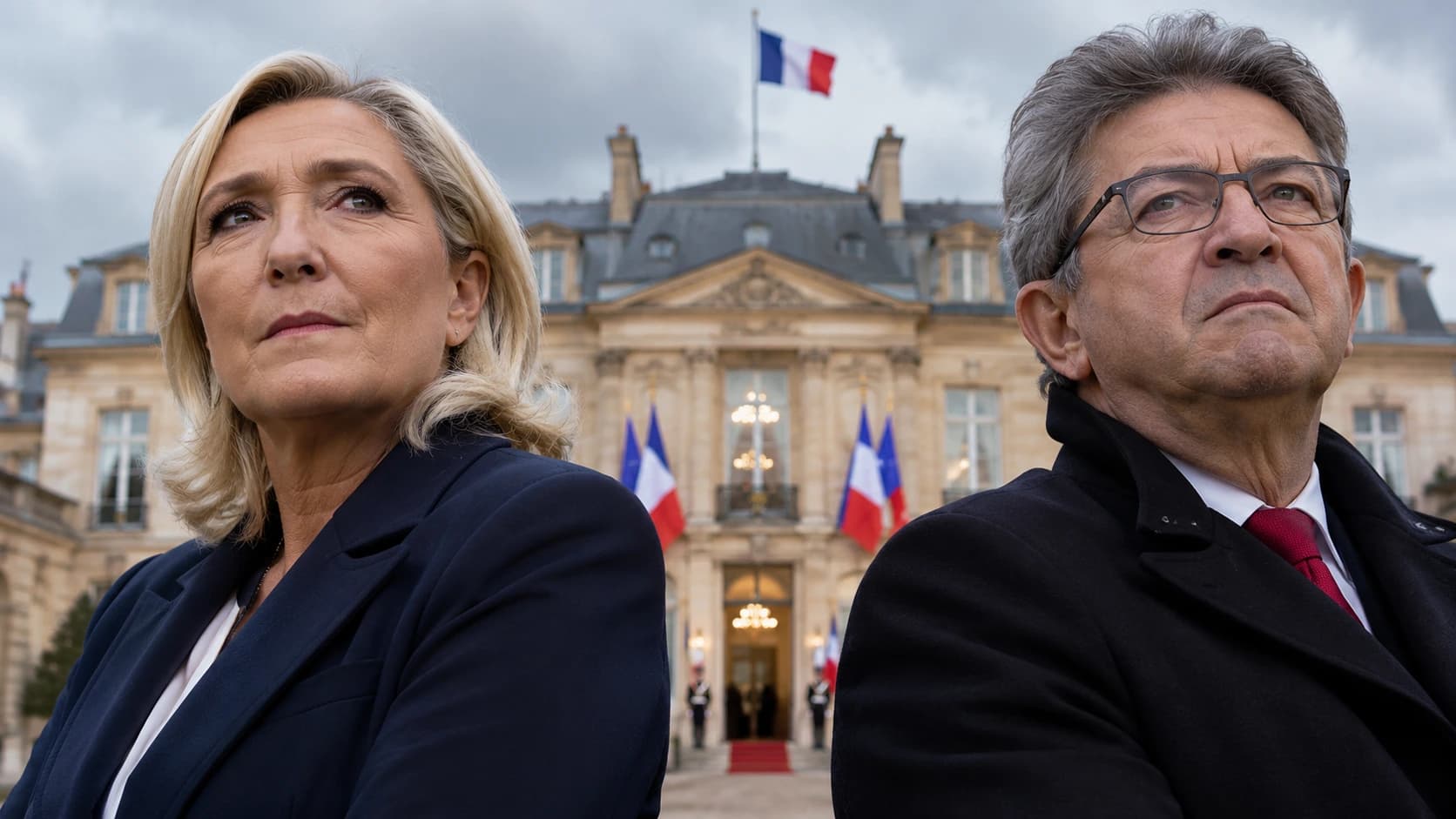
One year before the presidential election in France, Marine Le Pen and Jean-Luc Mélenchon are named the main contenders for the post of head of state, while their rivals from the centrists and moderate right can neither unite their supporters nor offer a convincing program. This assessment was given by a columnist for the French outlet Boulevard Voltaire, whose analysis is cited by Life.ru.
Why Le Pen and Mélenchon are leading
The author links Le Pen's advantage, as leader of the National Rally parliamentary faction, to a string of failures by the current government: the debt crisis, schoolchildren's protests and terrorist attacks. In case Le Pen is unable to run in the election, the outlet names party chairman Jordan Bardella as a possible replacement. Mélenchon, the founder of La France Insoumise, in the columnist's view, relies on radicalized youth and residents of disadvantaged urban neighborhoods — it is these groups that form his solid electoral base.
The fragmented centrist electorate
The author assesses the prospects of the other figures far more skeptically. He compared former prime ministers Édouard Philippe and Gabriel Attal, Les Républicains leader Bruno Retailleau, Cannes mayor David Lisnard and left-centrist Raphaël Glucksmann to 'ectoplasms, ghosts and zombies,' faulting them for the absence of recognizable ideas and of the ability to evoke strong emotions among voters. The key problem of the traditional camp is arithmetical: according to the columnist's calculations, it accounts for about 25–30% of potential votes in total — enough for a single candidate to reach the second round — but this electorate is currently split among several rivals.
What the favorites themselves have already presented
The columnist's assessments are backed by the actual steps of the competitors. Le Pen has already announced the main provisions of her campaign at the National Rally congress in Orléans, attended by more than eight thousand supporters: at the end of October she promised to turn France into a 'nation of peace,' to refrain from participating in military conflicts that do not affect the country's interests, and, in the event of victory, to appoint Bardella prime minister and form a government of national unity. On November 8, Mélenchon presented new provisions of the 'Our Common Future' program: the movement proposes an international conference on European security with Russia's participation, the possibility of not fulfilling certain European Union requirements in the economic and migration spheres, and a revision of relations with Washington. At the same time, the authors of the program did not specify whether Paris would continue supplying weapons to Kyiv if Mélenchon came to power.