The key facts
- Artur Danielyan arrested over Facebook posts criticizing Pashinyan and the security services
- More than a dozen NGOs called the case 'blatantly unlawful, disproportionate and politically motivated'
- According to Freedom House, nearly 95% of incitement cases concerned threats against Pashinyan and his supporters
Arrest over a Facebook post
In early October, Artur Danielyan, leader of the opposition Adekvad party, was arrested in Armenia. The reason was Facebook posts in which he criticized Prime Minister Nikol Pashinyan and the security services. As Deutsche Welle reports, over the past two years the authorities have brought charges against several opposition figures, and in most cases the basis was their activity on social media.
The essence of the conflict
One of the triggers was the prisoner exchange issue: in an interview with the Armenian outlet Infocom, Pashinyan ruled out exchanging an Azerbaijani soldier accused of attacking a 39-year-old resident of the Armenian village of Shakhi and her children for Armenians detained in Azerbaijan. Danielyan sharply criticized the prime minister in response, calling him a 'scumbag' and accusing him of unwillingness to bring citizens home. Baku is currently holding 19 Armenians, including former high-ranking officials of the de facto administration of Nagorno-Karabakh. This is a consequence of a conflict that lasted three decades: after Azerbaijan's offensive in 2023, Baku regained control over the region, and more than 100,000 Armenians were forced to flee.
A 'politically motivated' case and other incidents
More than a dozen Armenian civil society organizations condemned the persecution of the Adekvad leader, calling it in a joint statement 'blatantly unlawful, disproportionate and politically motivated' and noting that it 'is punitive in nature and sends a direct signal to society aimed at suppressing dissent.' Before the parliamentary elections in June, Artur Osipyan — an activist displaced from Nagorno-Karabakh — was also arrested after a verbal altercation with Pashinyan over his Karabakh policy; he is charged with disturbing public order, obstructing the ruling party's campaign, and inciting violence in a March post. According to Freedom House's 2025 report, nearly 95% of court cases on incitement to violence concerned alleged threats against Pashinyan and his supporters, while statements by members of the ruling party were not subjected to such scrutiny. The Yerevan Center for Democracy and Security documented hostile rhetoric from pro-government bloggers toward Karabakh refugees during the 2026 pre-election period, but law enforcement mostly declined to open cases.
Why the EU is silent
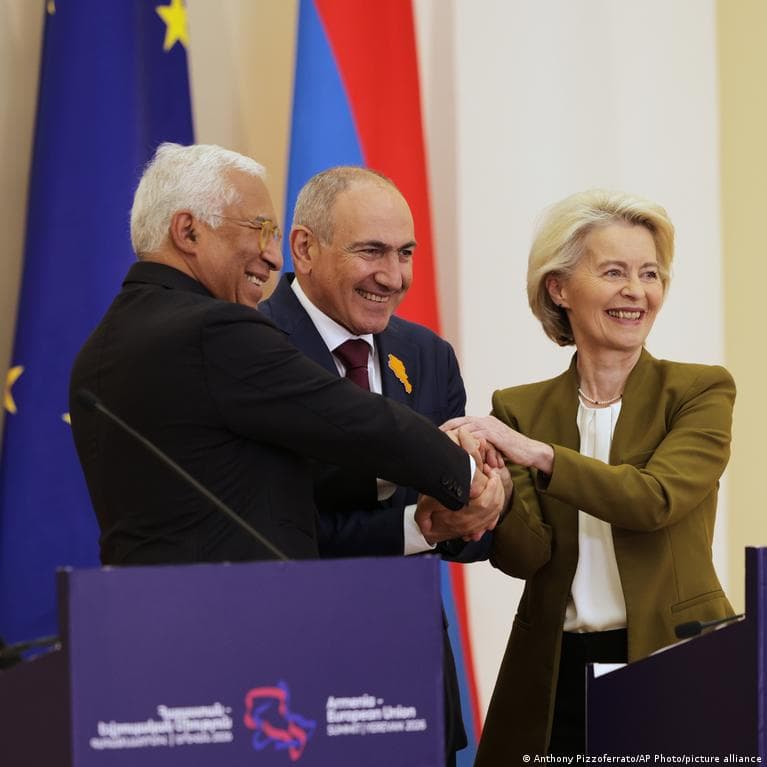
Observers in Yerevan note that, despite Armenia's course toward closer ties with the EU, Brussels has given no clear response to the suppression of opposition voices. Political scientist Tigran Grigoryan explains this by a pragmatic geopolitical approach: given the situation in Georgia , Armenia has become the EU's main partner in the region, and the alternative to Pashinyan is the pro-Russian opposition. DGAP expert Stefan Meister believes that European support for Armenia is driven primarily by policy toward Russia, and Pashinyan exploits this dynamic by portraying domestic opponents as 'Russian proxies' — while, in his words, not every critic of Pashinyan is pro-Russian, and the EU 'falls into this trap.' An official EU spokesperson, in a written response to DW, stated that democracy, the rule of law and fundamental rights underpin the CEPA agreement and the Partnership Agenda, and that criminal investigations must be conducted 'independently and impartially, without political considerations.'