The key facts
- The RLABC program links reinforcement learning with the Elegant program for beam calculations
- On a VEPP-5 channel model with 37 parameters, transmission reached 66–71%
- The results have so far been obtained only in computer simulations; the code is open
AI for tuning accelerator settings
Researchers at HSE University and the G.I. Budker Institute of Nuclear Physics of the Siberian Branch of the Russian Academy of Sciences have developed the RLABC program, which tunes particle accelerator settings using reinforcement learning. This was reported to Gazeta.Ru by the HSE press office; the work has been published in the journal Computer Physics Communications.
How the program works
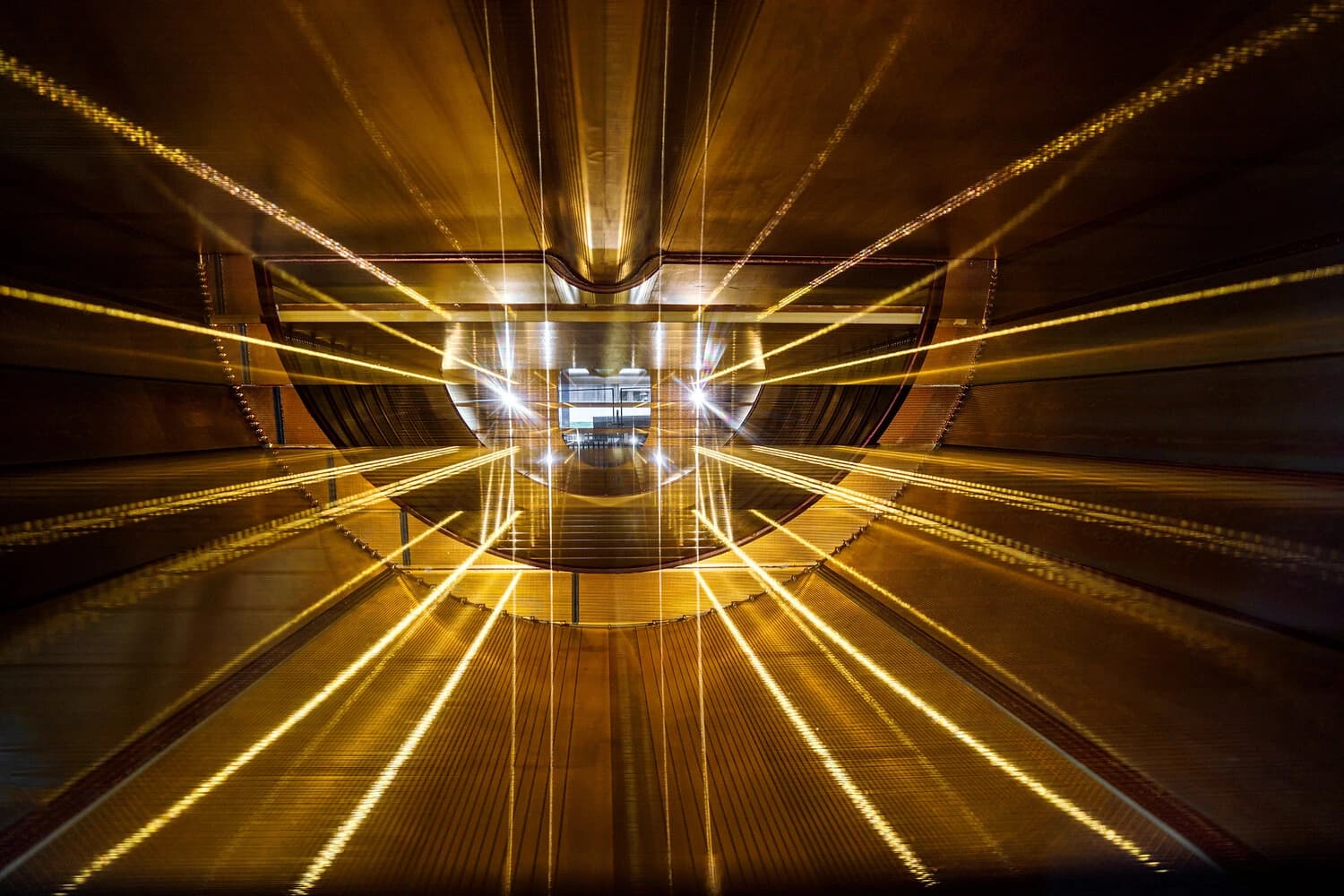
In accelerators, electric fields accelerate charged particles, while magnets steer and focus the beam. Poor settings lead to losses: particles deviate from the desired trajectory, and changing one element affects the passage of subsequent ones, so many parameters must be taken into account simultaneously. RLABC links machine learning algorithms with the Elegant program, which physicists use to calculate beam motion: the algorithm sets magnet parameters, receives simulation results and an evaluation of its actions, and the reward is higher the more particles pass further. By repeating attempts, the system learns to choose successful combinations of settings.
Results and limitations
The development was tested on a model of a channel based on the VEPP-5 injection complex, in a task with 37 controllable parameters. Under different tuning variants, transmission was about 66–70%, while on a model with a different magnet layout it was possible to transmit 71% of the particles. According to the authors, the results are comparable to the solutions of accelerator engineering specialists, but so far this concerns only computer tests: the program's capabilities still need to be verified on more complex transport channels and real facilities.
Open code and the operator's role
The RLABC code is open for use and further development. In the future, the program will be able to suggest suitable settings to the operator and take over part of the routine parameter tuning; the final decision is expected to remain with a human.