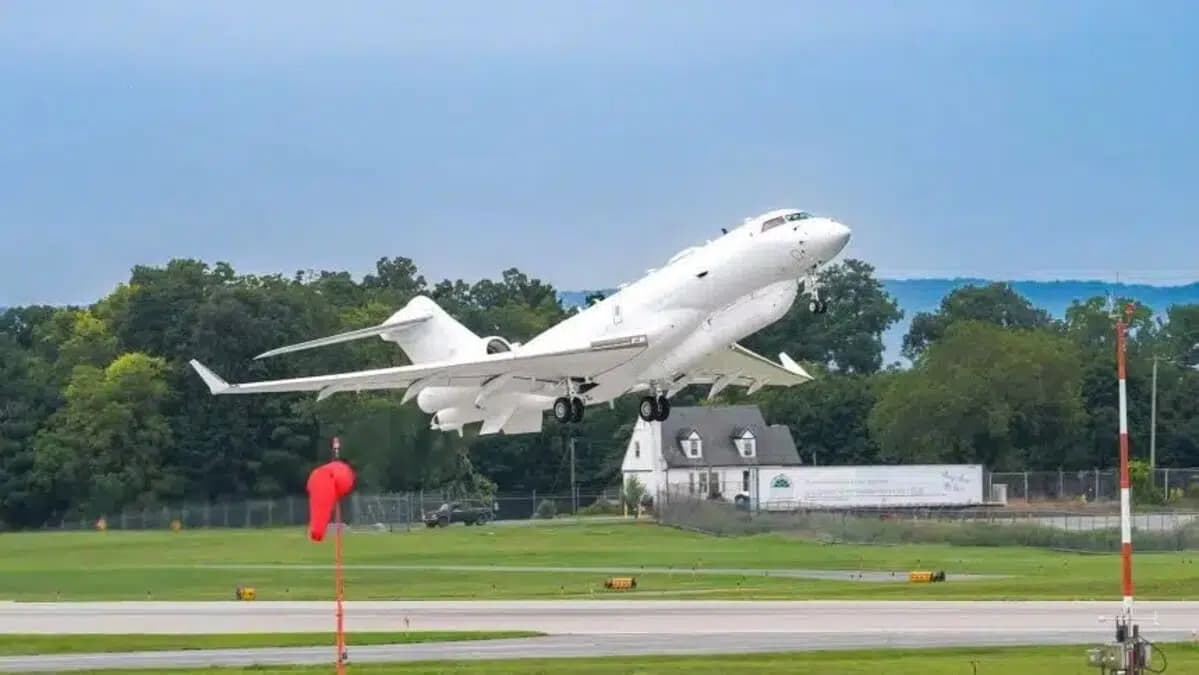
The key facts
- The first flight of the HADES prototype took place as part of the US Army's program to modernize its reconnaissance capabilities
- Preparation was the responsibility of the Fixed Wing Project Office, with Sierra Nevada Corporation involved in the work
- Special systems, including SIGINT, still need to be integrated and tested
First flight of the prototype
An experimental aircraft being developed under the HADES program (High Accuracy Detection and Exploitation System) has taken to the air for the first time. This was reported by Kun.uz citing a publication by The Aviationist. The program is aimed at modernizing the US Army's capabilities in aerial reconnaissance, surveillance and data collection: the system being developed is intended to provide information support for major military operations in various combat environments.
Who prepared the flight and how
A modern commercial jet platform was chosen as the base for the aircraft: compared with older turboprop reconnaissance aircraft, it offers greater speed and range, a larger payload and a higher flight ceiling. Preparation and conduct of the first flight were overseen by the US Army's Fixed Wing Project Office, with the program's industrial partner, Sierra Nevada Corporation, also taking part. Before the flight, the aircraft's readiness for testing was verified.
What has been done and what is only in the plans
The first flight moves the HADES program to its next stage, but it is important to understand its limits: for now, this concerns precisely the first flight of an experimental prototype. The installation and testing of special onboard systems, as well as flight tests under research and development work, are only planned for this stage. The aircraft is expected to integrate reconnaissance equipment for various environments and SIGINT electronic intelligence systems, which make it possible to collect and analyze data on the electromagnetic environment; the system is also expected to draw on information from other sources.
How HADES differs from traditional tactical reconnaissance
A key feature of the program is the priority given to long-range reconnaissance. Traditional tactical reconnaissance aircraft typically collect data on relatively limited areas where combat operations are underway, whereas HADES is being designed to detect objects at considerable distances and analyze data about them. In addition to extending the observation range, the system is oriented toward simultaneously working with data across several combat domains: this is expected to help commanders assess not only the situation in a particular area, but also processes across a broader space.