The key facts
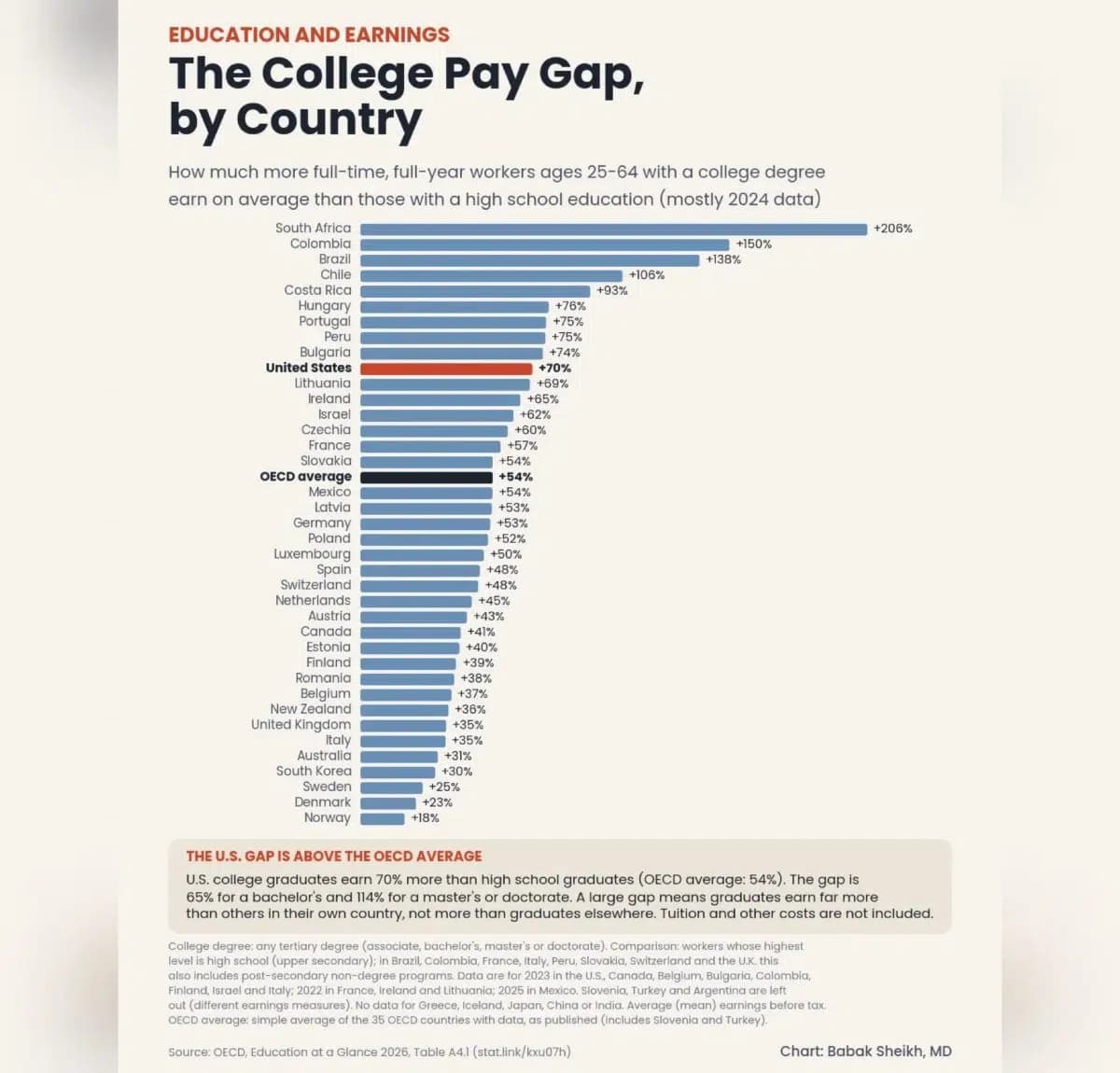
- In 35 OECD countries, workers aged 25–64 with higher education earn on average 54% more than those with complete secondary education
- The largest gap is in South Africa: 205.8%, that is, almost 3.06 times
- In Colombia (149.8%), Brazil (137.6%) and Chile (106.4%), the earnings of degree holders are more than twice as high; in the United States — by 69.8%
What the OECD data show
Higher education is usually associated with a better job and a higher salary, but the size of this premium varies greatly from country to country. This is pointed out in a publication by Kun.uz, based on an infographic by Babak Sheikh on the Voronoi platform, built on data from the Organisation for Economic Co-operation and Development (OECD). The comparison covers 38 countries and includes workers aged 25–64 who worked a full year. The category of people with higher education includes holders of bachelor's, master's and doctoral degrees, and, according to the OECD classification, also short-cycle higher education programmes.
The average gap and the leaders in inequality
Across the 35 OECD countries for which data are available, workers with higher education earn on average 54% more than people with complete secondary education. The largest gap was recorded in South Africa: the average salary of degree holders there is 205.8% higher than in the comparison group. As Kun.uz explains, this means not a twofold but an almost threefold difference — about 3.06 times. A more than twofold excess is also observed in Colombia (149.8%), Brazil (137.6%) and Chile (106.4%).
Other countries on the list
Next in the infographic come Costa Rica (93.2%), Hungary (76.4%), Portugal (75.4%), Peru (75%) and Bulgaria (74.01%). In the United States the gap is 69.8% — that is, degree holders earn almost 70% more than people with secondary education, while in Costa Rica the difference approaches a twofold level. The figures are based on data from the OECD report Education at a Glance 2026, which presents the original values on the earnings advantages from education; the Kun.uz publication itself does not link these figures to Uzbekistan, but presents them as an international comparison.