The key facts
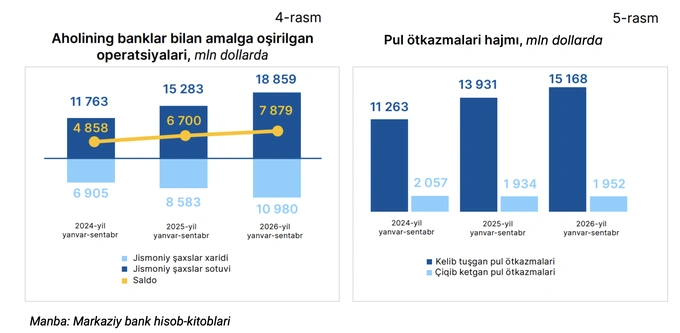
- Incoming remittances for the first nine months of 2026 — $15.16 billion (+8.9% year on year)
- In the third quarter, growth slowed to 2.9% versus 13% in the first half of the year
- Outgoing remittances — $1.95 billion; positive balance — $13.21 billion
Remittances grew, but more slowly than at the start of the year
From January to September 2026, $15.16 billion arrived in Uzbekistan through international money transfer systems — 8.9% (or $1.23 billion) more than in the same period of 2025. The data are given in the Central Bank's review of the domestic currency market, cited by Spot.uz and Kun.uz.
A slowdown in the third quarter
A key detail revealed by comparing periods: growth rates are declining. In the first half of the year, incoming remittances rose 13% — to $9.28 billion from $8.21 billion a year earlier. This means that in July–September about $5.88 billion entered the country, only 2.9% more than in the same quarter of 2025 ($5.71 billion). Outgoing remittances over nine months amounted to $1.95 billion versus $1.93 billion a year earlier; in the third quarter, by contrast, they fell 11.6% — to $625 million from $707 million. As a result, the positive balance for the quarter reached $5.25 billion versus $5 billion a year earlier, and $13.21 billion over nine months.
Context of multi-year dynamics
Kun.uz adds a longer-term perspective to the picture: according to the Central Bank, the volume of inflows from January to September 2026 exceeds the figure for the same period of 2024 by 34.6%, while outgoing remittances ($1.95 billion) are 5.3% below the level of the first nine months of 2024 ($2.05 billion). Over 2020–2025, the volume of remittances into the country tripled, and their share of GDP rose from 8.6% to 12.8%. Earlier, Spot.uz also reported that the supply of foreign currency in Uzbekistan is growing faster than demand, and the deficit in the domestic market is shrinking.