The key facts
- Opposition parties — the Democrats, Bennett's bloc and Yisrael Beiteinu — will recommend Eisenkot to President Herzog
- The Arab parties (19 mandates), according to Anadolu, are also ready to support him
- Netanyahu's bloc has 53 mandates, the opposition 48; a majority requires 61
The opposition's recommendations and the Arab parties' position
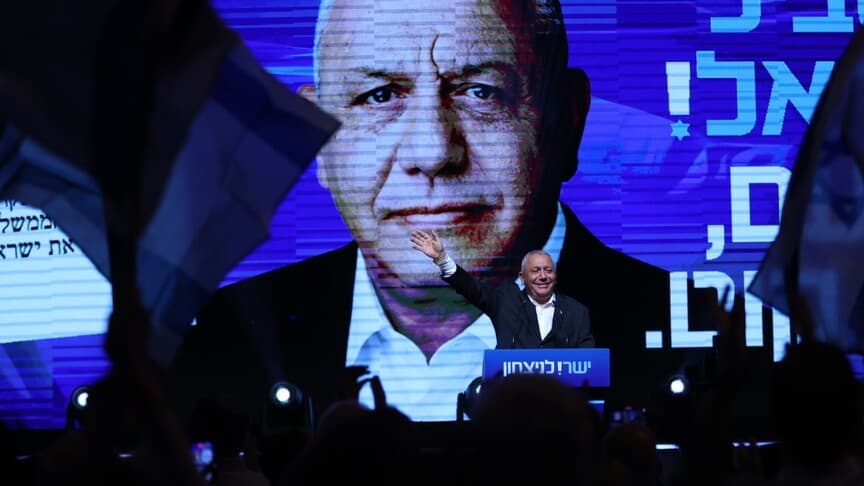
Israel's opposition parties have agreed to recommend to President Isaac Herzog that Gadi Eisenkot, leader of the Yashar party, be tasked with forming the next government. Consultations at the President's Residence are scheduled for Wednesday and Thursday. Yair Golan's Democrats announced their decision on Monday — following the Together bloc of former prime minister Naftali Bennett, which announced it on Sunday, and Avigdor Lieberman's Yisrael Beiteinu party, which spoke up on Monday. According to an Anadolu correspondent, Yusef Jabareen's Joint List and Mansour Abbas's United Arab Party are also preparing to announce similar recommendations.
The balance of power in the Knesset after the election
Last week's election produced a split Knesset: neither Netanyahu's bloc nor the opposition won the required 61 seats out of 120. Netanyahu's bloc took 53 seats (27 for Likud, seven each for Torah and Sabbath and Jewish Power, and six each for Shas and Religious Zionism). The opposition has 48: 21 for Yashar, 12 for the Together bloc, eight for the Democrats and seven for Yisrael Beiteinu. The Arab parties won 19 mandates — 11 for the Joint List and eight for the Raam party. If all 48 opposition and 19 Arab lawmakers recommend Eisenkot, he will have the support of 67 legislators against 53 for the prime minister's bloc, strengthening his position in the consultations even though Likud remains the largest single party.
Why the mandate does not equal the premiership
Receiving the mandate will not automatically make Eisenkot prime minister and does not guarantee the formation of a government. At a press conference in Modiin, Lieberman said he would not sit in a government with Netanyahu, but also rejected a minority government, warning that it could fall within a year and open the way for Netanyahu's return to power. There is no coalition agreement between the opposition and the Arab parties, so Eisenkot would need the support of additional lawmakers, including possible defectors from Netanyahu's bloc. Lieberman also acknowledged that the opposition performed far worse than expected in the election: 'The opposition suffered a crushing defeat. 48 mandates is far below our expectations,' placing the responsibility on Eisenkot and his team. His party will support Yair Lapid's candidacy for Knesset speaker — the Knesset will convene on November 10 — instead of the current speaker, Amir Ohana of Likud, whom the opposition accuses of violating parliamentary rules.
How a government is formed in Israel
Under Israel's system, voters vote for parties rather than directly for a prime minister. After the election, the president consults with the factions and tasks a lawmaker capable of winning the Knesset's confidence — not necessarily the leader of the largest party — with forming a government. The designee has 28 days, with a possible 14-day extension; if that fails, the mandate may go to another lawmaker with 28 days and no extension. If that too fails to produce a result, further parliamentary procedures and new elections are possible. A government takes office only after approval by the Knesset, and the sitting cabinet remains in place until one is formed. According to Anadolu, Herzog will begin consultations on Wednesday; if no agreement is reached, the possible scenarios remain continued negotiations, a national unity government, or a repeat election.