The key facts
- Sergei Tikhanovsky, released in June 2025, has resumed his video streams and criticizes, among others, his wife's office
- He proposed a supervisory council made up of 'former presidential candidates, protest leaders and iconic figures of the revolution'
- Political scientist Yuri Drakokhrust calls the situation a crisis and doubts the feasibility of Tikhanovsky's proposal
Conflict within the Tikhanovsky family
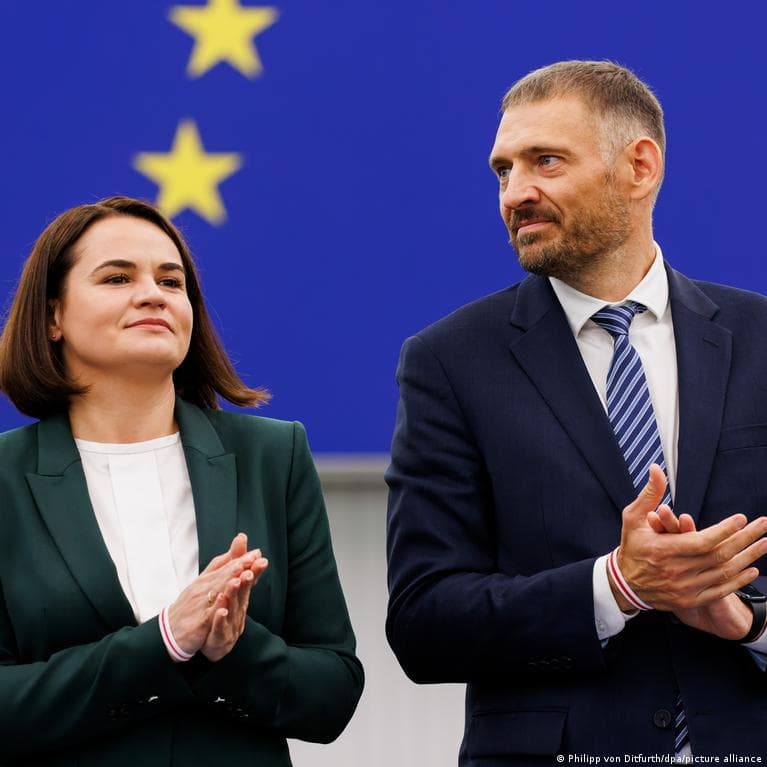
Blogger and dissident Sergei Tikhanovsky, 48, was detained in Belarus in May 2020 after announcing his intention to run against Alexander Lukashenko in the presidential election. In December 2021 he was sentenced to 18 years in prison, including for organizing 'mass riots.' After his arrest, his wife, Sviatlana Tsikhanouskaya, took his place and became the presidential candidate; after Lukashenko's declared victory in August 2020, which was accompanied by claims of large-scale falsification, mass protests swept the country and were brutally suppressed. Tsikhanouskaya left the country and became the leading representative of the Belarusian democratic movement. In June 2025, Tikhanovsky was released after nearly five years in captivity and forcibly removed from the country. This is reported by Deutsche Welle.
Criticism of Tsikhanouskaya's office and a new proposal
About 14 months after his release, Tikhanovsky resumed his YouTube channel, where, according to DW, he criticizes not only the Lukashenko regime but also the office of Sviatlana Tsikhanouskaya, Belarusian media in exile, and political analysts; his streams are watched by thousands of people. In one broadcast, he said that Tsikhanouskaya, having received 'a certain legitimacy from the European Union,' lacks legitimacy from the residents of Belarus who live 'quietly and silently,' and that many of those who voted for her as the united opposition candidate now regret it. Tikhanovsky also called his wife a 'technical candidate' who 'posed no threat to the regime' and had neither supporters nor political experience. He proposed creating a supervisory council called the 'United Office of Democratic Forces' made up of 'former presidential candidates, protest leaders and iconic figures of the revolution,' including himself and his wife; according to him, such a council could oversee the distribution of grant funds. Asked by DW about his goals, he refused to answer, referring to his streams.
The family and Tsikhanouskaya's reaction
Tikhanovsky lives in the United States and, by his own account, is currently not working. In early summer he said he was living in Los Angeles, learning English, preparing for university studies and writing a book. His children — a teenage son and a younger daughter — temporarily lived with him in the US, but now attend school in Poland, where Tsikhanouskaya resides. Neither she nor her office has commented on either the family situation or her husband's accusations. In December 2025, speaking to DW, Tsikhanouskaya said: 'What happens in the public sphere and what happens at home are different things. I understand Sergei's deep trauma and his very strong reactions to certain events. Sergei spent five years in prison, and I view this with great understanding. That is why I do not speak publicly and make no comments. We will sort things out between ourselves.'
A political scientist's assessment
Political scientist Yuri Drakokhrust believes that Tikhanovsky has 'returned to his old self' — with his particular traits and style of polemics, which may seem strange, including to Tsikhanouskaya's international partners. According to him, Tikhanovsky insists that he was a key figure in the events of 2020 and therefore has the right to all the benefits, privileges, recognition and invitations, but 'there is no way back.' Drakokhrust describes the situation within the democratic forces as a 'crisis' and doubts that Tikhanovsky will be able to reach agreement with all members of the council he has proposed, especially since his wife has already built up certain resources and status through her office. He noted that Tsikhanouskaya is received at the highest level — if not as an elected president, then as the leader of Belarus and Belarusian democracy, while other participants of the 2020 campaign in exile have not achieved a comparable level of representation and access to resources. The Belarusian authorities, in his words, view the opposition's disputes with irony and sometimes add fuel to the fire: 'Essentially, it does not matter to them who wins. The main thing is that there is conflict, squabbling and mutual accusations.'