The key facts
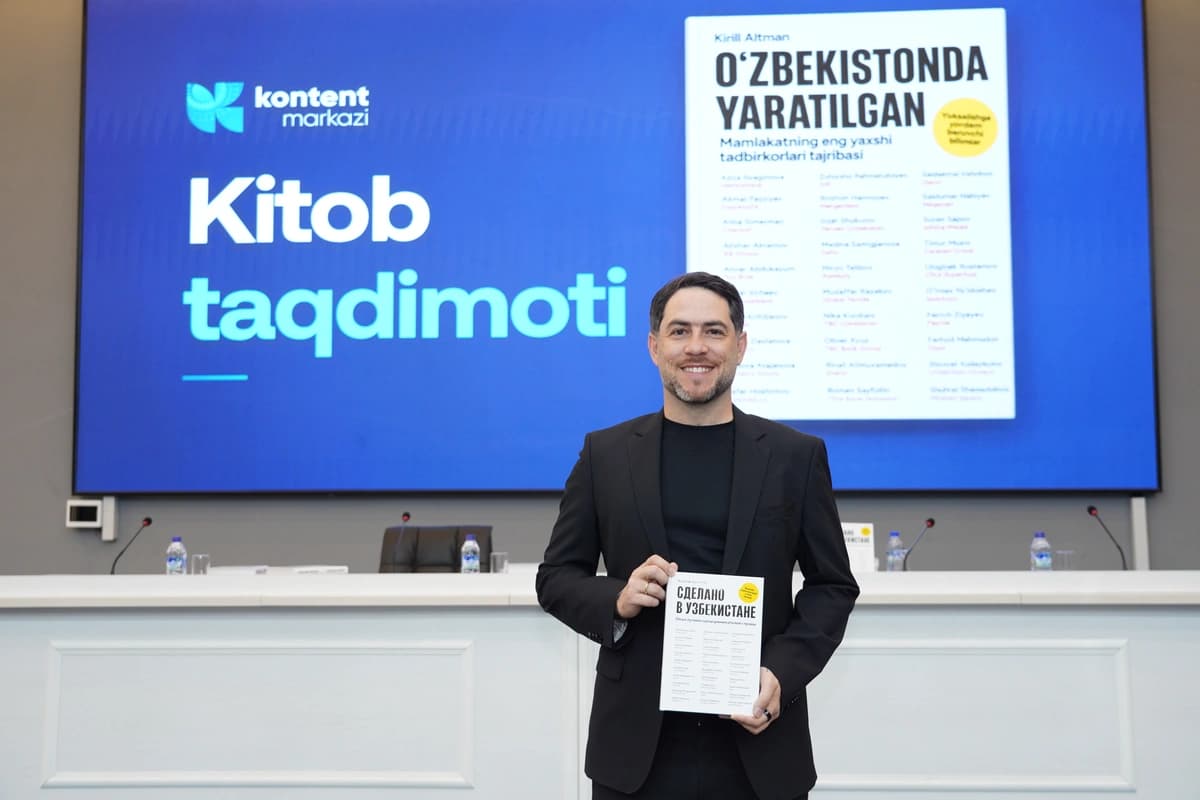
- Kirill Altman’s book “Made in Uzbekistan” was presented on 28 October; it contains conversations with 30 entrepreneurs in the form of monologues.
- Kirill Altman's book 'Made in Uzbekistan' was presented on October 28; it collects conversations with 30 entrepreneurs in the form of monologues.
- The protagonists share stories of their first earnings, their attitude to money, partnership and overwork; the author deliberately preserved the contradictions between them.
- The protagonists share stories of their first earnings, attitudes toward money, partnership and overwork; the author deliberately preserved the contradictions between them.
- The print run is 1,500 copies in two languages, the edition is designed as a flip book; it can be purchased on the official website.
Presentation and the idea behind the book
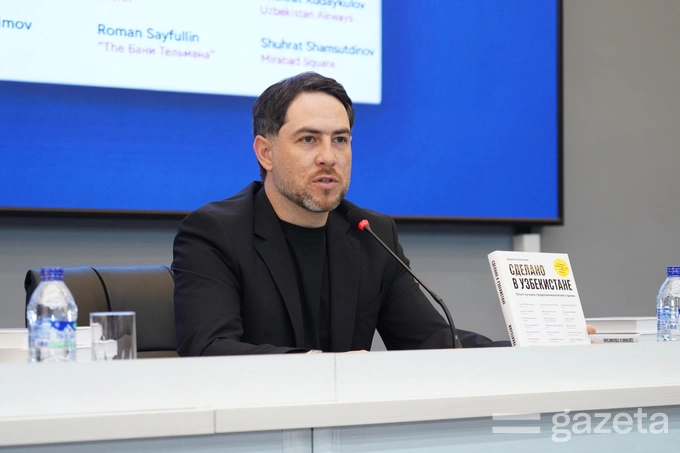
Blogger and author of the YouTube channel AlterEgo Kirill Altman presented the book “Made in Uzbekistan” on 28 October at a presentation held at the Center for Media Content Training, Gazeta reports. Over the course of a year, he spoke with 30 founders and executives of companies from various industries — from retail and restaurants to fintech and aviation. The conversations are published in the form of monologues. In the preface, the author explains that he wanted to preserve the personal conversations with entrepreneurs: “In an interview you get a path. In a personal conversation you get the truth — with doubts, bad decisions and an honest ‘back then I had no idea what I was doing’,” he writes. According to him, the protagonists sometimes contradict one another, and this is intentional: “there is no single right way to run a business, and thirty different answers are more honest than one correct one.”
First earnings and family
The protagonists of the book recall not only business experience but also their beginnings. Madina Samigjanova, founder of the Safia confectionery chain, says that despite coming from a well-off family, she collected bottles as a child because it was important for her to earn her own money. Alina Zimerman, founder of the Chaykof, Moloko and Tosh cafés, grew up in a family with little money and counts being able to support herself and her child on her own among the results of her work that she is proud of. Rinat Alimukhamedov, co-founder of Sherin, began selling sausage made by his classmate’s father in 1995, and Mirzo Talibov, founder of the pharmaceutical company Asklepiy, recalls a conversation with his father after which he began to treat money as a means rather than an end. Samigjanova says she started baking when her children had grown up, and her sons helped expand the business — they worked while still children, at 14, 12 and six years old: “My son really did stand at the cash register at the age of six!” Timur Musin, founder of Caravan Group and the Plov Museum, recalls that the biggest skeptic of his ventures was his mother, the art historian Natalya Musina, who asked whom he was going to seat in a hall with seven hundred seats.
Women in business and conditions for growth
Dildora Atadjanova, founder of the agro-export company Teodora Goods, says she started the company after harassment from her boss: she was afraid to move to another job as an employee because the situation could repeat itself. “It was precisely because of this that I started the company. I had no other ambitions,” Gazeta quotes her as saying. She notes that stereotypes persist in relations with farmers as well, but “15 minutes is enough — and they already talk in a completely different way.” Zafar Khashimov, founder of Korzinka, recalls a period when, in the “old” Uzbekistan, the chain’s growth had to be deliberately held back in order to stay under the radar — development was hampered by restrictions on supplies, currency conversion and taxation. Instead of expanding, he launched parallel projects, and he calls this dispersal of effort a big mistake. Timur Musin, speaking about crises, points to the consequences of the authorities’ decisions: “in six months businesses had their terraces torn down, their tandirs destroyed, and their signs removed,” he says, adding that only small entrepreneurs who need to feed their families will endure this, while large ones “simply will not invest in this economy.” This refers to the demolition of terraces and tandirs and the removal of signs — measures covered by separate documents issued in 2023 and 2026, available in Gazeta’s publications.
Partnership, work and publishing the book
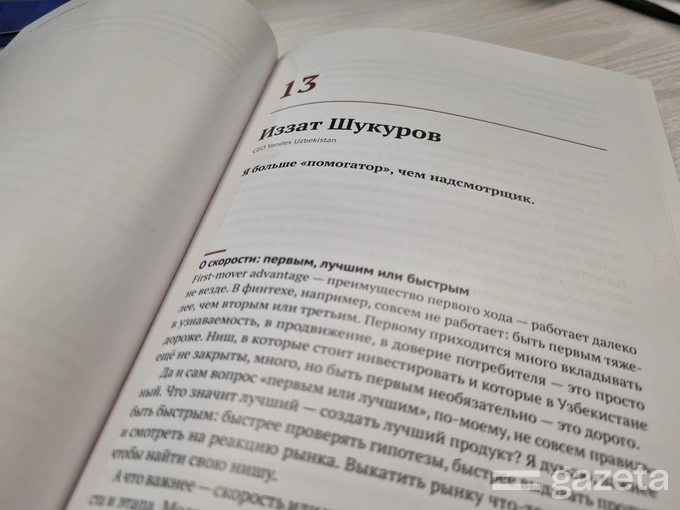
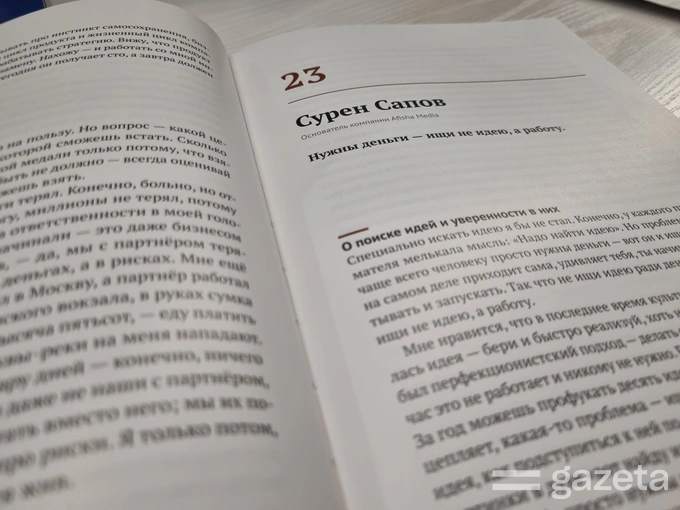
The protagonists' experience of working together varies: Alina Zimerman is satisfied, in her words, with 'about 10 percent' of business done with partners and tries to handle new projects herself, whereas Suren Sapov, the founder of Afisha Media, considers partnership necessary but advises writing down agreements and revisiting them regularly. Zafar Hashimov ties delegation to employees' readiness to treat a project as their own. The protagonists also have different attitudes toward overwork: Nika Kurdiani, head of TBC Uzbekistan, who played basketball at a professional level in his youth, does not believe in work-life balance, while Rinat Alimukhamedov recalls a routine of trading from eight in the morning until six in the evening and delivering goods until one at night, and only allowed himself his first car five years after launching production. The book was published by the Uzbekistan publishing house in a print run of 1,500 copies in Russian and Uzbek; it is designed as a flip book with two covers — turned over, it can be read in the other language. The edition can be purchased on the project's official website. The release of the book in Uzbek, with the same stories of the protagonists, was also reported by the Uzbek-language version of Gazeta.