The key facts
- The Ipsos survey involved 23,537 adult internet users from 31 countries; 20 professions and social groups were assessed.
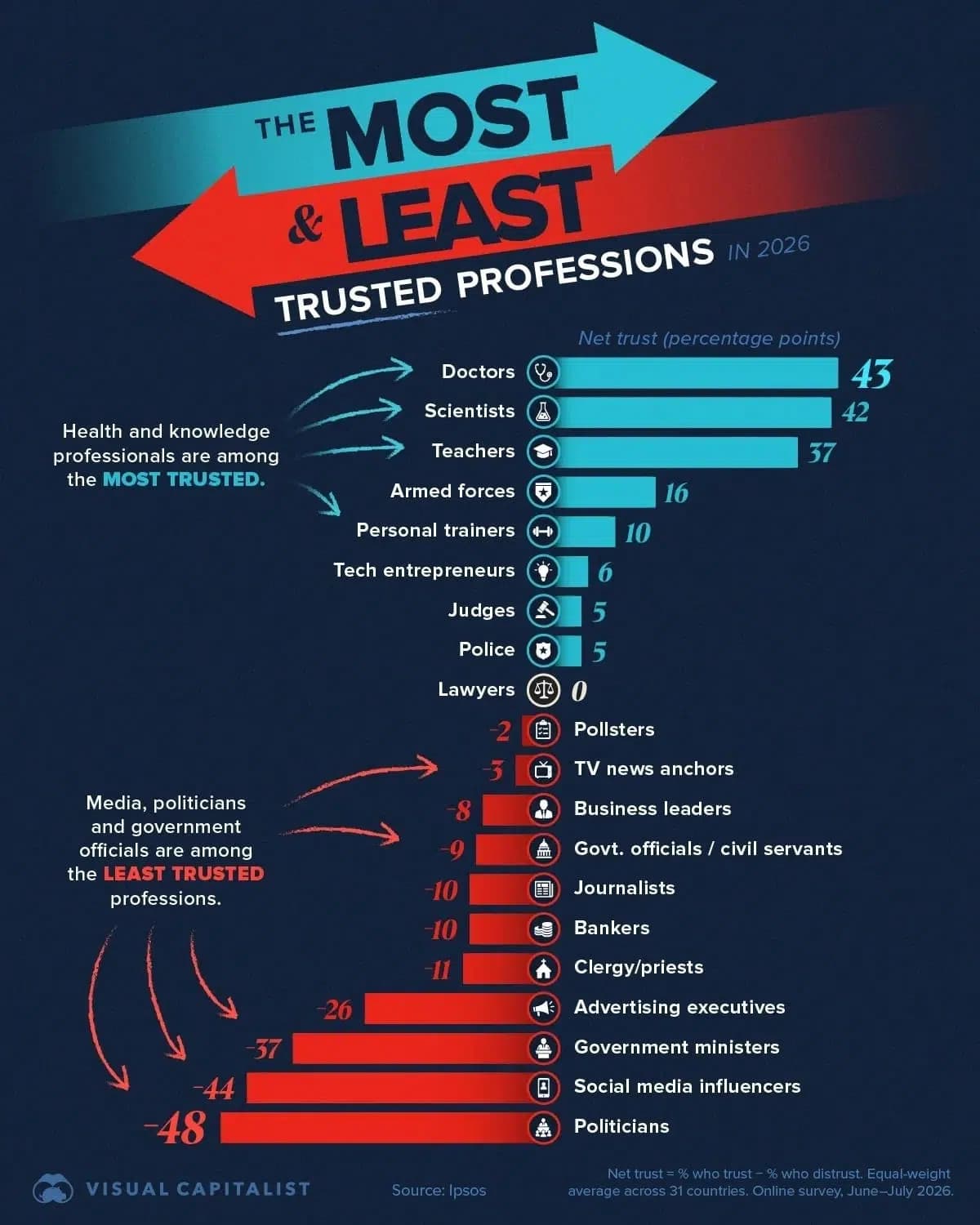
- The most trusted professions: doctors (+43), scientists (+42), teachers (+37); in 27 of 31 countries the top three is the same.
- The least trusted are politicians: a net index of −48, with only 13% of respondents considering them worthy of trust.
What the study showed
Ipsos has published the results of its Global Trustworthiness Index 2026 study on public trust in various professions; based on these findings, Visual Capitalist prepared an infographic, as reported by Kun.uz. The survey involved 23,537 adult internet users from 31 countries: they were asked how trustworthy the representatives of 20 professions and social groups are in their country. The ranking was based on the 'net' trust index — the difference between the share of those who trust a profession and the share of those who do not: a positive value means trust prevails, a negative one means distrust.
Leaders and laggards of the ranking
Doctors took first place with a score of +43 points, followed by scientists (+42) and teachers (+37). According to Ipsos, in 27 of the 31 participating countries these three professions occupied the top three spots, meaning attitudes toward them were similar across countries. The gap between third and fourth place is significant: the armed forces received +16 points — 21 points fewer than teachers. Next come personal fitness trainers (+10), entrepreneurs in the technology sector (+6), and judges and police officers (+5 each). Lawyers scored zero: the share of those who trust them equals the share of those who do not. Politicians close the ranking with a net index of −48: only 13% of respondents consider them worthy of trust, while 61% expressed the opposite view. The gap between doctors and politicians reached 91 percentage points.
How to read these figures
It is worth considering the methodology: the 'net' index does not show the absolute share of those who trust. A zero result for lawyers does not mean complete distrust, but an equality of both shares. In addition, the survey covered only internet users, which limits how representative the sample is for the population as a whole. Ipsos also emphasizes in the study description that using a professional's services or depending on their decisions does not always mean trusting them — and it is precisely this distinction that the survey measures.