The key facts
- Trump set a $1 million reward for fraud reports leading to convictions and is pushing to tighten mail-in voting and ID rules
- Trump set a $1 million reward for fraud reports leading to a conviction and is pushing to tighten rules on mail voting and voter ID
- Studies record about 4 cases of mail-in fraud per 10 million ballots; over 30 years, federal charges against non-citizens were brought 129 times
- The Supreme Court allowed the use of the SAVE database to verify voters, but examples from Georgia and Nevada show the limited effectiveness of such checks
- The Supreme Court allowed the SAVE database to be used to verify voters, but examples from Georgia and Nevada show the limited effectiveness of such checks
A $1 million reward and claims of 'widespread' violations
On the eve of the November 3 midterm elections, US President Donald Trump announced a $1 million reward (about £750,000) for reports of election fraud casesthat lead to a criminal conviction. As BBC Verify notes, before this Trump had questioned the security of voting, claiming 'widespread' fraud in mail-in voting and participation by non-citizens. Studies cited by the outlet indicate that actual cases of such violations are extremely rare.
Mail-in voting: attempts to restrict it and data on fraud
For years Trump pushed to restrict mail-in voting to cases of illness, disability, military service or travel, but Congress did not pass such a bill. An executive order under which the postal service was to deliver ballots only to voters on government citizenship lists was rejected by the Supreme Court, which called such changes on the eve of an election 'arbitrary and reckless' — with the caveat that the issue could be revisited later. Meanwhile, most states allow voting by mail without giving a reason, and in the 2024 elections about 48 million people voted by mail.
What the studies show
Data on the scale of mail-in fraud differs markedly from the president's rhetoric. A Brookings study of the 2016–2022 elections, based on the Heritage Foundation's database of convicted cases — a think tank that previously supported Trump — found on average about four cases of fraud for every 10 million mail-in ballots. Over 20 years, this database recorded 325 convictions for misuse of mail-in ballots. A 2020 study by the American Statistical Association covering eight states that mail ballots to all voters found no evidence of increased risk: in Oregon, from 2000 to 2020, with more than 100 million ballots sent, 40 cases of fraud were recorded. At the same time, every state cross-checks ballot data against voter rolls, and most additionally verify signatures.
Non-citizen voting and ID requirements
Non-citizen voting in federal elections is illegal and punishable by prison time, fines and deportation. A bill Trump is pushing requires state-issued photo ID at polling places and proof of citizenship at registration. Critics point out that the US has no national identity card: as Campaign Legal Center expert Jonathan Diaz explained, driver's licenses, the most common document, do not reflect immigration status. According to a 2023 Brennan Center for Justice survey, about 21.3 million voting-age citizens (roughly 9%) do not have documents proving citizenship readily available. On the other hand, Walter Olson, an expert at the conservative Cato Institute, notes that studies find no strong evidence of either mass fraud or voter suppression caused by existing ID laws. Since the 2024 elections, according to the Brennan Center, 21 restrictive voting laws have been enacted, mostly in Republican states.
The SAVE database and list checks: what practice has found
Trump is also pushing for the use of the federal SAVE database, created in the 1980s to verify eligibility for government benefits, to identify and remove non-citizens from voter rolls. The Supreme Court lifted restrictions on such use of it, although critics consider the data outdated — the database may include people who have since become citizens. Its use is voluntary, and states' results are modest: an audit in Georgia over 30 years identified 432 possible non-citizens on the rolls, and the Department of Homeland Security gave Nevada a list of 185 names, whom state authorities, after verification, recognized as citizens. The White House cites a case in New Jersey, where a software glitch registered about 6,600 non-citizens; according to state authorities, fewer than 400 of them voted, and all have been removed from the system. The Justice Department demanded that 20,000 mail ballots in California from 'probable non-citizen voters' not be counted, but an appeals court rejected the request; regarding the 20,000 ballots, charges have been brought against 28 people.
The scale of the problem in numbers
Comparing the data gives a sense of the real scale: the Heritage Foundation database recorded 24 convictions of non-citizens for voting between 2005 and 2025, while a Reuters analysis of federal courts found 129 charges over 30 years, of which 73 ended in convictions. Darrell West, a senior fellow at Brookings, explains this partly by the fact that illegal voting is an extremely risky step for people whose status depends on immigration, and that the proven cases are not enough to affect election outcomes.
 Image source, Getty Images
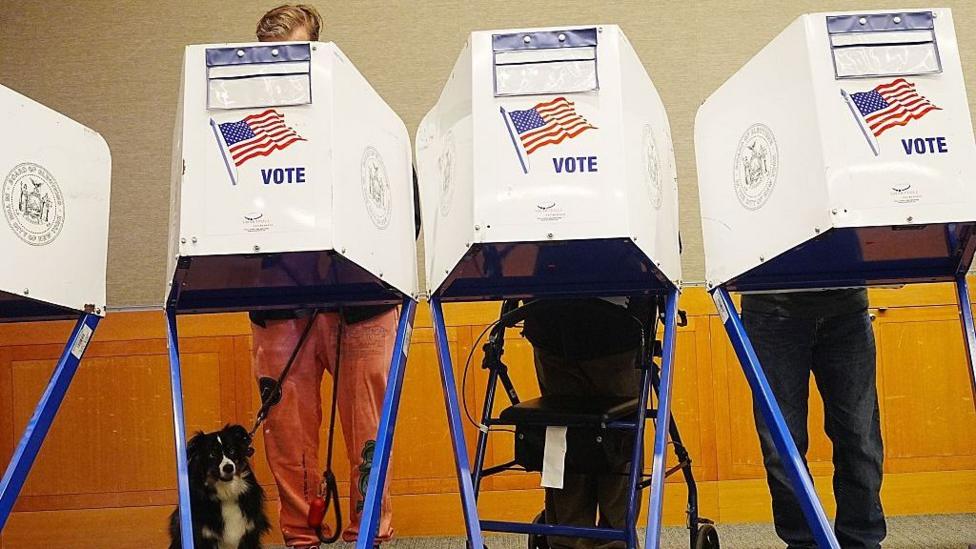 Image source, Getty Images
Millions of people have already voted early in the US midterm elections
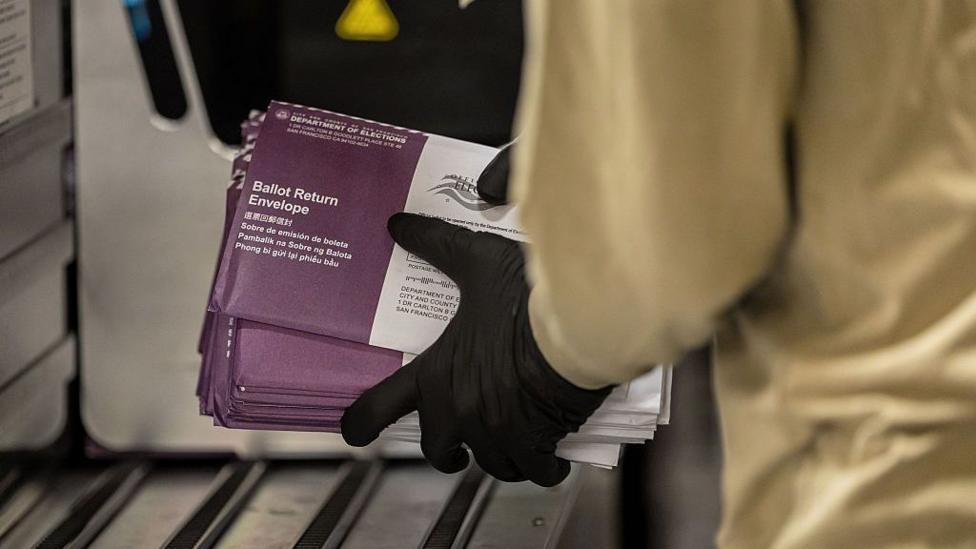 Image source, Getty Images
Every US state allows some postal voting and 29% of voters cast a ballot that way in the 2024 presidential election
