The key facts
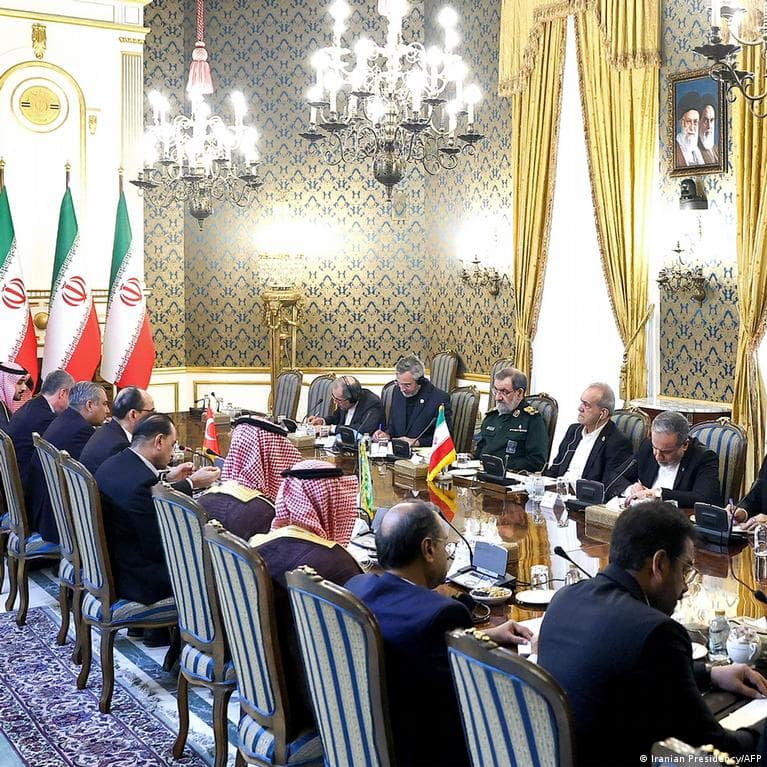
- On October 26, representatives from Saudi Arabia, Pakistan, and Turkey held talks with Iranian leadership in Tehran, including President Masoud Pezeshkian.
- Talks between representatives of Saudi Arabia, Pakistan, and Turkey and the Iranian leadership, including President Masoud Pezeshkian, took place in Tehran on October 26
- These are the first direct contacts between the Mecca Pact countries and Iran following the agreement's signing and the escalation of Houthi attacks on Saudi Arabia.
- No official breakthroughs were announced; both sides agreed to continue dialogue, with discussions reportedly covering a non-aggression network and the blockade of the Strait of Hormuz.
- No breakthroughs have been officially announced; the parties agreed to continue dialogue, and the talks touched, according to Reuters, on the issue of a non-aggression network and the blockade of the Strait of Hormuz
First visit of the Pact countries to Tehran
On October 26, high-level representatives from Saudi Arabia, Pakistan, and Turkey held talks with Iranian leadership in Tehran. The Saudi delegation was led by Defense Minister Prince Khaled bin Salman, Pakistan was represented by Army Chief of Staff Field Marshal Asim Munir, and Turkey by the head of the National Intelligence Organization, Ibrahim Kalyn, Anadolu Agency reported citing Ali Bagheri, Deputy Secretary of Iran's Supreme National Security Council. According to Turkish sources cited by the agency, the Iranian side was represented by the Council's Secretary, Mohsen Rezaei, while Saudi Deputy Foreign Minister for Public Diplomacy, Raed Krimli, stated that the guests would also meet with President Masoud Pezeshkian. The National described the visit as unexpected and noted that these are the first direct talks between the Mecca Pact countries and Iran following the signing of the pact and the escalation of Houthi attacks against Riyadh in August.
Visit objectives and crisis context
The Saudi Ministry of Foreign Affairs stated that the visit aims to de-escalate the current crisis, encourage dialogue and diplomatic solutions, and support the mediation efforts of Qatar and Pakistan. The Iranian Foreign Ministry called the meeting a 'key event in shaping regional diplomacy.' According to The National, one of Riyadh's main motivations was the stalemate in the Yemen war: Saudi Arabia has faced intensified Houthi attacks in recent weeks, including strikes on airports that disrupted air travel and led to the cancellation of major conferences and sporting events. A source in Tehran, cited by the publication, noted that 'one of the keys to resolving the Yemen issue lies in Iran.' Meanwhile, the risk of a new war between the US and Iran persists: Donald Trump stated last week about a possible repeat strike, but previously said he would not launch attacks before the US midterm elections on November 3.
What is known about the content of the talks
No official breakthroughs were announced following the meeting. Iranian state media only reported an agreement to continue dialogue, while Mohsen Rezaei, head of the Supreme National Security Council, stated on television that 'discussions went very well' and that 'a new atmosphere is emerging in the region.' Deutsche Welle, citing Reuters, provides more details: according to a Pakistani official, the talks covered the creation of a regional non-aggression network, as well as US-Iran negotiations, Houthi attacks on Saudi Arabia, the Strait of Hormuz, and a US naval blockade. Another source reported that Munir presented Iran with a resolution proposal offering something to both Washington and Tehran, mediated by the three Pact countries and Qatar, and that Trump had previously given Munir the green light for this diplomatic attempt. Iranian Foreign Minister Abbas Araghchi confirmed that indirect negotiations with the US through intermediaries are ongoing but emphasized Tehran's readiness to resume hostilities.
The Pact between deterrence and dialogue
The Mecca Agreement on Joint Defense, signed by Saudi Arabia, Turkey, and Pakistan in August 2026, enshrines the principle of 'an attack on one is an attack on all.' As euronews notesthe pact faced its first serious test amid the Houthi escalation: on October 5, at an emergency meeting in Riyadh, the parties agreed to begin implementing collective defense commitments, including the rapid deployment of agreed forces to Saudi Arabia. At the same time, Ankara distinguishes between supporting Riyadh's defense and taking part in offensive operations in Yemen: Turkish Foreign Minister Hakan Fidan said on October 8 that Turkish troops would not be sent to attack another country's territory. According to Euronews, the Tehran talks indicate that the pact's member states are engaging in dialogue with Iran alongside, rather than instead of, their defense commitments. Analyst Babak Dorbeki, commenting for Deutsche Welle, viewed the simultaneous presence of the three representatives as a signal that the countries are acting as a bloc, but stressed that the pact was created for deterrence, not for offensive war, and that its message can work both ways — as mediation or as a warning should the escalation continue.