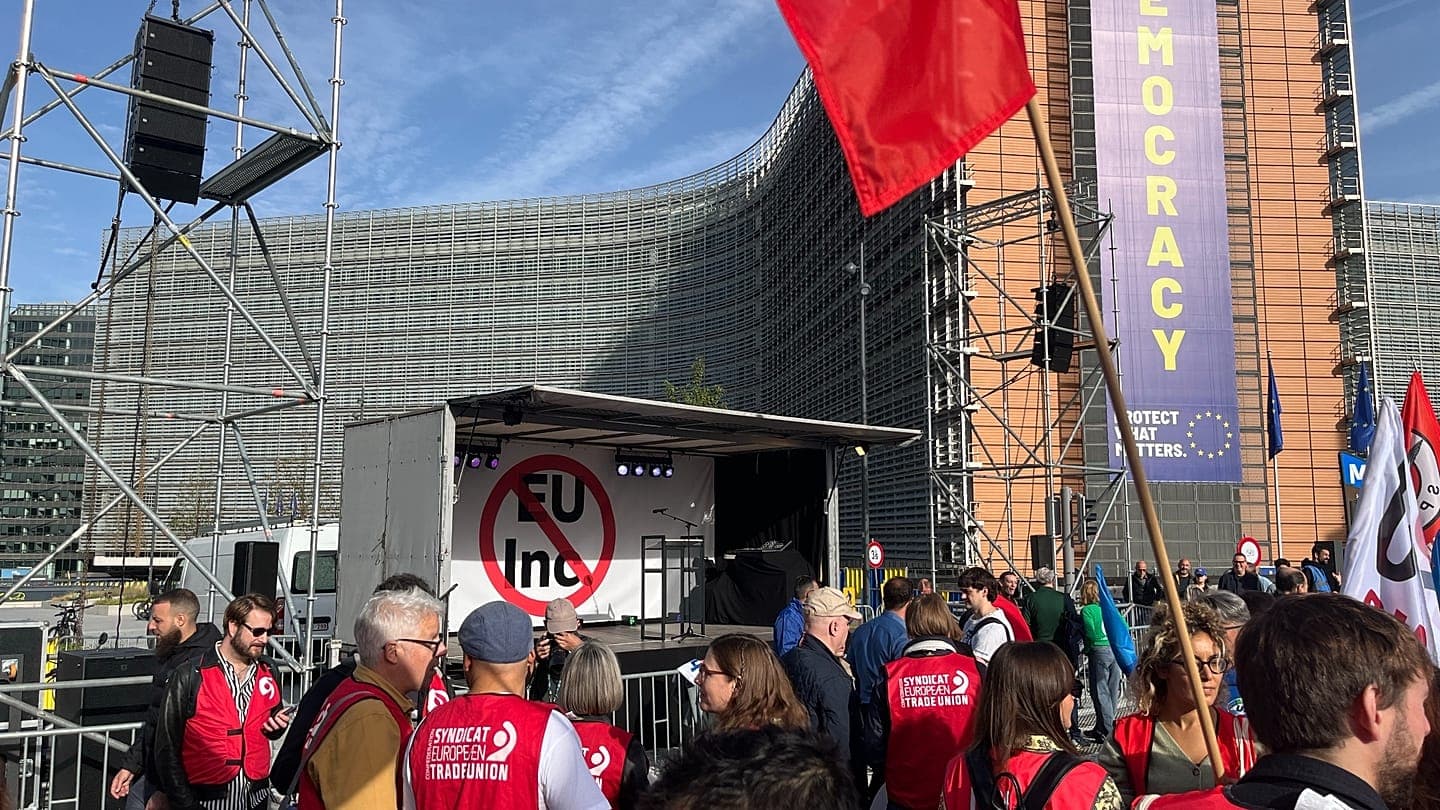
The key facts
- The European Parliament's JURI committee twice failed to muster a majority for rapporteur René Repasi's report on EU Inc
- The European Parliament's JURI Committee twice failed to gather a majority for rapporteur René Repasi's report on EU Inc
- The ETUC warns of a 'race to the bottom' in pay and the risks of 'regulatory shopping'
- The EU-INC campaign (26,000+ founders) stated that the reform 'no longer exists' in its original form and does not rule out delaying the bill
- The EU-INC campaign (26,000+ founders) stated that the reform 'no longer exists' in its original form and allows for a delay of the bill
What is EU Inc and where the talks are stuck
EU Inc is a proposed pan-European legal form for companies, referred to in Brussels as the '28th regime': it is meant to add a single set of rules alongside the 27 national legal systems, without changing national rules on companies, tax residency and social security. Under the European Commission's design, registration through a central EU interface would take 48 hours, the minimum capital would be €1 with no mandatory deposit, all procedures, including liquidation, would be fully digital and free of notaries and chambers, and unified employee stock options would work under the same rules regardless of the employee's country of residence. The Commission presented the proposal on 18 March 2026 and hopes for an agreement by the end of the year; the Council adopted its position on 23 October, supporting the goals while simplifying the framework and strengthening safeguards. However, the European Parliament's legal affairs committee (JURI) failed on 19 October to hold a vote on rapporteur René Repasi's (S&D) report — this is already the second failed vote, as Euronews reports.
Trade unions: risk of circumventing labour law
The main sticking point is workers' rights. The European Trade Union Confederation (ETUC) protested in Brussels and Strasbourg on 24 September and 20 October against the lack of guarantees. ETUC deputy secretary general Isabelle Schömann warns of 'regulatory shopping': companies will be able to register in countries with weak labour protection and operate in others, and since employee representation on boards depends on the country of registration, firms will be able to exclude employees from decision-making. According to an ETUC analysis, options could be used to replace salaries without an explicit ban, and accelerated liquidation would allow companies with unpaid wages and contributions to be closed while social security bodies have only limited time to object. Repasi, for his part, stresses that options are valuable for attracting talent but 'must not replace fair pay, pensions or social security contributions', and calls the absence of safeguards against abuse 'completely missing from the Commission's proposal'. Schömann adds that the reform fails to answer startups' main question — access to investment.
Founders: the reform is being watered down
Pressure is also coming from the opposite side. On 15 October the EU-INC campaign, uniting more than 26,000 founders, investors and entrepreneurs — including figures linked to Stripe, Klarna, Mistral AI and Atomico — warned EU leaders that 'the EU Inc you supported... no longer exists'. Campaign co-initiator Simon Schaefer says that instead of a single European legal framework, the Commission chose a version with dispute resolution in national courts, which yields '27 variants' of one system. Among the key disagreements are the exclusion of a single European company register from the Council's first compromise draft and limits on options based on company size and turnover. The campaign demands the restoration of five elements: freedom to register in any country, access for companies of all sizes and sectors, a single register, harmonised options with taxation upon share sale, and the tying of tax and labour obligations to actual economic activity. If these demands are watered down, the campaign, according to Schaefer, will try to delay the legislation: 'speed is not the main factor; it is more important to do it right'.
Unresolved contradictions of the project
Beyond the conflict over labor rights, the proposal has structural problems noted in the publication. The Commission relies on Article 114 of the EU treaties on the harmonization of legislation for the single market, but a group of European experts on corporate law doubts that this legal basis is suitable for a separate optional company form. The Federal Chamber of Notaries of Germany believes that with 48-hour digital registration, identity verification and legal safeguards are insufficient and increase the risks of shell companies, fraud and money laundering; the Commission, for its part, argues that protection against abuse will be preserved. There is also an internal contradiction: a company will be able to register in one country while being managed from another — tax residency remains governed by national rules, so a firm registered in Ireland but operating from Germany may face German tax obligations. For Schäfer, this is, on the contrary, a key advantage: free choice of the administrative headquarters will allow taxes to be paid where the company actually operates. An agreement by the end of the year, according to Repasi, depends on 'the willingness of all parties to work constructively,' and he calls on the Commission to be an 'honest broker,' without favoring one position over another.