The key facts
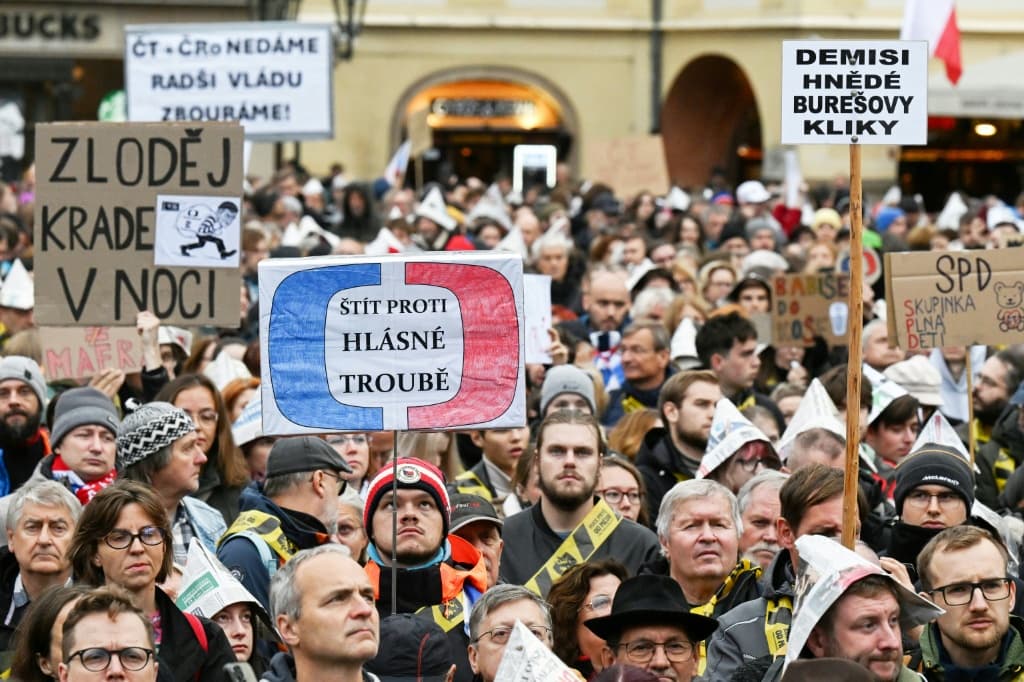
- On October 25, protests took place in Prague against the reform of public TV and radio funding
- On October 24–25, the lower house of parliament fast-tracked a bill abolishing the licence fee
- The reform envisages cutting the budgets of ČT and ČRo by about 15% and switching to direct budget funding
Mass rally in central Prague
Several thousand people gathered on October 25, 2026, on Old Town Square in Prague, to protest against the government's plans to change the funding system of public television and radio. The rally was organized by the initiative 'A Million Moments for Democracy'; participants carried placards with the slogans 'We don't want the return of censorship!' and 'Stop the government of arrogance and destruction!'. According to DW, in recent days similar but smaller rallies took place in Brno and other Czech cities.
The essence of the reform and its progress in parliament
The lower house of the Czech parliament on Saturday, October 24, voted to fast-track consideration of a billthat abolishes the licence fee for public media and replaces it with direct allocations from the state budget. According to Kun.uz citing DW, the bill passed its first reading in the Chamber of Deputies early in the morning of October 24, and it will now be considered by parliamentary committees. The reform also provides for cutting the funding of Czech Television (ČT) and Czech Radio (ČRo) by more than 15%. The law must still pass the upper house before taking effect.
Positions of the parties
The ruling coalition led by Prime Minister Andrej Babiš, which includes two far-right parties, argues that the broadcasters need to save money and that changing the funding model will not affect editorial independence. 'No one is going to interfere with programming or news coverage', Babiš wrote on X, adding that the funds would be guaranteed by law as mandatory expenditures. The opposition said it would challenge the reform in the constitutional court. President Petr Pavel, who has repeatedly clashed with Babiš since his return to power in 2025, called public media 'one of the fundamental pillars of our democracy' and warned that 'no hasty steps that cannot be undone should be taken'. According to DW, Pavel also criticized the attempt to push the bill through parliament in a rush, at night and on a weekend.
International criticism and the protesters' reaction
The European Broadcasting Union, the European Federation of Journalists, Reporters Without Borders and the International Press Institute spoke out against the plans. According to AFP, these organizations accuse Babiš of following the path of Slovak Prime Minister Robert Fico and Hungary's Viktor Orbán, seeking to bring the independence of public media under control. The rally organizers said in their call to demonstrate: 'The very future of the country for the coming decades is at stake. The government is testing how far it can go'. Among the participants were people who linked the reform to historical experience: 94-year-old Milan Kotal recalled two seizures of television in his lifetime — by the Nazis during the war and by the communists before 1989. According to the Reuters Institute Digital News Report 2026, trust in media in the Czech Republic is low — around 30–33%, while public broadcasters remain the most trusted brands.
What's next
The organizers announced a larger demonstration in Prague on November 15. The fate of the reform depends on the upper house of parliament and a possible constitutional challenge by the opposition; no final decision has been made yet.
Editorial context
The event matters because it touches on the funding model of public media for an entire country and has already drawn reactions from the president, the opposition and international professional organizations. In practical terms, this means that in the coming weeks the key decisions will be made by the upper house of parliament and, possibly, the constitutional court, while street pressure will continue with the planned rally on November 15. It should be noted that publications do not provide information on the exact timeline for consideration in the upper house.