The key facts
- For the first time in Uzbekistan, a hip joint was replaced using an AI-powered robotic assistant
- The surgery took place in Tashkent and was broadcast live to all regions
- The technology is planned to be introduced at the center's regional branches
The country's first robotic surgery
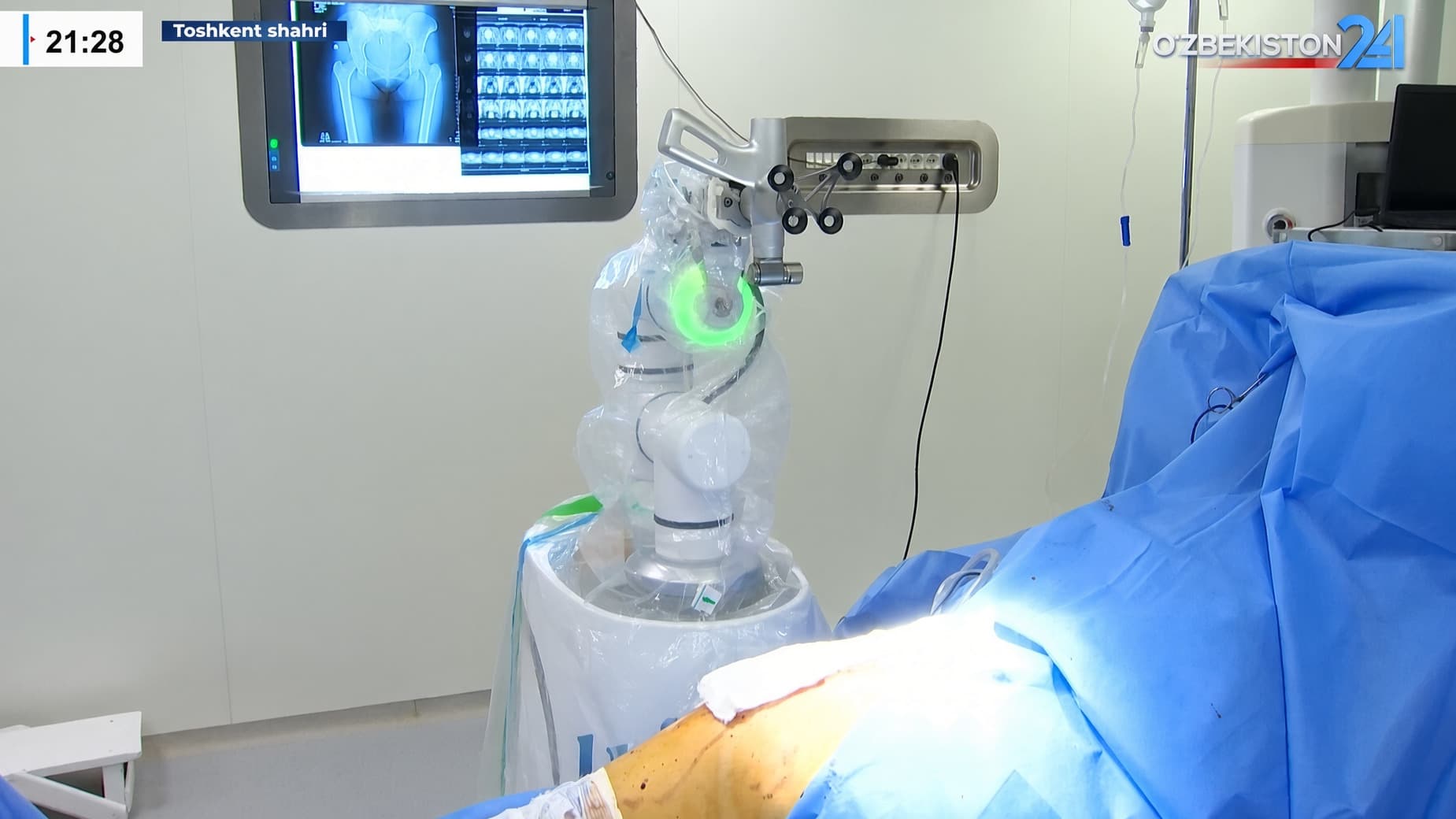
In Uzbekistan, a hip joint replacement surgery was performed for the first time using a robotic assistant controlled by artificial intelligence. The procedure was carried out at the Republican Specialized Scientific and Practical Medical Center for Traumatology and Orthopedics, and its progress was broadcast live to all regions of the country, UzNews.uz reports.
How the technology works and what doctors say
Before the surgery, the robotic assistant analyzes the patient's CT scan data and creates a virtual surgical plan, and during the operation it performs precise movements that are difficult for a human to execute manually. According to traumatologist-orthopedist, Doctor of Philosophy in Medical Sciences Dilshod Shamsimetov, the advantages of the technology include a shorter operation time, precise selection and placement of the endoprosthesis, a reduced risk of complications, and faster rehabilitation. It was noted that in cases of severe joint deformities correct placement of the prosthesis at the required angle determines the success of the operation.
International cooperation and plans
The surgery involved Xu Peng, a traumatologist-orthopedist from China. He emphasized that robots provide high precision, the surgical procedure is faster and easier, and the risk of complications is minimal. “As part of the comprehensive cooperation between China and Uzbekistan, extensive work is being carried out on the exchange of experience in medicine. Today we are also cooperating and performing surgical operations using robots. We are always ready to share our experience in applying new technologies developed in our country. The rapid development of this field in Uzbekistan also deserves recognition,” the doctor said. At the next stage, similar operations are planned to be introduced at the center's regional branches.
Why this matters
Robotic joint replacement concerns patients with severe hip joint deformities, for whom the precision of prosthesis placement is critical to the outcome. The stated advantages — a shorter operation time, a reduced risk of complications, and easier rehabilitation — suggest that the technology could change the practice of orthopedic care in the country. The planned expansion of the method to the center's regional branches means that patients outside Tashkent will gain access to such operations.