The key facts
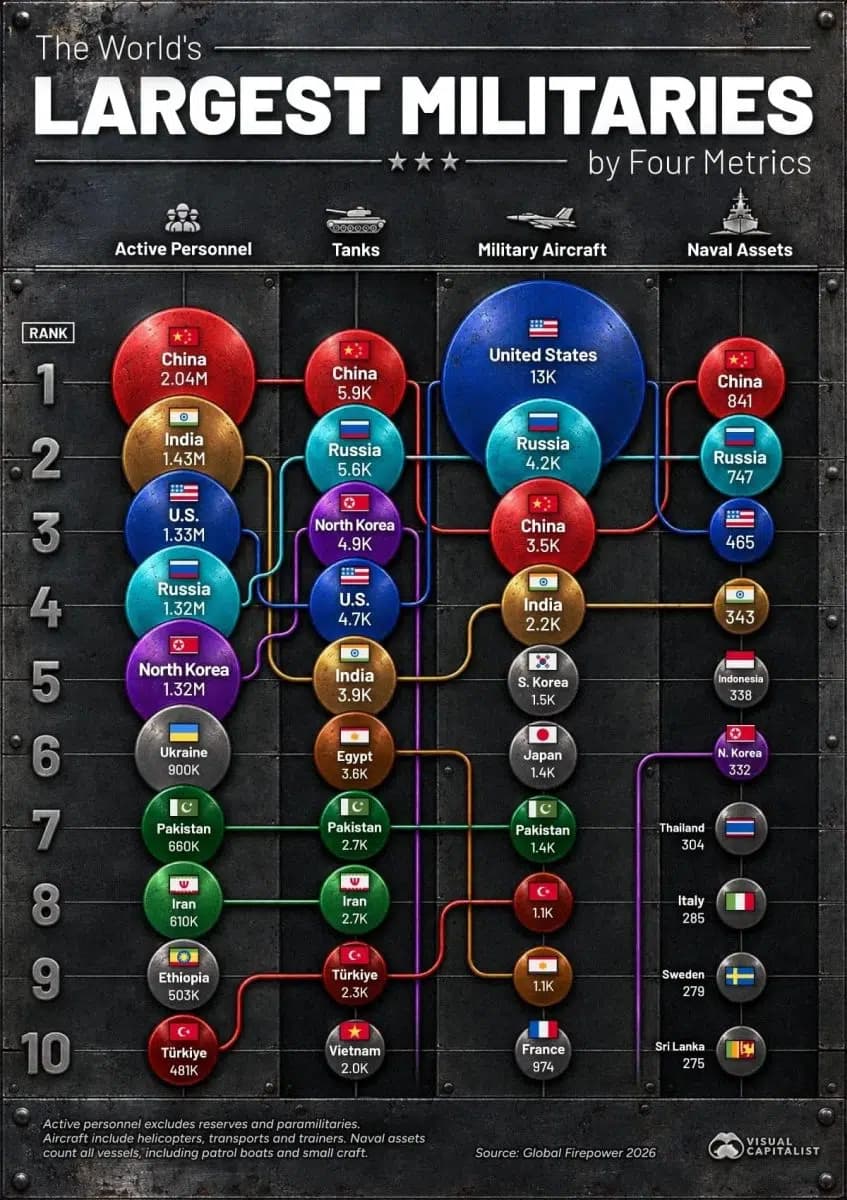
- China ranks first in the world in military personnel (2.04 million) and tanks, according to Global Firepower
- The US has 13,032 aircraft — more than the next four countries combined
- According to Kun.uz, China has more ships, but the US fleet is larger; the rankings do not reflect equipment quality
Four criteria of military strength
An infographic prepared by Visual Capitalist compares countries across four indicators: the number of active military personnel, tanks, military aircraft, and naval vessels. The leading positions in each category belong to different countries, which shows the limitations of such rankings when assessing real combat power.
Personnel: China leads, North Korea nearly catches up with the US
According to Global Firepower, China ranks first in the world in military personnel numbers — 2.04 million troops. One notable comparison concerns the US and North Korea: 1.33 million people serve in the American armed forces, and 1.32 million in North Korea. As Kun.uz notes, citing Japan's 2026 defense White Paper, most of North Korea's ground forces are concentrated near the demilitarized zone on the border with South Korea, which is linked to preparations for a possible land conflict on the Korean Peninsula.
Tanks: quantity is not quality
In the number of tanks, China also ranks first, while North Korea, overtaking the US, holds third place. According to the British Royal United Services Institute (RUSI), North Korea, alongside more modern equipment, continues to operate tanks based on Soviet designs from the 1950s and 1960s. Keeping old vehicles in service allows maintaining a high nominal tank count, but such counting does not reflect differences in armor, target detection systems, and armament, which can be decisive on the battlefield.
Aviation: the US lead
The US military aviation fleet comprises 13,032 aircraft — more than the combined total of the next four countries in the ranking. As Kun.uz explains, this gap is explained not only by the number of combat aircraft: the global military presence of the US requires moving troops and cargo across oceans and supplying aviation far from bases, which calls for numerous transport aircraft and aerial refueling tankers.
What lies behind the numbers
The data presented show that formal quantitative rankings distribute leadership in different ways: China leads in personnel and tanks, the US in aviation, and, in Kun.uz's wording, China has more ships, but the US Navy is larger. The editorial interpretation of these facts is as follows: such comparisons rather reflect the structure and missions of armed forces (North Korea's mass army, America's global logistics) than the real balance of power, since, as RUSI notes in the cited material, the counts do not take into account the quality of equipment and its characteristics. The sources do not provide ship tonnage figures, so the exact ratio of the US and Chinese fleets cannot be determined from these publications.