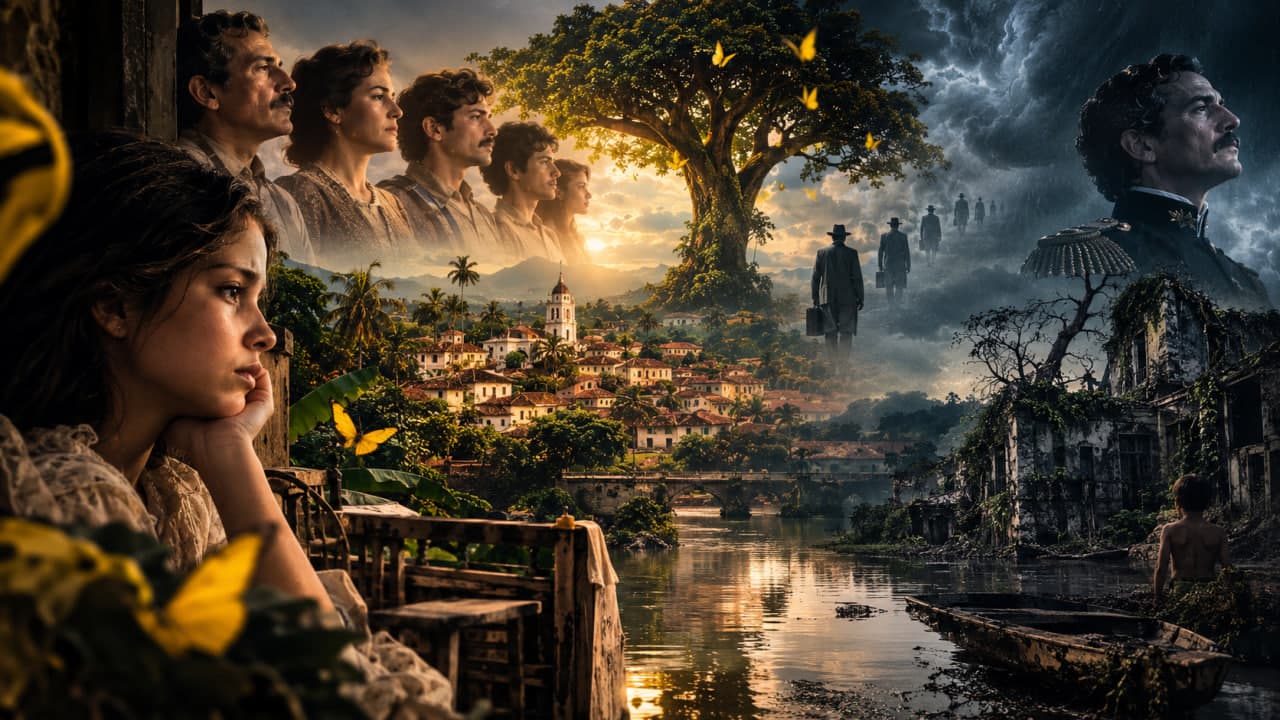
The key facts
- Márquez's novel was published in 1967 and still remains one of the most discussed works of world literature.
- The story unfolds in the fictional village of Macondo, where miracles are perceived as everyday occurrences.
- Key themes include solitude, the repetition of mistakes across generations, and the collective forgetting of crimes.
A novel that still surprises
Gabriel García Márquez's novel One Hundred Years of Solitude was published in 1967 and, as Kun.uz notes, it continues to surprise readers around the world to this day. The book is set in the village of Macondo, where unusual events are taken as a matter of course: the dead return to life, people rise into the sky, and rains last for years. According to the outlet, Márquez describes miracles so calmly that the reader cannot argue with his reality.
The story of the Buendía family
It all begins with José Arcadio Buendía and his wife Úrsula. They fear that a child born of a marriage between relatives could be born with a pig's tail, and this fear shapes the family's fate for many years. At first the village remains cut off from the outside world, simple and quiet, but then new people, ideas and problems arrive: Macondo grows, its population increases, and political conflicts begin.
Repeating mistakes and solitude
Despite the change of generations, the same strangeness repeats itself in the Buendía family: names such as José Arcadio and Aureliano are passed down to descendants along with their temperaments, inner conflicts and mistakes. Some take part in wars, others devote themselves to science, others suffer from love, but most withdraw into their own world and drift further and further away from those close to them. In Kun.uz's view, the heart of the novel is the theme of solitude: it is defined not by the absence of people nearby, but by the impossibility of sharing one's pain even with one's family. Telling is the case of Colonel Aureliano Buendía: he takes part in wars, finds himself at the center of political struggle and gains fame, but over the years he grows distant both from people and from his own feelings, and victories do not fill the emptiness in his soul.
The banana company and the forgetting of tragedy
A banana company comes to Macondo, bringing with it economic changes, new opportunities and severe social conflicts. The workers' discontent ends in a bloody tragedy, and what is most terrifying, according to the outlet, is that the murders committed by the government are denied, and life goes on as if nothing had happened. On this level the novel goes beyond a family story and speaks about society as a whole: people's memory is wiped clean, the people are taught to turn a blind eye to crimes, and as a result old tragedies repeat themselves again.
Why this matters
The novel remains relevant because its central themes — solitude within the family and the collective forgetting of tragedies — are directly connected to how societies treat their own history: according to Kun.uz, it is precisely the forgetting of crimes that leads to their repetition. For the reader, this is a practical reminder of the value of preserving memory of the past. It should be noted that the piece is a literary review of a single book and contains no data on current events or readers' reactions.